
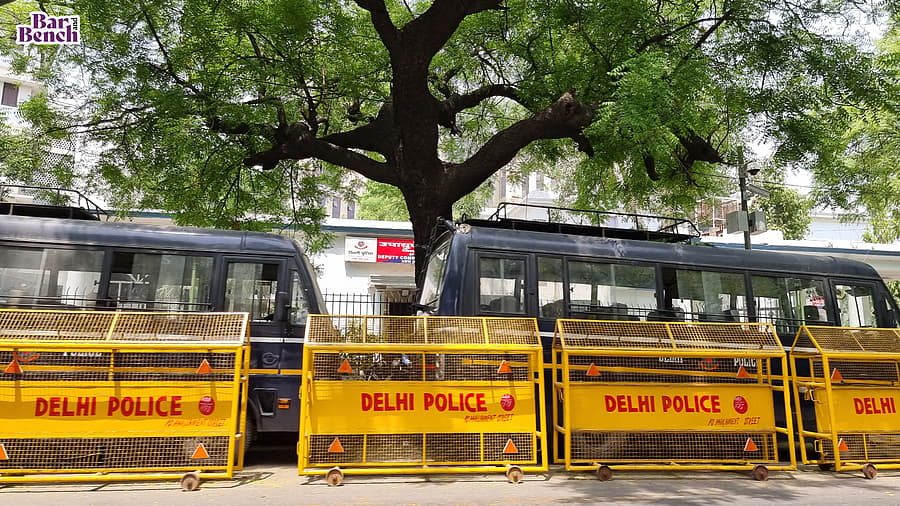
Delhi Police: Jantar Mantar Protest Site De-notification Follows SC Order
Summary
- Delhi Police informed the High Court that Jantar Mantar was de-notified as a protest site based on a Supreme Court order.
- The Supreme Court's October 9 order called for identifying alternative protest sites with basic amenities for peaceful demonstrations.
- This directive followed petitions concerning metro disruptions caused by a Cockroach Janta Party protest.
- The police stated they have identified three alternative sites in compliance with the Supreme Court's mandate.
- The disclosure was made during a Delhi High Court hearing on a plea by Uday Bhanu Chib challenging a protest denial at Jantar Mantar.
What Happened
The de-notification of Jantar Mantar as a designated protest site marks a profound and significant shift in the landscape for public assemblies and the exercise of the fundamental right to protest in India's capital.
The Delhi Police recently informed the Delhi High Court that its decision to remove Jantar Mantar from the list of designated protest sites was a direct consequence of a specific order issued by the Supreme Court on October 9. This significant revelation came during a High Court hearing where Justice Amit Mahajan presided over a petition challenging the police's refusal to grant permission for a planned demonstration. Additional Solicitor General (ASG) Chetan Sharma, representing the Delhi Police, presented this justification to the court, outlining the legal basis for the change.
The immediate context for this police submission was a plea filed by Uday Bhanu Chib, who serves as the head of the Indian Youth Congress. Chib's petition contested the Delhi Police's denial of his organization's request to stage a protest at Jantar Mantar. The proposed demonstration was intended to voice opposition against Chief Election Commissioner Gyanesh Kumar. The police's statement to the High Court clarifies that the de-notification of Jantar Mantar as a primary protest venue is not an arbitrary decision but rather a response to a higher judicial directive, fundamentally altering the landscape for public assemblies in the capital.
The Supreme Court's Directive
The Supreme Court's pivotal order, issued on October 9, emerged from its consideration of various petitions that had been filed in response to significant public disruptions. These disruptions included the closure of several metro stations and the cancellation of train services, measures taken by authorities in anticipation of a protest organized by the Cockroach Janta Party (CJP). During these proceedings, the apex court made a significant observation regarding the conditions for public demonstrations, stating unequivocally that "it is high time basic amenities were provided to those engaged in peaceful and lawful protest."
To facilitate this provision of essential amenities and ensure the continued viability of future demonstrations, the Supreme Court further directed that suitable alternative sites, specifically equipped to house such necessary infrastructure, should be identified and formally designated. The court explicitly advised the "Competent Authority" to consider this suggestion and make an appropriate decision, thereby setting a clear mandate for administrative action. ASG Sharma referenced this very order in the High Court, asserting that the Delhi Police had precisely followed the Supreme Court's mandate by subsequently identifying and establishing three alternative protest sites, thereby fulfilling the judicial directive.
Implications for Protests in Delhi
The de-notification of Jantar Mantar as a designated protest site marks a profound and significant shift in the landscape for public assemblies and the exercise of the fundamental right to protest in India's capital. This change, directly stemming from the Supreme Court's directive, as highlighted in the ongoing Uday Bhanu Chib v Union of India proceedings (where the SC order is cited), necessitates a comprehensive re-evaluation of protest planning strategies for organizations and individuals alike. The traditional and historically significant focal point for demonstrations in Delhi is now officially unavailable for such purposes, requiring a fundamental change in approach.
Consequently, groups and activists planning to organize protests must now identify and utilize the newly designated alternative protest sites Delhi Police has established, moving away from the long-standing practice of congregating at Jantar Mantar. This development underscores the evolving regulatory environment for public demonstrations, requiring organizers to adapt not only to new physical locations but also potentially to different logistical considerations and compliance requirements. The Supreme Court's emphasis on providing basic amenities at protest sites suggests a broader judicial push towards more organized, managed, and potentially decentralized protest spaces, even as the most historically prominent location is withdrawn from use. This shift will undoubtedly influence how the right to protest India is exercised in the capital moving forward.
Practical Implications
Lawyers advising clients on public assemblies and protests in Delhi must be aware that Jantar Mantar is no longer a designated protest site, and new alternative locations must be identified and utilized, impacting protest planning and compliance strategies.
Source
How does this affect you?
Get an AI analysis of this article grounded in your jurisdictions, practice areas, and any policy documents you've uploaded to Wansom.
Finish Reading the Full Story and the Expert Analysis.
Get the latest legal & regulatory intelligence in India
Wansom is AI and can make mistakes.