
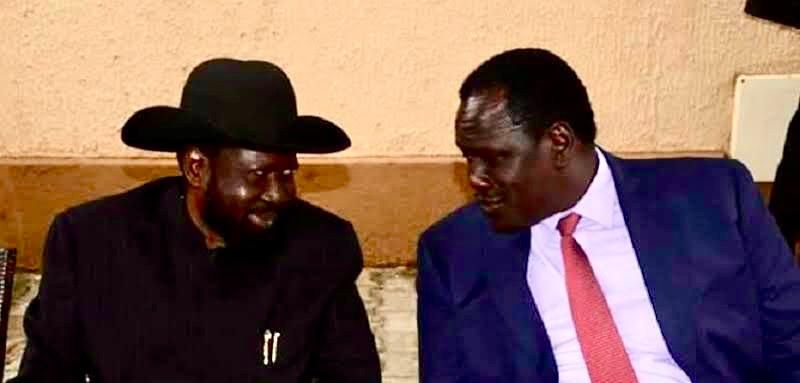
Ezekiel Lol Gatkuoth: Personal Loyalty to Kiir Undermines Institutions
Summary
- Ezekiel Lol Gatkuoth consistently uses his ministerial platform to express personal loyalty to President Salva Kiir, rather than defending government institutions.
- His public statements include equating Kiir's personal survival with government stability and suggesting that identity for some communities is defined by the president's patronage.
- Gatkuoth also reportedly threatened suspended First Vice President Riek Machar, stating Machar would "die in jail," despite Gatkuoth's own past affiliation with Machar's movement.
- This pattern of personalized allegiance over institutional governance raises concerns about South Sudan's institutional integrity and creates heightened political risk.
- Another notable instance of this pattern involved a public correction directed at Vice President Rebecca Nyandeng.
What Happened: A Pattern of Personal Allegiance
A country in dire need of robust, functioning institutions finds itself grappling with a political culture that appears to reward loyalty to an inner circle rather than adherence to established governmental processes and legal frameworks.
Ezekiel Lol Gatkuoth, a prominent figure in South Sudan's cabinet, has consistently demonstrated a public posture that prioritizes personal loyalty to President Salva Kiir over the defense of governmental institutions or policies. This pattern is evident across numerous public statements and interventions, often extending beyond the scope of his official ministerial duties. Observers note that this approach, while potentially serving as a strategy for political survival in Juba, fundamentally transforms public office into a mechanism for shielding a single individual.
A notable instance occurred in January 2026, amidst claims by SPLA-IO forces of advances in Upper Nile, Eastern Equatoria, and Central Equatoria. Gatkuoth publicly asserted that key urban centers, including Bor and Juba, would remain secure, and that the government under President Kiir was stable and enduring. While acknowledging minor "security challenges" in contested regions, his reassurance primarily focused on President Kiir's unshakeable position, equating the leader's personal staying power with the stability of the entire administration.
Further illustrating this personalized allegiance, during a tour of Maiwut and Longechuk counties in June and July 2026, Gatkuoth reportedly told residents that their identity should be defined by their financial benefactors, concluding that their "tribe" was, in essence, President Salva Kiir. This statement starkly highlights how political identity can be reduced to patronage, where loyalty is directed towards an individual provider rather than national institutions or a constitution. This formulation is particularly revealing in a nation where access to state resources and political patronage are critical levers of power.
The minister's public interventions have also targeted political rivals. In June 2026, Gatkuoth was reported to have stated that suspended First Vice President Riek Machar would "die in jail" unless Gatkuoth himself was no longer in Juba. This provocative remark, which prompted the SPLM-IO's youth wing to demand disciplinary action from President Kiir, is particularly striking given Gatkuoth's own political history as a former senior figure and chief of staff within Machar's movement before his defection to Kiir's government via the Taban Deng Gai faction. The comment, focused on the personal fate of a rival, underscores the use of a ministerial platform for highly personalized political contests. Another significant example of this pattern, identified by observers, involved a public correction directed at Vice President Rebecca Nyandeng.
Erosion of Institutional Integrity: Ministerial Conduct Under Scrutiny
The distinction between defending a government and defending a president is crucial for the health of any state, yet Ezekiel Lol Gatkuoth's public statements frequently blur this line. While cabinet ministers are expected to explain policy, absorb criticism directed at institutions, and advocate for collective governmental decisions, Gatkuoth's approach often deviates into the realm of personal advocacy for President Salva Kiir. This pattern raises significant questions about South Sudan ministerial conduct and its adherence to principles of institutional governance.
His interventions, such as the declaration that "no one can overthrow Kiir" or the assertion that the president embodies the "tribe" of certain communities, consistently frame political stability and identity through the lens of a single leader. This perspective undermines the concept of South Sudan institutional integrity, suggesting that the state's legitimacy and function are inextricably tied to one individual rather than to its constitutional framework, laws, or collective decision-making bodies. Such rhetoric transforms public service into a personal shield for the president, rather than a mechanism for upholding the broader governmental structure.
Furthermore, many of Gatkuoth's public remarks, including his threat against Riek Machar, fall well outside the typical purview of a ministerial portfolio. These statements, focused on the personal fate of political adversaries or the individual power of the president, highlight a political style where official platforms are leveraged for highly personalized political contests. This approach suggests a system where Salva Kiir political patronage may be a more significant driver of public discourse and loyalty than adherence to institutional norms or policy objectives.
Why It Matters: Political Risk and Governance Challenges
The consistent demonstration of Ezekiel Lol Gatkuoth's personal loyalty to President Salva Kiir, as evidenced by his public statements, points to a deeper systemic issue within South Sudan's political landscape. This pattern of prioritizing individual allegiance over institutional governance has profound implications for the nation's stability and development. A country in dire need of robust, functioning institutions finds itself grappling with a political culture that appears to reward loyalty to an inner circle rather than adherence to established governmental processes and legal frameworks.
This environment of personalized political patronage inherently elevates political risk for all stakeholders, including international partners and businesses operating within South Sudan. When loyalty is owed primarily to a person rather than to a nation, its constitution, or its laws, the predictability of regulatory enforcement and the stability of governance structures become highly uncertain. Decisions may be influenced more by personal relationships and political expediency than by established legal or policy guidelines, leading to an unpredictable operating environment.
Ultimately, the public record of figures like Ezekiel Lol Gatkuoth underscores a fundamental challenge to South Sudan institutional integrity. The conversion of public office into a tool for personal defense or political maneuvering, rather than for collective governance, suggests a system where political power is exercised through personal provision and loyalty rather than through transparent, accountable institutions. This patronage-driven political culture necessitates that legal and compliance professionals advising clients in the region account for heightened political risk and potential unpredictability in regulatory enforcement, recognizing the deep-seated influence of personalized political loyalty.
Practical Implications
This article highlights a pattern of personalized political loyalty over institutional governance in South Sudan, suggesting that legal and compliance professionals advising clients in the region must account for heightened political risk and potential unpredictability in regulatory enforcement due to a patronage-driven political culture.
Source
How does this affect you?
Get an AI analysis of this article grounded in your jurisdictions, practice areas, and any policy documents you've uploaded to Wansom.
Finish Reading the Full Story and the Expert Analysis.
Wansom is AI and can make mistakes.