
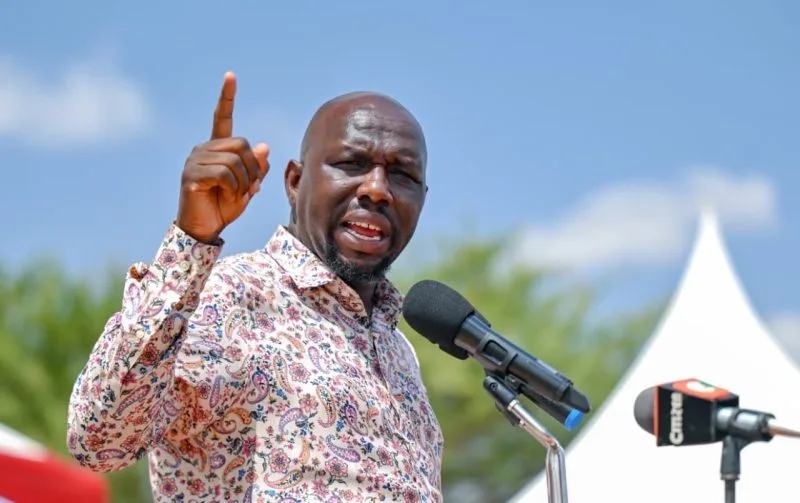
Murkomen Vows to Isolate Paul Mackenzie in Prison Over Fears of Radicalising Inmates
Summary
- Interior Cabinet Secretary Kipchumba Murkomen has vowed to keep Paul Mackenzie in isolated prison custody.
- This decision is based on intelligence reports indicating Mackenzie's attempts to radicalize fellow inmates and police officers.
- Paul Mackenzie was recently sentenced to 200 years in prison for his role in the Shakahola massacre, which caused 191 deaths.
- The government aims to prevent Mackenzie from spreading extremist religious teachings and influencing other prisoners.
- Murkomen affirmed that firm measures against religious extremism will be taken while upholding the right to freedom of worship.
Custody Measures for Paul Mackenzie
The government's primary concern is to prevent him from spreading extremist religious teachings or influencing vulnerable individuals within the prison system.
Kenya's Interior Cabinet Secretary, Kipchumba Murkomen, has affirmed the government's commitment to maintaining strict, isolated custody for controversial preacher Paul Mackenzie. This decision stems from intelligence reports suggesting Mackenzie has attempted to radicalize both fellow inmates and police officers while in detention. The government's primary concern is to prevent him from spreading extremist religious teachings or influencing vulnerable individuals within the prison system.
Speaking at a church service in Ikolomani Constituency, Kakamega, Murkomen emphasized that a secluded area would be designated for Mackenzie to serve his sentence, thereby restricting his interaction with the general prison population. This measure is specifically designed to avert further radicalization by individuals like Mackenzie, ensuring that the prison environment is not exploited for such purposes. Authorities are particularly worried that if not contained, Mackenzie's teachings could be adopted by other prisoners, potentially leading to the formation of similar movements upon their release.
The Shakahola Conviction
This announcement follows closely on the heels of the High Court in Mombasa sentencing Paul Mackenzie to a staggering 200 years in prison. Justice Diana Kavedza-Mochache delivered consecutive 100-year sentences for 183 counts of murder by starvation and an additional eight counts related to direct homicide. The conviction is linked to the horrific Shakahola massacre, which tragically resulted in the deaths of 191 individuals, comprising 190 children and one adult.
Mackenzie was found to be the orchestrator of a system of religious indoctrination where followers, including children, were compelled to starve themselves in preparation for what he described as 'meeting Jesus.' The prosecution presented compelling evidence, including forensic analyses, medical reports, and witness testimonies, which detailed how this enforced fasting was maintained through intimidation, violence, and confinement. In addition to Mackenzie, 28 co-accused individuals were also convicted, receiving prison sentences ranging from 10 to 160 years for their roles in the atrocities. Cabinet Secretary Murkomen publicly commended the Office of the Director of Public Prosecutions (ODPP), the Directorate of Criminal Investigations (DCI), and the Judiciary for their diligent work in securing these convictions.
Government Stance on Religious Extremism
The Shakahola tragedy first came to light in 2023 when investigators uncovered mass graves in Kilifi County, ultimately recovering hundreds of bodies from the forest. Mackenzie's sentencing represents a significant milestone in the prosecution of these killings, although he continues to face separate legal proceedings for other alleged offenses. The government views this case as a critical test of its resolve against religious extremism.
Murkomen reiterated the government's firm commitment to combating religious extremism and radicalization, asserting that robust measures would be implemented without infringing upon the constitutional right to freedom of worship. This policy underscores a broader effort to safeguard society from the dangers of extremist ideologies, particularly within vulnerable settings like correctional facilities. The decision to isolate Paul Mackenzie in prison is a direct manifestation of this heightened vigilance, aiming to prevent the spread of his radical views and protect other inmates from potential indoctrination.
Practical Implications
This development signals the Kenyan government's heightened vigilance against religious extremism within correctional facilities, potentially leading to stricter inmate management protocols for high-profile offenders. Lawyers representing clients accused of radicalization or those involved in prison reform advocacy should monitor evolving policies on inmate segregation and religious freedom within the penal system.
Source
How does this affect you?
Get an AI analysis of this article grounded in your jurisdictions, practice areas, and any policy documents you've uploaded to Wansom.
Finish Reading the Full Story and the Expert Analysis.
Get the latest legal & regulatory intelligence in Kenya
Wansom is AI and can make mistakes.