
Motorists Association Kenya: Demands EPRA Fuel Price Audit, G-to-G Import Scrutiny
Summary
- The Motorists Association of Kenya (MAK) has demanded an independent audit of both the recent fuel price review and the government-to-government (G-to-G) petroleum import arrangement.
- MAK questioned the significant increase in kerosene pump prices, which rose by 14.89% despite its landed cost increasing by only 9.41%.
- The association called for the Energy and Petroleum Regulatory Authority (EPRA) to publish a complete breakdown of all fuel price calculations, including taxes, levies, and margins.
- MAK challenged the justification that higher kerosene prices deter fuel adulteration, arguing it unfairly burdens low-income households.
- Parliament, the Auditor-General, and the Competition Authority of Kenya were urged by MAK to scrutinize petroleum procurement and pricing.
What Happened
MAK emphasized that if the government-to-government arrangement cannot demonstrably prove that Kenyans are acquiring petroleum more competitively than through alternative means, its continued protection from market competition lacks economic justification.
The Motorists Association of Kenya (MAK) has called for an immediate and independent audit of the latest fuel price review, alongside a thorough examination of the government-to-government (G-to-G) petroleum import arrangement. In a statement released on October 14, MAK expressed strong disapproval of the recent price adjustments, asserting that these changes would exacerbate the already challenging cost of living and impose significant financial strain on motorists, transport operators, and Kenyan households.
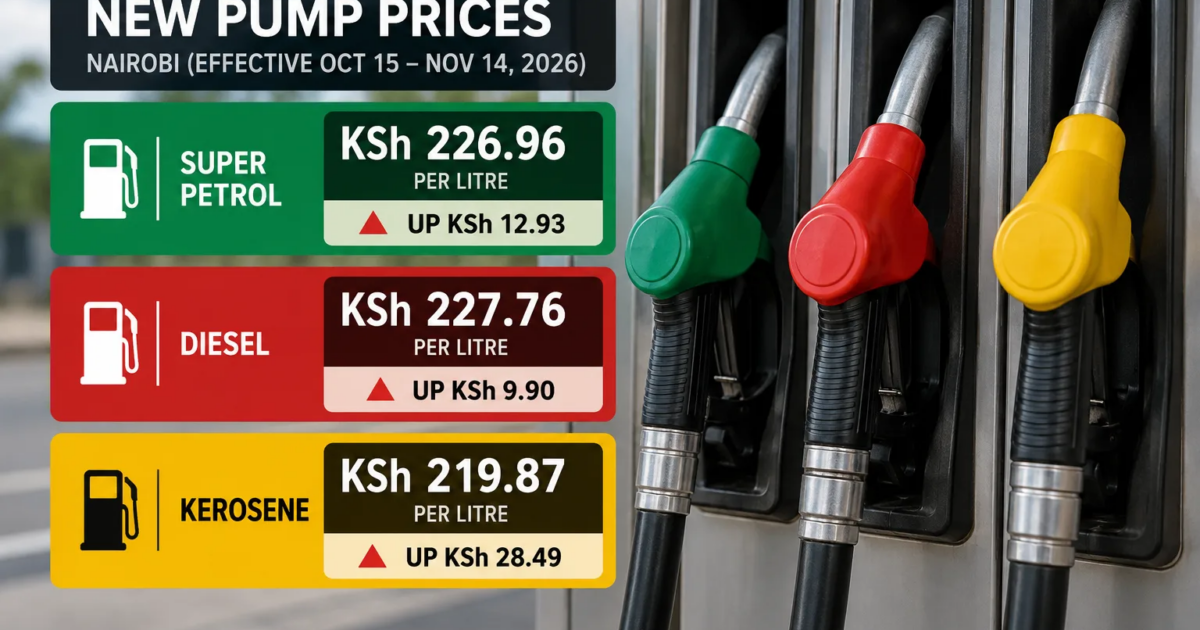
Effective from October 15 to November 14, new fuel prices in Nairobi saw petrol reach Sh226.96 per litre, diesel Sh227.76, and kerosene Sh219.87. These figures represent substantial increases: petrol rose by Sh12.93, diesel by Sh9.90, and kerosene by an alarming Sh28.49. MAK characterized these adjustments not as minor economic shifts, but as a direct attack on the nation's productive capacity.
A particular point of contention for MAK was the pricing of kerosene. Despite recording the lowest percentage increase in landed cost at 9.41%, kerosene experienced the steepest percentage increase at the pump, surging by 14.89%. In contrast, petrol's landed cost rose by 11.81% leading to a 6.04% pump price increase, while diesel's landed cost increased by 11.32% resulting in a 4.54% pump price hike. MAK questioned this disparity, asking how the product with the smallest landed cost increase could incur the largest percentage jump for consumers.
Demands for Pricing Transparency and Regulatory Accountability
While acknowledging that various factors such as taxes, levies, margins, transport costs, and potential stabilization adjustments contribute to final pump prices, MAK has nonetheless demanded that the Energy and Petroleum Regulatory Authority (EPRA) provide a comprehensive breakdown of the calculations underpinning the new prices. This call for an EPRA fuel price breakdown Kenya aims to shed light on the methodology used by the regulator.
Furthermore, the association strongly challenged EPRA's reported rationale for the kerosene price adjustment, which suggested it was partly intended to narrow the price gap between kerosene and automotive fuels to discourage adulteration. MAK labeled this explanation an "extraordinary admission of regulatory failure." They argued that instead of burdening households that rely on kerosene for cooking and lighting, authorities should focus on strengthening surveillance, enhancing fuel quality testing, and prosecuting dealers involved in adulteration. The association stressed that fuel adulteration is an enforcement issue and should not serve as a pretext for imposing punitive prices on the nation's most vulnerable citizens. MAK also called for an audit of the Petroleum Development Levy Funds, requesting public disclosure of receipts, disbursements, stabilization balances, and product-specific allocations.
Scrutiny of the G-to-G Petroleum Import Arrangement
Beyond the immediate price review, MAK also sought a comprehensive independent audit of the Kenya G-to-G petroleum import arrangement. The association specifically requested the disclosure of its costs and measurable benefits, particularly when compared against competitive procurement methods. MAK questioned whether this arrangement had truly delivered on its promises to consumers, such as improved market stability and reduced pressure on foreign exchange reserves, three years after its implementation.
The association demanded the publication of any actual savings generated by the G-to-G deal, alongside details of supplier premiums, financing costs, freight charges, and foreign exchange exposure, and their collective impact on pump prices. MAK emphasized that if the government-to-government arrangement cannot demonstrably prove that Kenyans are acquiring petroleum more competitively than through alternative means, its continued protection from market competition lacks economic justification.
Calls for Broader Institutional Oversight
In a broader appeal for accountability, MAK urged Parliament, the Auditor-General, and the Competition Authority of Kenya to scrutinize petroleum procurement and pricing arrangements. This call for Competition Authority of Kenya petroleum scrutiny underscores the association's belief that a multi-agency approach is necessary to ensure fair practices within the sector.
The association articulated that consumers deserve the ability to differentiate between price fluctuations caused by international market movements and those resulting from domestic policy decisions. This distinction is crucial for fostering transparency and public trust in the energy sector's regulatory framework. The increased public and regulatory scrutiny on EPRA's fuel pricing methodology and the G-to-G oil import deal could lead to demands for greater transparency, potential investigations, and shifts in compliance requirements related to pricing disclosures and anti-adulteration measures.
Practical Implications
Lawyers advising clients in Kenya's energy and petroleum sectors should monitor the increased public and regulatory scrutiny on EPRA's fuel pricing methodology and the G-to-G oil import deal. This could lead to demands for greater transparency, potential investigations by the Auditor-General or Competition Authority, and shifts in compliance requirements related to pricing disclosures and anti-adulteration measures.
Source
How does this affect you?
Get an AI analysis of this article grounded in your jurisdictions, practice areas, and any policy documents you've uploaded to Wansom.
Finish Reading the Full Story and the Expert Analysis.
Get the latest legal & regulatory intelligence in Kenya
Wansom is AI and can make mistakes.