
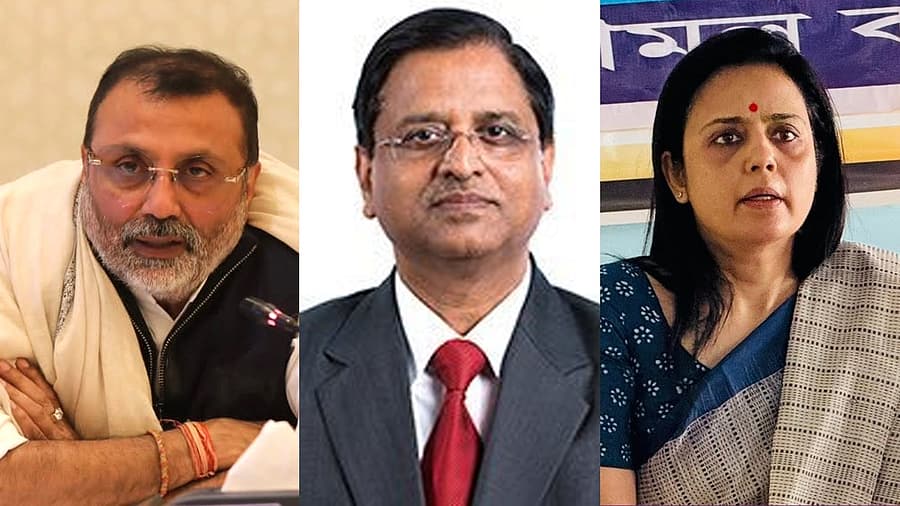
Delhi High Court: Mahua Moitra Removes Nishikant Dubey Tweet Defamation
Summary
- Mahua Moitra agreed in the Delhi High Court to remove a tweet calling Nishikant Dubey a 'fake degree man'.
- Former finance secretary Subhash Chandra Garg also committed to blocking a video portion where he called Dubey a 'blackmailer'.
- Justice Tushar Rao Gedela recorded these statements and issued summons to both Moitra and Garg in a defamation suit filed by Dubey.
- The judge strongly objected to the term 'blackmailer', deeming it 'intemperate and absolutely derogatory'.
- Moitra's counsel maintained the right to question Dubey's degree, asserting the political nature of their dispute.
Court Directs Removal of Content in Defamation Case
Lawyers advising public figures or media clients should note the Delhi High Court's strong stance against derogatory language like 'blackmailer' in public discourse, even in political contexts, indicating a low tolerance for such terms in defamation proceedings.
In a significant development at the Delhi High Court, Trinamool Congress Member of Parliament (MP) Mahua Moitra has committed to removing a specific tweet that referred to Bharatiya Janata Party (BJP) MP Nishikant Dubey as a "fake degree kism ke aadmi," translating to a man with a fake degree. This undertaking was made during proceedings for a defamation lawsuit initiated by Dubey, which targets both Moitra and former finance secretary Subhash Chandra Garg.
Concurrently, Subhash Chandra Garg informed the High Court that he would contact the podcaster responsible for a particular video. His intention is to request the blocking of a segment where he described Dubey as "blackmailing kism ke aadmi," or a man who resorts to blackmailing. Justice Tushar Rao Gedela officially recorded these statements in his order and subsequently issued summonses to both Moitra and Garg, signaling the court's formal engagement with the allegations.
Judicial Scrutiny of Derogatory Language
The commitments from Moitra and Garg followed a direct intervention by Justice Gedela, who expressed strong disapproval regarding the use of the term "blackmailer." The judge unequivocally stated that such a word is inappropriate for any individual, characterizing it as both "intemperate and absolutely derogatory." This judicial stance underscores the court's low tolerance for highly offensive language in public discourse, particularly when directed at public figures.
Justice Gedela further emphasized the reputational damage such terms can inflict, questioning whether the individuals involved would accept being called a blackmailer themselves. This highlights the court's view that public figures, despite their political disagreements, are entitled to protection from certain levels of personal attack. Lawyers advising public figures or media clients should note the Delhi High Court's strong stance against derogatory language like 'blackmailer' in public discourse, even in political contexts, indicating a low tolerance for such terms in defamation proceedings.
Implications for Public Commentary
While Moitra's counsel affirmed her intention to remove the specific tweet, they also asserted her right to continue questioning Dubey's academic qualifications, framing the dispute as fundamentally political. However, the court's intervention, particularly Justice Gedela's firm remarks on the 'blackmailer' comment, sets a precedent for the boundaries of acceptable public speech, especially under Indian defamation law public figures.
This case demonstrates the potential for courts to compel removal of objectionable content early in a defamation suit, highlighting the importance of careful public commentary. The judicial directive serves as a reminder to public figures that while political debate is robust, the use of overtly derogatory and intemperate language can lead to legal repercussions, even if the underlying dispute is political. The court's willingness to address the nature of the language used, rather than solely the truth of the allegations, signals a significant focus on maintaining civility in public discourse.
Practical Implications
Lawyers advising public figures or media clients should note the Delhi High Court's strong stance against derogatory language like 'blackmailer' in public discourse, even in political contexts, indicating a low tolerance for such terms in defamation proceedings. This case demonstrates the potential for courts to compel removal of objectionable content early in a defamation suit, highlighting the importance of careful public commentary.
Source
Source: Original reporting via Live Law
How does this affect you?
Get an AI analysis of this article grounded in your jurisdictions, practice areas, and any policy documents you've uploaded to Wansom.
Finish Reading the Full Story and the Expert Analysis.
Wansom is AI and can make mistakes.