
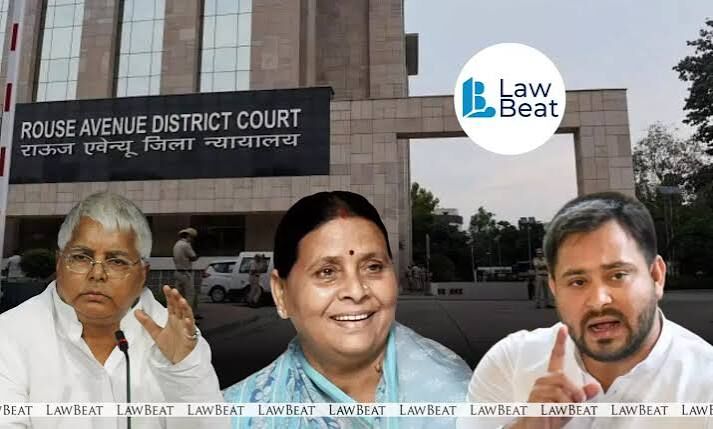
Delhi Court Orders Money Laundering Charges Against Lalu, Rabri, Tejashwi
Summary
- A Delhi court has ordered the framing of money laundering charges against Lalu Prasad Yadav, Rabri Devi, and Tejashwi Yadav in the IRCTC hotels case.
- Special Judge Vishal Gogne found a "strong suspicion of abuse of office and proceeds of crime" related to the alleged manipulation of hotel tenders during Lalu Prasad's time as Union Railway Minister.
- The case involves allegations of a quid pro quo where prime Patna land was transferred to a company linked to the Yadav family in exchange for railway hotel contracts.
- The Enforcement Directorate alleges dubious funds were routed through 151 companies and an NBFC to acquire the land, with shares later transferred to Rabri Devi and Tejashwi Yadav at nominal prices.
- Formal charges are scheduled to be framed on October 3, with nine individuals facing charges while seven others were discharged.
Court Orders Charges in IRCTC Case
Special Judge Vishal Gogne, after reviewing the evidence, found a "strong suspicion of abuse of office and proceeds of crime" involving Rabri Devi and Tejashwi Yadav, who are alleged to have benefited from a tainted land parcel in Patna.
A Delhi court has directed the formal framing of money laundering charges against former Bihar Chief Minister Lalu Prasad Yadav, his wife Rabri Devi, and their son Tejashwi Yadav. The order, issued on a Thursday, pertains to alleged irregularities in the leasing of two Indian Railway Catering and Tourism Corporation (IRCTC) hotels in Ranchi and Puri during Lalu Prasad's tenure as Union Railway Minister. Special Judge Vishal Gogne, after reviewing the evidence, found a "strong suspicion of abuse of office and proceeds of crime" involving Rabri Devi and Tejashwi Yadav, who are alleged to have benefited from a tainted land parcel in Patna.
The court's directive means that formal charges will be framed on October 3. This development comes after a detailed examination of the alleged IRCTC hotels case, where the tender process for awarding sub-lease rights was reportedly manipulated. The prosecution contends that railway officials orchestrated the tender in favor of M/s Sujata Hotels Pvt. Ltd., a company linked to Vijay and Vinay Kochhar, while Lalu Prasad was the Railway Minister. In exchange for these contracts, 358 decimals of prime land in Patna were allegedly transferred in February 2005 to M/s Delight Marketing Company Pvt. Ltd., a firm associated with the family of RJD leader PC Gupta.
Further allegations suggest that the ownership of this Patna land was subsequently transferred through shares in the company to Rabri Devi and Tejashwi Yadav, purportedly at nominal prices. The court's decision to proceed with the charges underscores its prima facie finding that the tender process was indeed manipulated, and the land transactions were directly connected to the railway hotel contracts. Out of sixteen accused individuals, charges were ordered against nine, including the Yadav family members, while seven others were discharged from the case.
Allegations of Quid Pro Quo and Money Laundering
Both the Enforcement Directorate (ED) and the Central Bureau of Investigation (CBI) have been investigating the matter, alleging that Lalu Prasad and certain IRCTC officials misused their positions to manipulate the tender process. The agencies characterize the arrangement as a clear quid pro quo, where public contracts were exchanged for valuable private property, land, and company shares, ultimately benefiting the Yadav family. The ED, specifically, has focused on the money laundering aspect, asserting that the funds used to acquire the Patna land were of dubious origin.
The ED's investigation revealed that these funds were allegedly routed through a complex network of 151 companies linked to PC Gupta, with a non-banking financial company (NBFC), M/s Abhishek Finance Company Ltd., purportedly facilitating some of these transactions. The agency also raised questions regarding the source of funds Rabri Devi used to acquire shares and highlighted that some individuals from whom Tejashwi Yadav allegedly purchased shares denied any knowledge of holding such shares. The ED filed its initial chargesheet in this case in 2018, naming Lalu Prasad, Rabri Devi, Tejashwi Yadav, PC Gupta, Sarla Gupta, Lara Projects, and several others.
It is important to note that this is not the first time the Yadav family has faced legal action in connection with the IRCTC hotels scam. In a related case prosecuted by the CBI, the Rouse Avenue Court had already framed charges against Lalu Prasad Yadav, Rabri Devi, Tejashwi Yadav, and others on October 13, 2025. Those charges included criminal conspiracy, cheating, and various offenses under corruption laws, further illustrating the multi-faceted nature of the allegations against them.
Implications of the Court's Decision
The Delhi court's order to frame money laundering charges against Lalu Prasad Yadav, Rabri Devi, and Tejashwi Yadav marks a significant step in a long-running high-profile case. Special Judge Vishal Gogne's observation of a "strong suspicion of abuse of office and proceeds of crime" underscores the judiciary's commitment to pursuing allegations of financial misconduct, particularly those involving public officials and their families. This development highlights the persistent scrutiny of alleged corruption during Lalu Prasad's tenure as Union Railway Minister and the intricate web of transactions uncovered by investigative agencies.
The progression of this case, with formal charges set to be framed, reinforces the legal system's resolve to address complex financial crimes, even years after the alleged incidents. The findings regarding alleged manipulation of tenders and the subsequent transfer of assets through shell companies and nominal share acquisitions provide crucial insights into the methods purportedly used to launder money and convert illicit gains into legitimate-appearing assets. This ruling serves as a reminder that allegations of quid pro quo and abuse of public office will continue to be rigorously examined, with potential long-term legal ramifications for those involved.
Practical Implications
This development underscores the judiciary's commitment to prosecuting high-profile money laundering cases involving public officials, even years after the alleged incidents. Lawyers and compliance officers should note the court's prima facie findings regarding abuse of office and proceeds of crime, which can inform risk assessments and litigation strategies in complex financial crime matters involving political figures and alleged quid pro quo.
Source
Source: Original reporting via Live Law
How does this affect you?
Get an AI analysis of this article grounded in your jurisdictions, practice areas, and any policy documents you've uploaded to Wansom.
Finish Reading the Full Story and the Expert Analysis.
Wansom is AI and can make mistakes.