
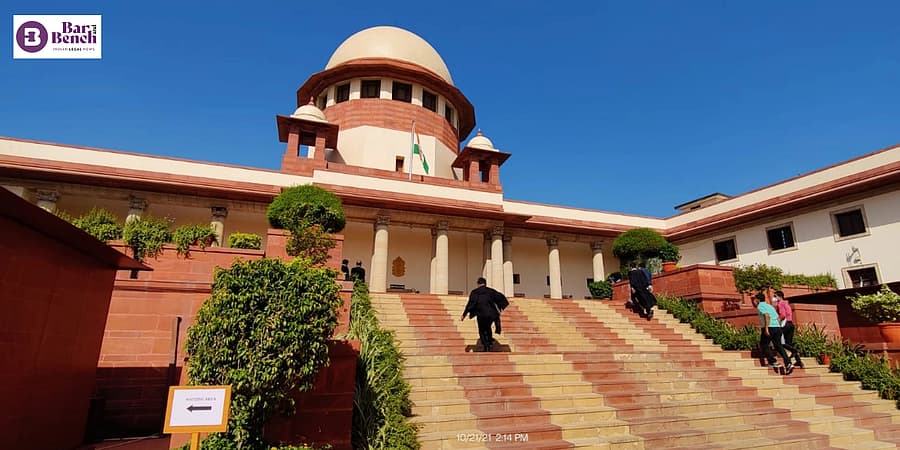
Supreme Court: Sets Aside SS Das Compulsory Retirement
Summary
- The Supreme Court set aside the compulsory retirement of Indian Trade Service officer S.S. Das, who was retired just 2.5 months after his promotion.
- Justices Dipankar Datta and Sheel Nagu ruled that promoting an officer and then branding them 'deadwood' for compulsory retirement under Fundamental Rule 56(j) were contradictory actions.
- The Centre was ordered to pay Mr. Das ₹9 lakh for loss of reputation and ₹6 lakh in costs, totaling ₹15 lakh.
- Mr. Das, having reached superannuation, is to be called back for a farewell ceremony with full honors.
- The ruling establishes a precedent against arbitrary compulsory retirement, especially when it contradicts recent promotions.
What Happened
The Court held that the decisions to promote Das and then almost immediately treat him as “deadwood” were mutually contradictory.
India's Supreme Court recently intervened in a significant employment dispute, overturning the compulsory retirement of an Indian Trade Service (ITS) officer, S.S. Das. The high court, in a judgment delivered on September 9, determined that the government's decision to retire Das, branding him as "deadwood" just months after his promotion to a senior role, was fundamentally contradictory. This ruling effectively sets aside the compulsory retirement of SS Das, providing a crucial precedent for similar cases involving government employees.
Mr. Das, who commenced his career with the Indian Trade Service in 1989, had a history of regular promotions. His career progression saw him placed in the Senior Administrative Grade, equivalent to a Joint Secretary level, in November 2017. Following this, he was formally promoted to that grade on February 27, 2018. However, a mere two and a half months later, on May 10, 2018, the Centre invoked Fundamental Rule 56(j) to compulsorily retire him.
As a result of the Supreme Court's decision, the Centre has been directed to compensate Mr. Das with a total of ₹15 lakh. This sum includes ₹9 lakh specifically for the damage to his reputation and an additional ₹6 lakh to cover legal costs. Furthermore, recognizing that Mr. Das has since reached the age of superannuation, the Court issued a unique directive: the Director General of Foreign Trade must arrange for his return to the office to receive a farewell ceremony with full honors, mirroring the respect he would have been accorded upon a regular retirement.
Legal Context
The core of the legal challenge in SS Das v. Union of India revolved around the application of Fundamental Rule 56(j), a provision allowing for the compulsory retirement of government employees deemed to be 'deadwood' or ineffective, in the public interest. The Supreme Court, comprising Justices Dipankar Datta and Sheel Nagu, meticulously examined the sequence of events leading to Mr. Das's retirement. Their analysis highlighted the inherent inconsistency in promoting an officer to a high-ranking position and then, shortly thereafter, initiating proceedings for compulsory retirement under the 'deadwood' classification.
The Court's judgment underscored that the two actions—promotion and subsequent compulsory retirement—were mutually exclusive and could not logically coexist. The bench articulated that once an individual has been promoted, particularly to a senior administrative grade, it becomes untenable for superior officers to then label them as 'deadwood' to justify their removal in the purported public interest. This finding directly addresses the issue of Fundamental Rule 56(j) arbitrary retirement, emphasizing that such decisions must be based on consistent and logical assessments of an employee's performance and utility.
This ruling establishes a significant legal benchmark against the arbitrary application of compulsory retirement. It reinforces the principle that personnel actions by government departments must demonstrate coherence and rationality. The Court's strong stance against contradictory promotion and compulsory retirement decisions provides a clear directive that an employee's recent promotion serves as a powerful counter-indicator to claims of ineffectiveness or being 'deadwood'.
Why It Matters
This Supreme Court decision carries substantial implications for government employment practices across India, particularly concerning the use of Fundamental Rule 56(j). By setting aside SS Das's compulsory retirement, the Court has sent a clear message regarding the need for consistency in performance evaluations and personnel management within public service. It directly challenges the notion that an employee can be deemed fit for promotion one day and then summarily dismissed as 'deadwood' a short time later, effectively preventing India government employee wrongful termination under such inconsistent circumstances.
For government departments and public sector undertakings, the ruling necessitates a more rigorous and transparent approach to compulsory retirement decisions. It implies that any action taken under Fundamental Rule 56(j) must be supported by a consistent record of performance assessment, especially when an employee has recently received a promotion. The judgment serves as a deterrent against arbitrary or poorly substantiated personnel actions, ensuring greater accountability from authorities.
Conversely, for government employees, this case provides a robust legal avenue to challenge compulsory retirement orders that appear to be contradictory to their recent career progression. The emphasis on the 'mutually destructive' nature of promotion followed by compulsory retirement offers a powerful argument against what might otherwise be perceived as an arbitrary or unfair dismissal. This landmark decision reinforces the principles of fairness and due process in public employment.
Practical Implications
This ruling establishes a precedent regarding the arbitrary application of compulsory retirement under Fundamental Rule 56(j), particularly when an employee has recently been promoted. Lawyers advising government departments or public sector undertakings must ensure consistency in performance assessments and personnel actions to avoid legal challenges, while those representing employees can cite this case to challenge contradictory employment decisions.
Source
How does this affect you?
Get an AI analysis of this article grounded in your jurisdictions, practice areas, and any policy documents you've uploaded to Wansom.
Finish Reading the Full Story and the Expert Analysis.
Get the latest legal & regulatory intelligence in India
Wansom is AI and can make mistakes.