
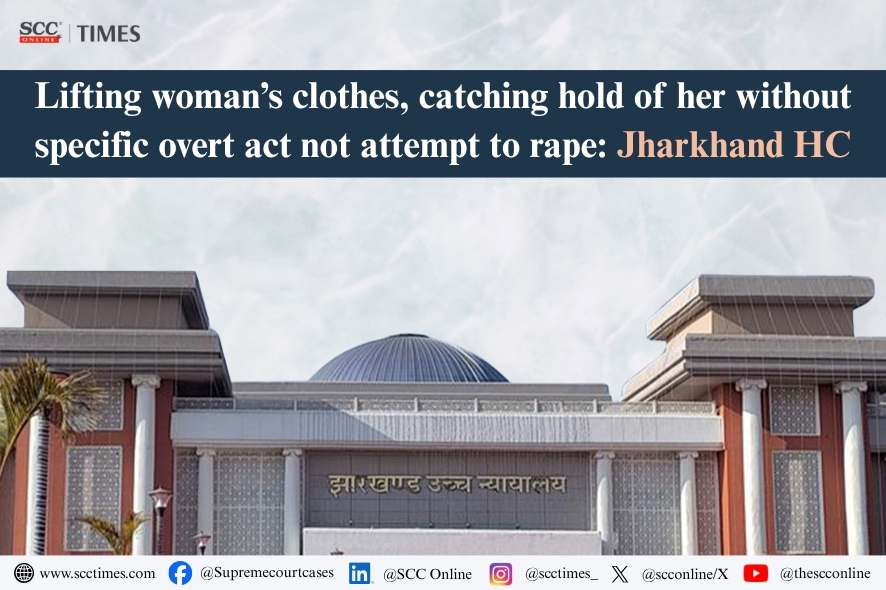
Jharkhand High Court: Lifting Clothes Not Rape Attempt, Not 376/511 IPC
Summary
- The Jharkhand High Court ruled that lifting a woman's clothes and catching hold of her, without further specific overt acts, does not constitute an attempt to rape.
- The court found that such actions establish an assault with the intent or knowledge that it would outrage the prosecutrix’s modesty.
- The conviction was altered from attempted rape (Sections 376/511 IPC) to outraging modesty (Section 354 IPC).
- A conviction under Section 452 IPC for house-trespass after preparation for hurt, assault, or wrongful restraint was simultaneously upheld.
- The ruling emphasizes the requirement of a "specific overt act" directly aimed at sexual penetration for an attempt to commit rape.
What Happened
The court determined that these specific actions, without further explicit overt acts indicating an intent to complete sexual intercourse, do not automatically constitute an attempt to rape under Sections 376/511 of the Indian Penal Code (IPC).
The Jharkhand High Court recently issued a significant ruling clarifying the distinction between an attempt to commit rape and an act intended to outrage a woman's modesty. In a case involving actions such as lifting a woman's clothes and catching hold of her, the court determined that these specific actions, without further explicit overt acts indicating an intent to complete sexual intercourse, do not automatically constitute an attempt to rape under Sections 376/511 of the Indian Penal Code (IPC). This decision led to a modification of the conviction for the accused.
Initially, the evidence presented in the case did not reveal any specific overt act that unequivocally pointed towards the commission of rape. Instead, the court found that the evidence firmly established an assault. This assault was carried out with the clear intention or knowledge that such actions were highly likely to outrage the modesty of the prosecutrix. This crucial distinction guided the court's final judgment regarding the appropriate legal classification of the offense.
The Court's Rationale
The Jharkhand High Court's reasoning hinged on the precise interpretation of "attempt to rape" as defined by Sections 376 (rape) read with 511 (punishment for attempting to commit offences punishable with imprisonment for life or other imprisonment) of the IPC. The court emphasized that for an act to qualify as an attempt to rape, there must be a discernible, specific overt act directly aimed at the completion of sexual intercourse. Merely lifting clothes or physically restraining a person, while deeply offensive and criminal, does not, in itself, meet this stringent threshold if further steps towards sexual penetration are absent.
Consequently, the court concluded that while the evidence did not support a conviction for attempted rape, it overwhelmingly demonstrated an offense under Section 354 IPC, which deals with assault or criminal force to a woman with intent to outrage her modesty. This section specifically addresses acts that infringe upon a woman's dignity and honor. The court therefore altered the conviction to Section 354 IPC, acknowledging the severe nature of the assault while differentiating it from an attempt at sexual assault. Importantly, the conviction for the separate charge under Section 452 IPC, pertaining to house-trespass after preparation for hurt, assault, or wrongful restraint, was upheld, indicating the court's recognition of the overall criminal conduct.
Implications for Criminal Law
This ruling by the Jharkhand High Court provides crucial guidance for criminal lawyers in India, particularly in cases involving sexual assault and outraging modesty. It underscores the necessity of meticulously evaluating the evidence to distinguish between an attempt to rape and an act primarily intended to outrage modesty. The emphasis on a "specific overt act" for an attempt to rape under Sections 376/511 IPC clarifies the evidentiary bar that prosecutors must meet, impacting case strategy and the framing of charges.
For practitioners, this means a careful assessment of whether the accused's actions progressed beyond mere assault or indignity to a direct, unequivocal step towards sexual penetration. While lifting clothes and catching hold of a woman are grave offenses that constitute criminal assault and outraging modesty in India, the court has drawn a clear line regarding what constitutes an *attempt* to commit rape. This distinction is vital for ensuring that charges accurately reflect the nature and extent of the criminal act, influencing potential sentencing and the overall legal outcome in such sensitive cases heard by the Jharkhand High Court criminal bench.
Practical Implications
This ruling provides crucial guidance for criminal lawyers in India on distinguishing between an attempt to rape and an act intended to outrage modesty, emphasizing the necessity of a 'specific overt act' for the former. Practitioners must carefully evaluate evidence in sexual assault cases to determine the appropriate charges under Sections 376/511 IPC versus Section 354 IPC, impacting case strategy and potential sentencing.
Source
Source: Original reporting via SCC Times
How does this affect you?
Get an AI analysis of this article grounded in your jurisdictions, practice areas, and any policy documents you've uploaded to Wansom.
Finish Reading the Full Story and the Expert Analysis.
Get the latest legal & regulatory intelligence in India
Wansom is AI and can make mistakes.