
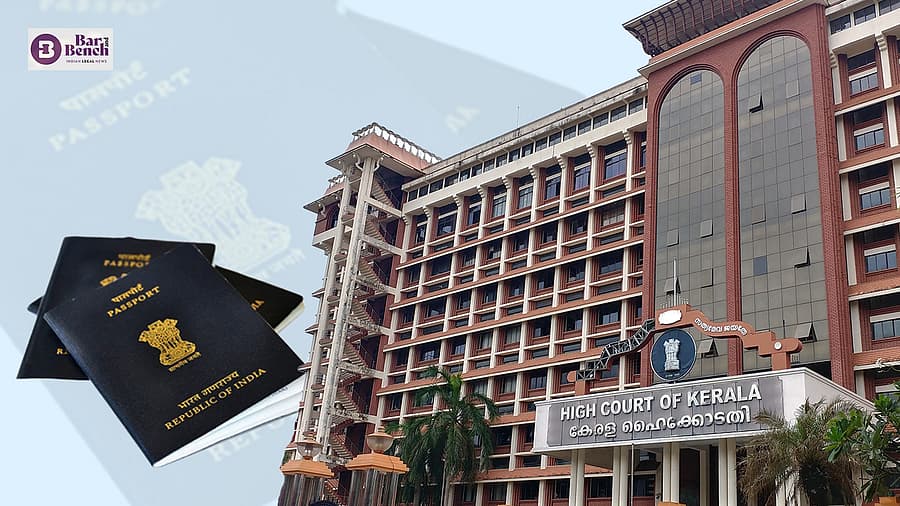
Kerala High Court: No Divorce Decree for Passport Ex-Spouse Name Deletion
Summary
- The Kerala High Court ruled that passport authorities cannot demand a divorce decree to delete an ex-spouse's name from a passport.
- Justice Murali Purushothaman noted that Schedule III of the Passport Rules, 1980, does not require such proof for ex-spouse name deletion.
- The court emphasized that executive instructions or office memorandums cannot override statutory rules.
- The ruling stemmed from a Muslim woman's petition after her passport re-issuance application was rejected for not providing a divorce decree.
- This decision clarifies that an additional documentary requirement not specified in statutory rules cannot be imposed through executive directives.
Judicial Clarification on Passport Procedures
By affirming that passport authorities cannot demand a divorce decree for ex-spouse name deletion when the Passport Rules 1980 do not require it, the court has ensured that administrative practices remain consistent with legislative intent.
The Kerala High Court has recently issued a significant ruling clarifying the requirements for individuals seeking to remove an ex-spouse's name from their passport. The court determined that passport authorities lack the power to insist on the production of a court-issued divorce decree for this specific administrative action. This decision provides crucial guidance for divorced persons in India navigating passport re-issuance processes, particularly concerning the deletion of an ex-spouse's name.
The ruling stemmed from a petition filed by a Muslim woman who sought to have her passport re-issued after deleting her former husband's name. Her application was subsequently rejected by the passport authorities, who cited her failure to provide a divorce decree as the reason for denial. This insistence on a document not explicitly required by statutory rules became the central point of contention before the High Court, leading to a definitive judgment on the matter.
Legal Basis and Statutory Interpretation
Justice Murali Purushothaman, presiding over the case, meticulously examined the existing legal framework governing passport applications. The court specifically referenced Schedule III of the Passport Rules, 1980, which outlines the necessary documents to be submitted with an application. A key finding was that these statutory rules do not include a divorce decree as a mandatory requirement for a divorcee seeking to remove a former spouse's name from their passport.
This detailed review highlighted a disparity between the demands of the passport authorities and the provisions of the governing legislation. The absence of such a requirement within the Passport Rules, 1980, formed the bedrock of the court's decision, underscoring that administrative bodies must adhere strictly to the letter of the law when imposing documentary obligations on citizens, especially regarding passport spouse name removal India.
Upholding Statutory Supremacy
A fundamental principle reiterated by the Kerala High Court in this ruling is the supremacy of statutory rules over executive instructions. The court explicitly stated that office memorandums or other executive directives cannot override, amend, or supersede established statutory provisions. This means that if a statute does not mandate a particular proof, such as a divorce decree for ex-spouse name deletion, then an administrative instruction cannot unilaterally impose it.
The court specifically referenced an office memorandum, identified as Annexure R2(a), which it deemed an attempt to introduce an additional documentary requirement not contemplated by the statutory rules. The judgment firmly established that such executive instructions cannot create new obligations that are not enshrined in the primary legislation, thereby reinforcing the legal hierarchy and the principle that executive instructions statutory rules override.
Impact on Passport Applications
This landmark decision by the Kerala High Court has significant implications for individuals seeking to update their passport details following a divorce. It clarifies that the absence of a divorce decree should not be a barrier to removing an ex-spouse's name from a passport, provided all other statutory requirements are met. The ruling effectively streamlines the process for many divorced individuals, removing an unnecessary bureaucratic hurdle by confirming that a divorce decree not needed passport India for this specific change.
By affirming that passport authorities cannot demand a divorce decree for ex-spouse name deletion when the Passport Rules 1980 do not require it, the court has ensured that administrative practices remain consistent with legislative intent. This judgment, often referred to as the Justice Murali Purushothaman passport ruling, serves as a vital precedent, reinforcing citizens' rights against arbitrary administrative demands and ensuring that the process for passport spouse name removal in India is governed by clear statutory provisions rather than supplementary executive instructions.
Practical Implications
Lawyers advising divorced clients on passport re-issuance can cite this Kerala High Court ruling to challenge passport authorities demanding a divorce decree for ex-spouse name deletion, as it clarifies that executive instructions cannot supersede statutory rules not requiring such proof.
Source
How does this affect you?
Get an AI analysis of this article grounded in your jurisdictions, practice areas, and any policy documents you've uploaded to Wansom.
Finish Reading the Full Story and the Expert Analysis.
Get the latest legal & regulatory intelligence in India
Wansom is AI and can make mistakes.