
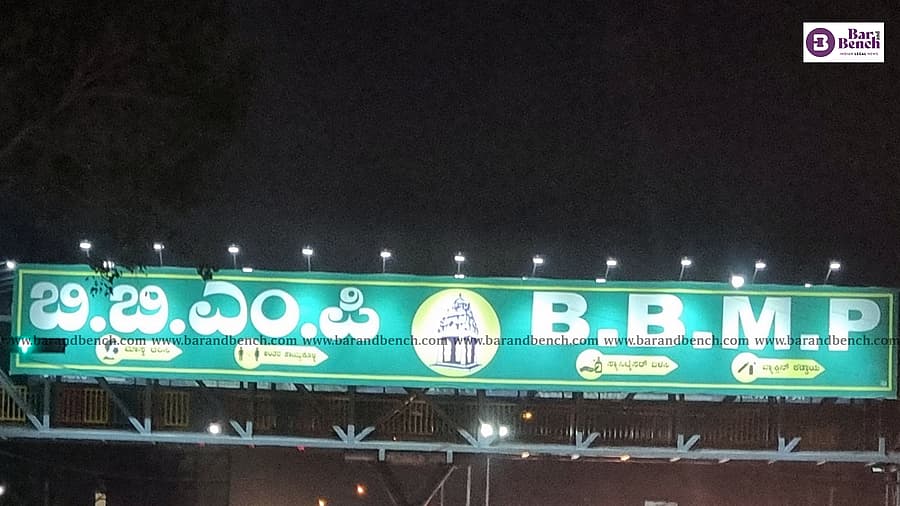
Karnataka High Court Asks BBMP for Status Report on Unauthorised LED Signboards Distracting Drivers
Summary
- The Karnataka High Court has directed the BBMP to submit a status report on curbing unauthorised advertisement hoardings in Bengaluru.
- This directive is part of a public interest litigation (Deeksha N Amruthesh v. Government of Karnataka) addressing flashy signboards that distract drivers.
- A previous court order from November 13, 2025, requiring this report was issued almost a year ago, yet new unauthorised advertisements have emerged.
- The status report pertains to the enforcement of Bye-Law 15 of the BBMP (Advertisement) Bye-Laws, 2024, which empowers the BBMP to remove unpermitted advertisements.
- Concerns were raised about commercial advertisements inside St Joseph's School and advertisers potentially paying lower taxes on self-advertisements.
Court Scrutiny on Bengaluru Signboards
The Karnataka High Court's sustained focus on this matter, particularly regarding Karnataka High Court BBMP LED signboards, signals a clear expectation for stricter adherence to the BBMP (Advertisement) Bye-Laws 2024 and a more proactive approach from the municipal body to ensure public safety and regulatory compliance in Bengaluru's advertising space.
The Karnataka High Court has recently compelled the Bruhat Bengaluru Mahanagara Palike (BBMP) to furnish a detailed status report regarding its efforts to control unauthorised advertisement hoardings throughout Bengaluru. This directive stems from an ongoing public interest litigation, titled Deeksha N Amruthesh v. Government of Karnataka, which seeks judicial intervention to address the proliferation of visually distracting signboards. The core concern highlighted in the petition is the potential for these flashy displays to divert drivers' attention, thereby increasing the risk of road accidents.
During a recent hearing, a Bench comprising Justices Anu Sivaraman and KS Bharath Kumar specifically questioned the BBMP on viable strategies for the safe placement of advertisements, ensuring they do not pose a hazard to traffic. Justice Sivaraman explicitly inquired about locations where such displays could be erected without compromising driver safety, suggesting that certain areas might be more suitable for advertising without creating distractions for motorists. This judicial inquiry underscores the court's focus on balancing commercial interests with public safety, particularly concerning the visual environment of the city's roads.
Regulatory Framework and Enforcement Gaps
The petitioner's counsel, Advocate Amruthesh NP, reminded the Court of a prior directive issued on November 13, 2025, which had instructed the BBMP to submit this very status report. Despite this order, which was issued almost a year prior to the current proceedings, the Court was informed that new advertising structures and erections have continued to appear across the city. This suggests a persistent challenge in enforcing existing regulations and controlling the spread of unauthorised signage.
The requested status report is crucial for assessing the implementation of Bye-Law 15 of the BBMP (Advertisement) Bye-Laws, 2024. This particular bye-law grants the BBMP explicit authority to dismantle or remove any advertisements that have been put up without the requisite official permission. The ongoing non-compliance, even after a specific judicial order and the existence of clear regulatory powers, highlights a significant gap in the enforcement mechanism for Bengaluru's advertising landscape.
Implications for Public Safety and Compliance
Beyond the general issue of traffic distraction, the advocate for the petitioner specifically drew the Court's attention to commercial advertisements erected within St Joseph's School, located on Vittal Mallya Road. This example illustrates the pervasive nature of unauthorised advertising, even in sensitive locations, and its potential impact on the urban environment. The continued presence of such structures, particularly those that are flashy or large, raises serious questions about the effectiveness of current oversight.
Furthermore, the counsel pointed out that advertisers might be benefiting from reduced tax liabilities by classifying certain displays as "self-advertisement," a practice that could circumvent higher taxation rates applicable to commercial advertising. This financial incentive potentially contributes to the proliferation of unauthorised displays. The Karnataka High Court's sustained focus on this matter, particularly regarding Karnataka High Court BBMP LED signboards, signals a clear expectation for stricter adherence to the BBMP (Advertisement) Bye-Laws 2024 and a more proactive approach from the municipal body to ensure public safety and regulatory compliance in Bengaluru's advertising space.
Practical Implications
Lawyers advising clients with physical advertising in Bengaluru should be aware of the Karnataka High Court's continued scrutiny over unauthorised LED signboards and hoardings. Compliance officers must ensure their signage adheres strictly to the BBMP (Advertisement) Bye-Laws, 2024, to mitigate risks of enforcement actions, fines, or removal, especially concerning traffic safety and distraction.
Source
How does this affect you?
Get an AI analysis of this article grounded in your jurisdictions, practice areas, and any policy documents you've uploaded to Wansom.
Finish Reading the Full Story and the Expert Analysis.
Get the latest legal & regulatory intelligence in India
Wansom is AI and can make mistakes.