
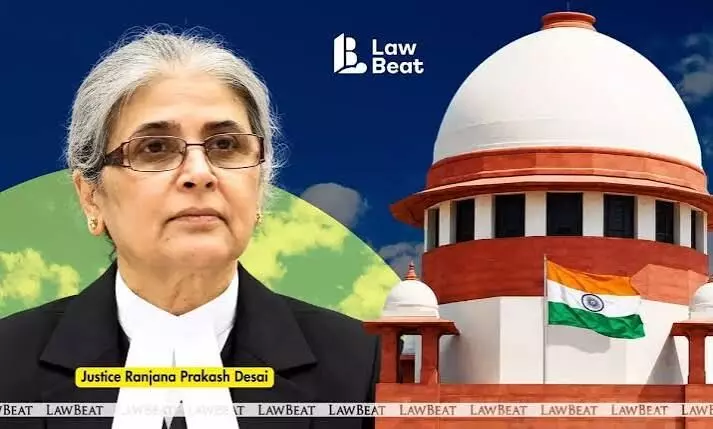
India Supreme Court Affirms Justice Ranjana Desai as Reliance KG Basin Mediator
Summary
- The Supreme Court appointed former Justice Ranjana Prakash Desai to mediate the $1.55 billion Krishna-Godavari basin gas dispute.
- The Union Government confirmed it has no objection to Justice Desai serving as the mediator.
- The Court requested the mediator to be assisted by two domain experts suggested by the parties.
- Reliance Industries' counsel, Kapil Sibal, objected to any proposed domain expert who previously handled this specific case in an official capacity.
- The parties are permitted to make written and oral presentations and will report on mediation progress in four weeks.
Supreme Court Endorses Key Mediator
Sibal articulated that any official who had previously engaged with the specifics of this particular case in their official capacity should be precluded from serving on the expert panel.
The Indian Supreme Court recently affirmed its selection of former Justice Ranjana Prakash Desai to mediate a significant $1.55 billion dispute concerning gas migration in the Krishna-Godavari (KG) basin. This development follows an earlier directive from the Court, issued on October 30, which formally requested Justice Desai to undertake the mediation role after the involved parties failed to reach an independent resolution. The bench, comprising Chief Justice Surya Kant, Justice Joymalya Bagchi, and Justice V Mohana, had initially proposed Justice Desai's involvement, noting the inability of the litigants to forge a viable settlement on their own.
A point of clarification arose when Attorney General R Venkataramani, representing the Union Government, addressed the Court. He confirmed that the government held no reservations regarding Justice Desai's appointment, dispelling any concerns she might have harbored about potential governmental objections. The Attorney General conveyed that the government had already communicated its full support to Justice Desai, emphasizing its commitment to cooperate with the mediation process. This assurance was critical, as the Court had previously recorded that Justice Desai's appointment had the mutual consent of all parties involved in the complex litigation.
Expert Selection and Conflict Concerns
Central to the Court's mediation framework is the provision for Justice Desai to receive assistance from two domain experts, whose nominations are to be put forward by the disputing parties. Senior Advocate Kapil Sibal, representing Reliance Industries Ltd (RIL), reiterated the necessity of these experts for the mediation panel. He highlighted that the government had proposed a former Petroleum Secretary as its chosen domain expert. While not objecting to the individual per se, Sibal raised a crucial point regarding impartiality.
Sibal articulated that any official who had previously engaged with the specifics of this particular case in their official capacity should be precluded from serving on the expert panel. This stance underscores a commitment to ensuring the neutrality and integrity of the mediation process, preventing any perception of bias stemming from prior involvement. The Attorney General subsequently provided assurances that this concern would be addressed, indicating a willingness to ensure that the selected experts meet the stringent criteria of impartiality. The Court has also granted permission for both written and oral submissions to be presented to the mediator.
The Krishna-Godavari Basin Dispute
The ongoing Krishna-Godavari basin gas migration dispute pits Reliance Industries Ltd, alongside its international partners BP and Niko, against the Union Government. This high-stakes conflict, valued at $1.55 billion, has been a protracted legal battle. The Supreme Court's decision to mandate mediation, with a formally endorsed mediator like Justice Ranjana Desai, signifies a strategic judicial intervention aimed at fostering an amicable resolution where direct negotiations have faltered.
The Court's proactive approach in facilitating a mediated settlement, coupled with its emphasis on carefully selected, impartial domain experts, reflects a broader judicial interest in resolving complex natural resource disputes efficiently. The parties are expected to report back to the Court on the progress of the mediation within four weeks, marking a critical juncture for the potential settlement of this significant energy sector disagreement.
Practical Implications
Lawyers advising clients in complex, high-stakes disputes, particularly those involving natural resources and government entities, should note the Supreme Court's emphasis on mediation with a formally endorsed mediator. This case highlights the importance of carefully vetting proposed domain experts for potential conflicts of interest based on prior involvement, which is a critical consideration for ensuring the impartiality and integrity of the mediation process.
Source
How does this affect you?
Get an AI analysis of this article grounded in your jurisdictions, practice areas, and any policy documents you've uploaded to Wansom.
Finish Reading the Full Story and the Expert Analysis.
Get the latest legal & regulatory intelligence in India
Wansom is AI and can make mistakes.