
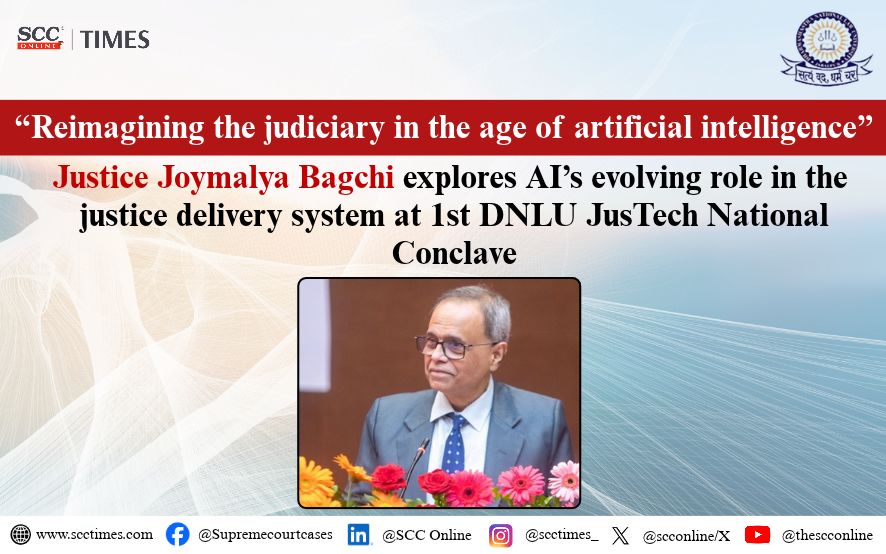
Justice Joymalya Bagchi: AI Judiciary Can Reduce Pendency
Summary
- Justice Joymalya Bagchi spoke at the 1st DNLU JusTech National Conclave on artificial intelligence in the judiciary.
- His address was titled "Reimagining the Judiciary in the Age of Artificial Intelligence: Balancing Algorithmic Efficiency with Human Conscience."
- Justice Bagchi explored AI's evolving role in the justice delivery system.
- He highlighted AI's potential to address judicial pendency and streamline case management.
- He also noted AI's capacity to assist in routine adjudication processes.
Judicial Insights on AI Integration
The very title of Justice Bagchi's address, "Reimagining the Judiciary in the Age of Artificial Intelligence: Balancing Algorithmic Efficiency with Human Conscience," encapsulates the central challenge and opportunity presented by AI.
Justice Joymalya Bagchi recently delivered a significant address at the inaugural DNLU JusTech National Conclave, focusing on the transformative potential of artificial intelligence within the Indian justice system. His presentation, titled "Reimagining the Judiciary in the Age of Artificial Intelligence: Balancing Algorithmic Efficiency with Human Conscience," explored the evolving role that AI could play in modernizing judicial processes and enhancing the delivery of justice.
During his remarks, Justice Bagchi delved into how AI technologies might be leveraged to tackle some of the most persistent challenges facing the judiciary today. His participation in the 1st DNLU JusTech National Conclave underscores a growing interest among legal luminaries in understanding and harnessing technological advancements for systemic improvement. The discussion centered on practical applications and the broader philosophical considerations of integrating advanced algorithms into a human-centric legal framework.
Addressing Systemic Challenges with Technology
A core theme of Justice Bagchi's address was the capacity of artificial intelligence to significantly mitigate judicial pendency, a long-standing issue that contributes to delays in the justice delivery system. By automating certain tasks and providing analytical support, AI could help reduce the backlog of cases, thereby accelerating the resolution process for litigants across the country. This potential for increased efficiency represents a crucial area where AI legal tech India could make a substantial impact.
Furthermore, Justice Bagchi highlighted AI's utility in streamlining case management. This involves optimizing workflows, organizing vast amounts of legal data, and improving the administrative aspects of judicial proceedings. Such advancements could lead to more organized dockets, quicker access to relevant information for judges and lawyers, and an overall more efficient operational environment within courts. The integration of AI in Indian justice system is envisioned as a tool to enhance, rather than replace, human judgment.
AI's Role in Routine Adjudication
Beyond case management and pendency reduction, Justice Bagchi also pointed to AI's potential to assist in routine adjudication. This suggests that AI tools could be developed to support judges in handling less complex or repetitive aspects of legal decision-making, freeing up judicial time for more intricate and nuanced cases. While the specifics of such assistance were not detailed, the implication is that AI could provide preliminary analyses, identify relevant precedents, or even draft standard orders, all under human oversight.
The concept of artificial intelligence judicial pendency reduction through assistance in routine tasks is a forward-looking approach that acknowledges the immense workload on the judiciary. By offloading some of the more mechanical aspects of legal work to AI, the focus can shift towards the critical human elements of justice, such as ethical considerations, interpretation of complex facts, and the application of discretion.
Balancing Efficiency and Human Conscience
The very title of Justice Bagchi's address, "Reimagining the Judiciary in the Age of Artificial Intelligence: Balancing Algorithmic Efficiency with Human Conscience," encapsulates the central challenge and opportunity presented by AI. It acknowledges the undeniable benefits of algorithmic efficiency in processing information and managing cases, while simultaneously emphasizing the irreplaceable role of human judgment, ethics, and empathy in the administration of justice. This balance is paramount to ensure that technological advancements serve to augment, rather than diminish, the fundamental principles of fairness and equity.
This thoughtful framing suggests that the future integration of AI in the Indian justice system will not merely be a technical exercise but will also involve profound ethical and philosophical considerations. The discussions initiated at events like the DNLU JusTech National Conclave are vital for shaping a future where AI tools enhance the justice delivery system without compromising the human element that is intrinsic to judicial integrity.
Practical Implications
Lawyers and compliance officers should monitor the ongoing discussions and potential future integration of AI tools within the Indian judiciary, as these developments could significantly impact case management, legal research, and the efficiency of the justice delivery system, necessitating adaptation in legal strategies and practice.
Source
Source: Original reporting via SCC Times
How does this affect you?
Get an AI analysis of this article grounded in your jurisdictions, practice areas, and any policy documents you've uploaded to Wansom.
Finish Reading the Full Story and the Expert Analysis.
Get the latest legal & regulatory intelligence in India
Wansom is AI and can make mistakes.