
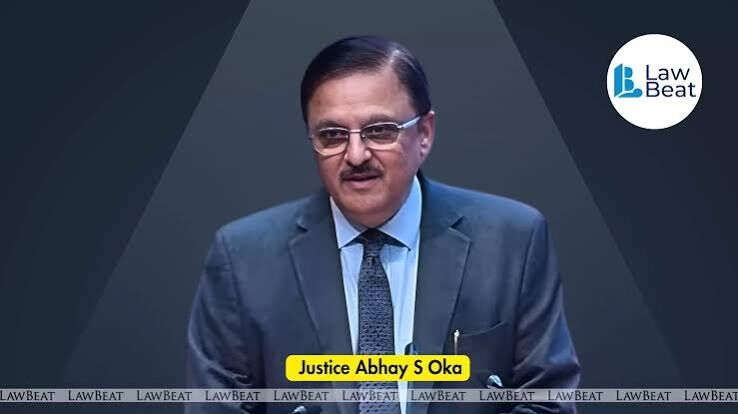
Justice Abhay Oka: Collegium Must Assert on Pending Recommendations, Questions SC Roster
Summary
- Former Supreme Court Justice Abhay S. Oka delivered a keynote address at a CJAR panel on judicial accountability.
- Justice Oka defended the Collegium system but urged it to question the government on pending recommendations.
- He criticized the Supreme Court's roster system, describing it as 'too CJI-centric,' and questioned case listing practices.
- Justice Oka called for the higher judiciary to stop directing time-bound disposal of cases by trial courts.
Justice Oka's Critical Assessment
Justice Abhay S. Oka emphasized that the Collegium must actively engage with the government by posing direct questions regarding the status of its recommendations.
During a recent keynote address at a panel organized by the Campaign for Judicial Accountability and Reforms (CJAR), former Supreme Court Justice Abhay S. Oka offered a comprehensive critique of several aspects of India's judicial system. The event, which focused on the crucial topic of judicial accountability, provided a platform for Justice Oka to share his insights and raise significant questions regarding the operational mechanisms of the higher judiciary.
Justice Oka's remarks touched upon the functioning of the Collegium system, the management of the Supreme Court's case roster, and the directives issued to lower courts. His address underscored a need for greater transparency and efficiency within the judicial framework, sparking further discussion on the systemic challenges facing the Indian judiciary. His observations are particularly noteworthy given his extensive experience on the bench, offering an insider's perspective on these critical issues.
Collegium and Roster Under Scrutiny
A central theme of Justice Oka's address was his staunch defense of the Collegium system, which is responsible for judicial appointments. However, he coupled this defense with a strong call for the Collegium to adopt a more assertive stance. Justice Oka emphasized that the Collegium must actively engage with the government by posing direct questions regarding the status of its recommendations, particularly those that have been left pending for extended periods.
Beyond appointments, Justice Oka also turned his attention to the internal workings of the Supreme Court, specifically criticizing its roster management. He characterized the Supreme Court's roster system as being excessively centered around the Chief Justice of India, raising questions about its operational fairness and potential for bias. Furthermore, he questioned the rationale behind the listing of matters, particularly in instances where multiple benches were assigned to hear the same categories of cases, suggesting a potential for inefficiency or lack of clear allocation.
Implications for Judicial Efficiency
Justice Oka extended his critique to the directives often issued by the higher judiciary to trial courts. He urged the superior courts to discontinue the practice of mandating time-bound disposal of cases by lower judicial bodies. This particular point highlights a broader concern about the pressures placed on trial courts and the potential impact on the quality of justice when speed is prioritized over thoroughness.
These observations from a former Supreme Court judge contribute significantly to the ongoing discourse surrounding judicial independence, accountability, and the overall efficiency of the justice delivery system in India. His insights underscore the need for continuous evaluation and reform within the judiciary to ensure that it remains robust, transparent, and equitable for all litigants. The points raised by Justice Oka are integral to understanding the current challenges and future directions for judicial administration.
Practical Implications
Lawyers should monitor the ongoing discourse on judicial appointments and the Supreme Court's internal roster management, as these discussions reflect broader concerns about judicial independence and efficiency. Awareness of these systemic issues can inform expectations regarding case listing, judicial capacity, and the overall pace of justice delivery, which may be relevant when advising clients on litigation timelines or judicial process.
Source
Source: Original reporting via Live Law
How does this affect you?
Get an AI analysis of this article grounded in your jurisdictions, practice areas, and any policy documents you've uploaded to Wansom.
Finish Reading the Full Story and the Expert Analysis.
Wansom is AI and can make mistakes.