
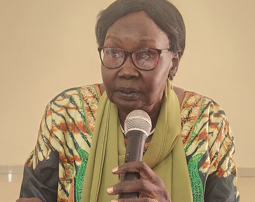
Julia Duany: South Sudan Weak Institutions Hinder State-Building
Summary
- Professor Julia Duany, head of the South Sudan Civil Service Commission, states the nation has not built functioning state institutions since independence.
- She highlights weak public administration, exemplified by her own commission lacking an office, and a failure to implement existing laws.
- Duany argues that effective state-building requires stability, robust laws, and responsible resource management, not the 'liberation mindset' previously applied.
- Despite significant human resources, the country struggles to deliver basic services and faces profound governance issues due to institutional incapacity.
- She calls for renewed focus on institutional capacity, active citizen involvement, and stronger government-civil society cooperation to address these challenges.
South Sudan's Institutional Deficit
The problem, she clarified, stems not from an absence of legislation, but from the profound inability of existing institutions to implement the legal and regulatory environment already in place.
Professor Julia Aker Duany, who chairs the South Sudan Civil Service Commission, recently delivered a stark assessment of the nation's post-independence development, asserting that the country has yet to establish functioning state institutions. Speaking at a panel discussion organized by the South Sudan Human Rights Defenders Network (HRDN) in Juba on Tuesday, Professor Duany questioned whether genuine state-building efforts had even commenced since independence, concluding unequivocally that a functional state has not been built.
Her remarks underscored a critical challenge: the country's public administration is profoundly weak, hindering its capacity to govern effectively and provide essential services to its populace. Professor Duany attributed this ongoing struggle to an initial misapplication of a 'liberation mindset' and its associated tools to the complex process of state-building, despite significant resources being available around 2005. She emphasized that constructing a viable state demands a distinct set of instruments, including stability, security, robust legal frameworks, responsible management of national resources, socioeconomic development, and social justice.
Manifestations of Weak Governance
The failure to establish effective institutions is glaringly evident in the condition of South Sudan's public administration, which Professor Duany characterized as among the weakest in the region. She highlighted that many public institutions and commissions, including her own Civil Service Commission, lack even basic operational facilities, such as an office. This fundamental deficiency severely impedes their ability to function and fulfill their mandates, contributing significantly to South Sudan public administration challenges.
Beyond administrative shortcomings, the country faces severe South Sudan governance issues, struggling to deliver basic services across vital sectors like education, healthcare, clean water, infrastructure, food security, and rural development. Professor Duany clarified that the core problem is not an absence of laws, but rather the profound inability of existing institutions to implement the legal and regulatory environment already in place. This institutional incapacity creates significant legal and regulatory uncertainty for any entity operating within the country.
A Path Towards State-Building Progress
Despite her pointed criticisms regarding the current state of affairs, Professor Duany maintained that South Sudan possesses considerable human resources, including a large number of individuals with advanced academic qualifications, whose potential remains largely untapped. She urged the nation to leverage this existing knowledge and internal resources to address its challenges, rather than passively awaiting external solutions. To foster genuine South Sudan state-building progress, she advocated for drawing lessons from other countries while adapting those experiences to South Sudan's unique traditions and circumstances.
Professor Duany stressed the imperative for citizens to actively participate in strengthening institutions, rather than solely relying on the government. She called for enhanced cooperation between governmental bodies and civil society, urging them to view each other as partners, not adversaries. She emphasized that government institutions should be receptive to credible information and concerns raised by civil society organizations and journalists, acting swiftly to rectify identified problems. This collaborative flow of information, she argued, is crucial for robust governance, offering a vital opportunity for South Sudan to change its course and overcome its challenges.
Practical Implications
Lawyers and compliance officers advising on South Sudan operations must account for significant legal and regulatory uncertainty and enforcement risks due to the acknowledged weakness of state institutions. This necessitates heightened due diligence and robust risk mitigation strategies for clients operating or considering investment in the country.
Source
How does this affect you?
Get an AI analysis of this article grounded in your jurisdictions, practice areas, and any policy documents you've uploaded to Wansom.
Finish Reading the Full Story and the Expert Analysis.
Wansom is AI and can make mistakes.