
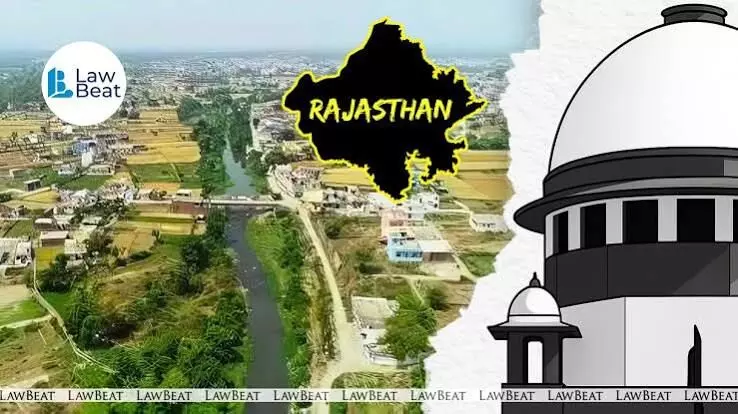
Supreme Court: Rajasthan Faces Contempt Over Jojari River Pollution
Summary
- The Supreme Court strongly criticized the Rajasthan government for its "absolutely lethargic" response to pollution in the Jojari, Bandi, and Luni rivers.
- The Court warned it could initiate suo motu contempt proceedings against state officials if tangible improvements are not made.
- This judicial intervention stems from the ongoing case, "In Re: 2 Million Lives at Risk, Contamination in Jojari River, Rajasthan," which has seen multiple directives issued since November 2025.
- Key issues include illegal bajri mining, industrial pollution, and a severe drinking water shortage in areas like Balotra.
- The Court emphasized that officers would face consequences if a clear plan for positive action is not presented by the next hearing on December 10.
Supreme Court Issues Stern Warning to Rajasthan
The threat of suo motu contempt proceedings against Rajasthan officials signals a direct and severe consequence for perceived 'lethargy'.
The Supreme Court of India has delivered a sharp rebuke to the Rajasthan government, characterizing its response to the severe pollution affecting the Jojari, Bandi, and Luni rivers as "absolutely lethargic." During a recent hearing, the apex court issued a stark warning, indicating its readiness to initiate suo motu contempt proceedings against state officials if concrete actions are not taken to address the environmental degradation.
The Bench, comprising Justice Vikram Nath and Justice Sandeep Mehta, made these strong observations while presiding over the suo motu case titled "In Re: 2 Million Lives at Risk, Contamination in Jojari River, Rajasthan." Addressing Additional Solicitor General (ASG) SV Raju, who represented the State, the Court urged him to advise the government to implement ground-level solutions rather than face judicial wrath. The justices explicitly stated their unwillingness to allow bureaucratic delays or red-tapism to impede progress, vowing to take drastic measures to compel authorities to act. The matter is scheduled for further orders on December 10.
History of Judicial Directives
The Supreme Court's scrutiny of environmental compliance in Rajasthan, particularly concerning the Luni, Jojari, and Bandi rivers, has a significant history of directives. In November 2025, the Court established a High-Level Ecosystem Oversight Committee, tasked with identifying the root causes of pollution, supervising remedial measures, and proposing long-term solutions to reverse the damage. This was followed by an August 2026 directive for the State to form an Integrated Coordination Group (ICG), to be headed by the Chief Secretary, to collaborate with the oversight committee on an integrated, coordinated, and time-bound implementation framework.
Further judicial intervention occurred on October 26, 2026, when the Court prohibited the State from authorizing any new industrial units along or near the riverine ecosystem until the high flood line and buffer zones were scientifically determined. This order also mandated a Special Investigation Team (SIT) probe into illegal bajri mining. Earlier, on September 29, 2026, the Court had reviewed reports from both the High-Level Ecosystem Oversight Committee and the State, noting that despite previous directions, numerous concerns remained unaddressed, necessitating a proactive approach.
Persistent Environmental Challenges and State's Response
Senior Advocate Balbir Singh, assisting the Court as amicus curiae, reiterated the State's "absolutely lethargic" response, referencing the October 26, 2026 order. The amicus informed the Bench that, in compliance with that directive, the State had indeed formed a special investigation team to investigate organized illegal bajri mining impacting the Luni, Jojari, and Bandi rivers and their tributaries, and that some First Information Reports (FIRs) had been registered as per a status report. However, the Court remained unconvinced by the outlined steps.
The Bench cautioned ASG Raju that if a "positive action and positive blueprint" were not presented, not only would officers suffer, but it would also reflect poorly on the government as a whole. Beyond the pollution, the Court also highlighted the critical shortage of drinking water in Balotra, questioning why a pipeline of approximately 100 kilometers from the Narmada canal could not be established to provide water to the millions residing in the area. The Jojari river traverses Jodhpur, the Bandi flows through Pali, and the Luni passes through Balotra, with the Bandi and Jojari converging with the Luni near Balotra city.
Why It Matters
The Supreme Court's forceful stance on Jojari River pollution and the broader environmental degradation across Rajasthan signifies a critical moment for environmental compliance in India. The explicit threat of suo motu contempt against Rajasthan officials for perceived "lethargy" underscores the judiciary's heightened intolerance for governmental inaction and bureaucratic hurdles in addressing ecological crises. This warning extends beyond individual officers, indicating that the entire state administration could face severe repercussions if tangible progress is not demonstrated.
This development, stemming from the significant case "In Re: 2 Million Lives at Risk, Contamination in Jojari River, Rajasthan," highlights the immense public health and environmental stakes involved. The Court's insistence on a "positive action and positive blueprint" for addressing issues like illegal bajri mining and industrial pollution, alongside the acute drinking water scarcity, sets a clear precedent. It signals that judicial oversight will continue to be rigorous, demanding proactive and demonstrable efforts from state authorities to ensure environmental protection and the well-being of its citizens.
Practical Implications
Lawyers advising government entities or industries operating in Rajasthan, particularly near the Jojari, Bandi, and Luni rivers, must immediately assess their clients' environmental compliance and responsiveness to court directives. The Supreme Court's warning of suo motu contempt against officials signals a heightened risk of direct judicial action for perceived 'lethargy' in addressing environmental pollution, necessitating proactive and demonstrable compliance efforts to avoid severe penalties and reputational damage.
Source
How does this affect you?
Get an AI analysis of this article grounded in your jurisdictions, practice areas, and any policy documents you've uploaded to Wansom.
Finish Reading the Full Story and the Expert Analysis.
Get the latest legal & regulatory intelligence in India
Wansom is AI and can make mistakes.