
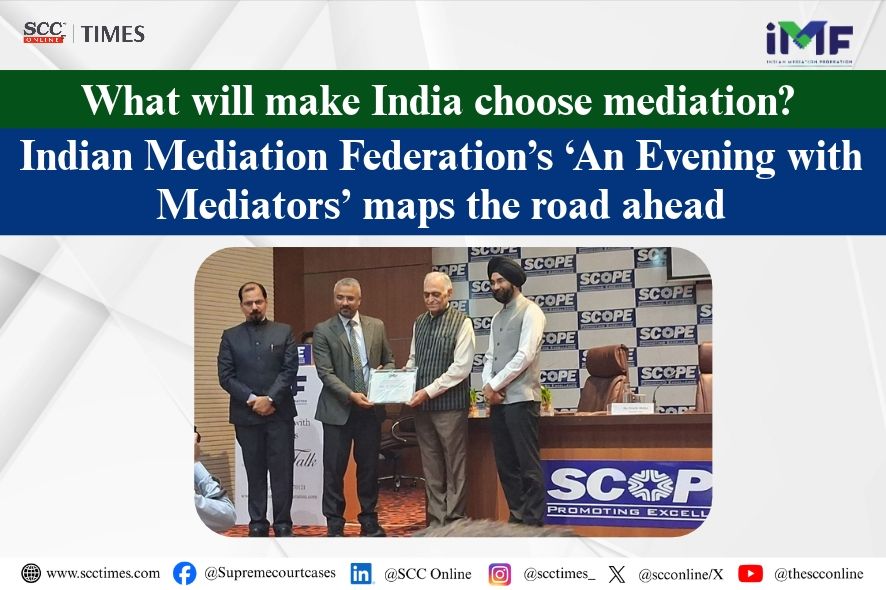
Indian Mediation Federation: Charting Future of Mediation Ecosystem
Summary
- The Indian Mediation Federation's 'An Evening with Mediators' event focused on advancing India's dispute resolution landscape.
- The gathering stressed the need to build a credible, trusted, and accessible mediation ecosystem.
- It highlighted moving beyond mere legislative recognition to foster a more robust system.
- The future of dispute resolution in India will be shaped by public confidence, institutional strength, and professional competence.
What Happened
The core message underscored the imperative to cultivate a mediation environment characterized by credibility, widespread trust, and ease of access for all stakeholders.
The Indian Mediation Federation recently hosted ‘An Evening with Mediators,’ an event designed to critically assess the trajectory of dispute resolution within the nation. This gathering served as a pivotal platform to articulate a forward-looking vision for the Indian mediation ecosystem, emphasizing that its development must extend beyond mere legislative acknowledgment. The core message underscored the imperative to cultivate a mediation environment characterized by credibility, widespread trust, and ease of access for all stakeholders.
The discussions at the event highlighted a collective understanding that while legislative recognition provides a foundational framework, it is insufficient on its own to fully realize the potential of mediation in India. Instead, the focus must shift towards practical implementation and the establishment of an operational ecosystem that genuinely serves the needs of the populace. This strategic pivot is essential for fostering a robust and effective alternative dispute resolution mechanism across the country.
The Path Forward for Dispute Resolution
Participants at ‘An Evening with Mediators’ articulated a clear roadmap for the future of India dispute resolution mediation, advocating for a system that actively earns and maintains public confidence. This involves a concerted effort to build an infrastructure where mediation is not just an option, but a preferred and reliable method for resolving conflicts. The emphasis on moving beyond simple legislative recognition for mediation in India signals a mature approach to its integration into the national legal fabric.
Developing a truly credible and trusted mediation ecosystem necessitates a multi-faceted strategy. It requires ensuring that the processes are transparent, fair, and consistently deliver equitable outcomes, thereby encouraging greater adoption by individuals and corporations alike. Accessibility is also paramount, meaning that mediation services must be readily available and understandable to a diverse population, irrespective of their socio-economic background or geographical location. This comprehensive approach is vital for the continued Indian mediation ecosystem development.
Pillars of a Strong Mediation Ecosystem
The future of dispute resolution in India, particularly concerning the Indian Mediation Federation ecosystem future, is envisioned to be shaped by three critical pillars: public confidence, institutional strength, and professional competence. Cultivating public confidence is fundamental, as it directly influences the willingness of parties to engage in mediation and abide by its outcomes. This trust is built through consistent positive experiences and a clear understanding of mediation's benefits.
Simultaneously, the development of robust institutional strength is crucial. This refers to the establishment of well-governed, efficient, and ethical mediation institutions that can support and regulate the practice effectively. These institutions play a vital role in setting standards, providing resources, and ensuring the integrity of the mediation process. Finally, professional competence among mediators is non-negotiable. This encompasses rigorous training, adherence to ethical guidelines, and continuous professional development, ensuring that mediators possess the necessary skills and impartiality to guide parties towards constructive resolutions. These combined elements are seen as indispensable for the evolution and widespread acceptance of mediation as a primary tool for conflict resolution in India.
Practical Implications
Lawyers and compliance officers in India should anticipate a strategic shift towards a more robust and trusted mediation ecosystem. This necessitates staying abreast of evolving mediation standards and institutional developments to effectively advise clients on dispute resolution strategies and leverage mediation as a primary tool for conflict resolution.
Source
Source: Original reporting via SCC Times
How does this affect you?
Get an AI analysis of this article grounded in your jurisdictions, practice areas, and any policy documents you've uploaded to Wansom.
Wansom is AI and can make mistakes.