
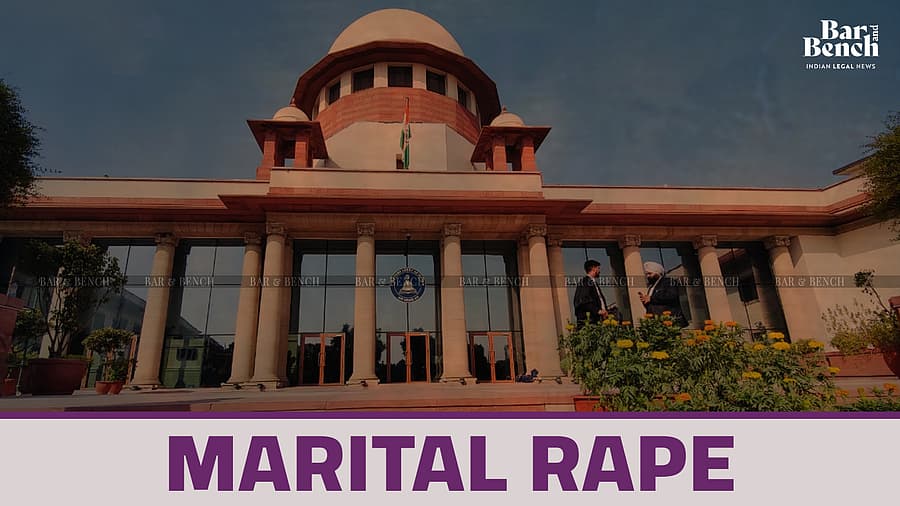
India Supreme Court: Marital Rape Hearing Date Not Postponed, Govt Arguments First
Summary
- The Supreme Court refused to immediately defer the hearing on petitions challenging the marital rape exception.
- A bench led by Chief Justice of India Surya Kant will hear the Union government on September 9 before setting a final argument date.
- The batch of eight petitions primarily stems from a May 2022 Delhi High Court split verdict on the marital rape exception, now codified as part of Section 63 of the Bharatiya Nyaya Sanhita (BNS), 2023 (formerly Exception 2 to Section 375 of the Indian Penal Code (IPC)).
- One Delhi High Court judge found the exception unconstitutional, while another upheld it based on legislative classification.
- Other cases include an appeal against a Karnataka High Court ruling that declined to quash marital rape charges against a husband.
Supreme Court Sets Stage for Marital Rape Hearing Date
The Supreme Court's eventual decision on the India Supreme Court marital rape hearing date and the subsequent judgment will have far-reaching implications for the legal framework governing sexual autonomy and marital rights in the country.
India's Supreme Court recently declined an immediate request to postpone the hearing of a series of petitions challenging the marital rape exception. The Court explicitly rejected a plea to defer the proceedings until November, signaling its intent to move forward with the significant legal matter. A distinguished bench, comprising Chief Justice of India Surya Kant, Justice Joymalya Bagchi, and Justice V Mohana, announced that it would first hear arguments from the Union government on Wednesday, September 9. This crucial step will precede the final determination of a date for the comprehensive arguments in the case, which addresses the constitutional validity of the marital rape exception.
Senior Advocate Indira Jaising brought the matter to the Court's attention, highlighting that the consolidated batch of cases includes eight distinct petitions. These matters are collectively listed as Item 108 on the September 9 roster, underscoring the Court's commitment to addressing this complex legal issue. The Court's decision not to delay the process further indicates the urgency and importance it attaches to the ongoing legal debate surrounding spousal sexual assault within the existing legal framework.
The Genesis of the Legal Challenge
The current proceedings before the Supreme Court largely originate from a pivotal split verdict delivered by the Delhi High Court in May 2022. In that landmark decision, Justice Rajiv Shakdher concluded that the marital rape exception, now codified as part of Section 63 of the Bharatiya Nyaya Sanhita (BNS), 2023 (formerly Exception 2 to Section 375 of the Indian Penal Code (IPC)), was unconstitutional. This exception effectively shields a husband from charges of non-consensual sexual acts against his adult wife, a provision that has long been a subject of intense legal and social scrutiny. Conversely, Justice C Hari Shankar, in the same Delhi High Court ruling, upheld the exception, arguing that the legislature's classification was based on an 'intelligible differentia,' thereby justifying its continued existence.
Beyond the Delhi High Court's divergent opinions, the Supreme Court's consolidated batch of petitions also includes other significant appeals. Among these is a challenge against a ruling by the Karnataka High Court, which had previously refused to quash marital rape charges framed against a husband under Section 376 IPC. This particular appeal further broadens the scope of the Supreme Court's review, encompassing various facets of how marital sexual assault is addressed under Indian law. Four of the eight matters listed before the Supreme Court arise from a direct reference, indicating the profound legal questions at stake.
Constitutional Validity and Broader Implications
At the heart of the ongoing legal battle is the fundamental question of the constitutional validity of the marital rape exception under Section 63 BNS, 2023 (formerly Section 375 IPC). This provision, specifically the marital rape exception, has been a contentious point, as it differentiates between sexual assault committed by a husband against his wife and other forms of rape, effectively decriminalizing non-consensual sexual acts within marriage. The challenge posits that this exception violates fundamental rights, including equality and dignity, guaranteed under the Indian Constitution.
The Supreme Court's eventual decision on the India Supreme Court marital rape hearing date and the subsequent judgment will have far-reaching implications for the legal framework governing sexual autonomy and marital rights in the country. The challenge to the marital rape exception under Section 63 BNS, 2023 (formerly Section 375 IPC Exception 2) directly confronts a long-standing legal anomaly, and the outcome will redefine protections against spousal sexual assault. The `CJI Surya Kant marital rape case` is poised to be a landmark ruling, potentially reshaping the `India marital rape law constitutional validity` and impacting how `marital rape charges` are handled across various High Courts, including those stemming from the `Delhi High Court marital rape split verdict` and the `Karnataka High Court marital rape charges`.
Practical Implications
Lawyers practicing family law, criminal law, or constitutional law in India should closely monitor the Supreme Court's decision on the hearing date for the marital rape exception, as the outcome will significantly impact the legal framework for spousal sexual assault and potentially redefine marital rights and protections.
Source
How does this affect you?
Get an AI analysis of this article grounded in your jurisdictions, practice areas, and any policy documents you've uploaded to Wansom.
Finish Reading the Full Story and the Expert Analysis.
Wansom is AI and can make mistakes.