
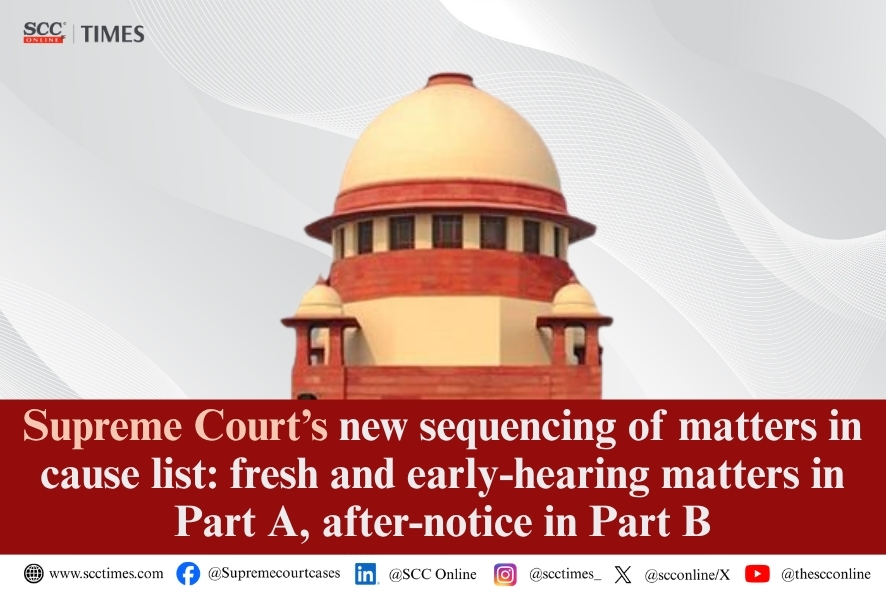
India Supreme Court: Bifurcates Cause List into Part A, Part B
Summary
- The Supreme Court of India has implemented a new two-part cause list arrangement.
- Part A of the cause list will feature fresh and early-hearing matters.
- Part B is designated for cases that have already received notice.
- The previous practice of assigning a sequence to matters at 10:30 a.m. has been discontinued, effective with the new system formalized on October 9, 2026.
- The Supreme Court Bar Association (SCBA) informed the legal community about these changes.
Significant Procedural Update
The clear distinction between Supreme Court India fresh matters Part A and Supreme Court India after-notice matters Part B, formalized by a circular on October 9, 2026, replaces the former method of sequencing, which involved assigning a specific order to cases at 10:30 a.m. each day.
The Supreme Court of India has introduced a notable modification to its daily cause list arrangement, a change that will directly impact how cases are scheduled and tracked. This revised system, communicated by the Supreme Court Bar Association (SCBA), marks a departure from previous practices, aiming to streamline the presentation of matters before the court.
Under the new framework, the India Supreme Court cause list will now be bifurcated into two distinct segments: Part A and Part B. This structural alteration is designed to categorize cases based on their procedural status, providing a clearer overview for legal practitioners and litigants alike. The implementation of this two-part system is a key development in the court's administrative procedures.
New Cause List Structure Explained
The newly instituted Part A of the India Supreme Court cause list is specifically designated for fresh matters and those requiring an early hearing. This means that cases appearing for the first time or those prioritized for expedited consideration will be grouped together under this section. This arrangement for Supreme Court India fresh matters Part A aims to ensure that new filings and urgent applications receive prompt attention within the court's daily schedule.
Conversely, Part B of the cause list will encompass matters that have already received notice. These are cases where the initial procedural steps have been completed, and parties have been formally informed. This clear distinction between Supreme Court India fresh matters Part A and Supreme Court India after-notice matters Part B, formalized by a circular on October 9, 2026, replaces the former method of sequencing, which involved assigning a specific order to cases at 10:30 a.m. each day. The implementation of this two-part system effectively discontinues the previous 10:30 a.m. sequencing practice, addressing long-standing concerns from the legal fraternity. This is a fundamental aspect of these Supreme Court of India procedural changes.
Implications for Legal Practitioners
The shift to a two-part India Supreme Court cause list carries significant implications for lawyers practicing before the apex court. With the previous practice of sequencing matters at 10:30 a.m. now abolished, legal professionals must adapt their case monitoring and preparation strategies. The clear division into Part A for fresh and early-hearing matters and Part B for after-notice matters necessitates a thorough understanding of the new cause list sequencing India.
This revised arrangement underscores the importance for advocates to meticulously review the daily cause list to identify their cases within the appropriate section. Failure to correctly track cases under the new Part A and Part B structure could lead to missed appearances or inadequate preparation. The SCBA's announcement serves as a crucial alert to the legal fraternity, highlighting the need to be fully conversant with these procedural adjustments to ensure effective representation and efficient management of court proceedings.
Practical Implications
Lawyers practicing before the Supreme Court of India must be aware of the new two-part cause list structure (Part A for fresh/early-hearing matters, Part B for after-notice matters) to accurately track and prepare for their cases, as the previous 10:30 a.m. sequencing practice has been discontinued. This directly impacts case monitoring and scheduling.
Source
Source: Original reporting via SCC Times
How does this affect you?
Get an AI analysis of this article grounded in your jurisdictions, practice areas, and any policy documents you've uploaded to Wansom.
Finish Reading the Full Story and the Expert Analysis.
Get the latest legal & regulatory intelligence in India
Wansom is AI and can make mistakes.