
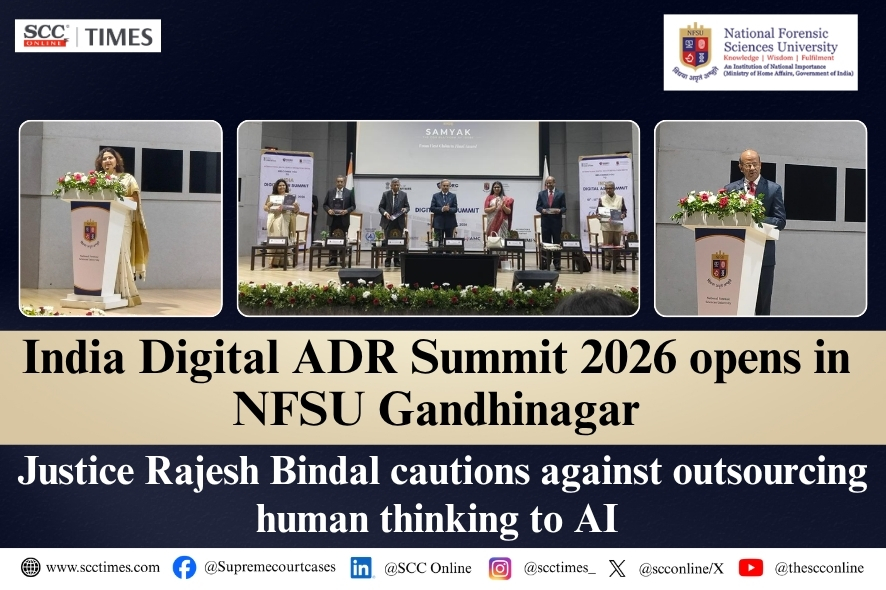
India Digital ADR Summit 2026 AI: Justice Bindal Cautions on Over-Reliance
Summary
- The India Digital ADR Summit 2026 commenced at NFSU Gandhinagar, featuring the launch of IDRC's new ODR platform, SAMYAK.
- Retired Supreme Court Justice Rajesh Bindal, now an Honorary Distinguished Jurist at Galgotias University, cautioned against over-reliance on artificial intelligence, specifically regarding the outsourcing of human thought processes.
- Professor Purvi Pokhariyal of NFSU outlined plans to fully digitize dispute resolution from initial filing through to the final award.
- The summit highlights India's accelerating trend towards digital arbitration and the careful integration of AI in legal processes.
Digital ADR Summit Kicks Off in Gandhinagar
Retired Supreme Court Justice Rajesh Bindal's AI caution injects a necessary note of prudence, urging stakeholders to balance innovation with ethical considerations and the preservation of human intellect in decision-making.
The India Digital ADR Summit 2026 officially commenced its proceedings at the National Forensic Sciences University (NFSU) in Gandhinagar, marking a significant event for the advancement of digital dispute resolution within the country. The inaugural ceremony was distinguished by a traditional lamp-lighting ritual, symbolizing the initiation of new endeavors in the digital legal sphere.
A pivotal moment during the opening was the official unveiling of SAMYAK, a cutting-edge Online Dispute Resolution (ODR) platform developed by the Indian Dispute Resolution Centre (IDRC). This new platform's introduction represents a concrete stride towards enhancing digital arbitration in India 2026 and beyond, aiming to modernize and streamline legal processes.
Judicial Caution on AI Integration
During the summit's opening address, Retired Supreme Court Justice Rajesh Bindal, now an Honorary Distinguished Jurist at Galgotias University, delivered a crucial message, offering a cautionary perspective on the increasing integration of artificial intelligence within legal frameworks. His remarks specifically highlighted the potential risks associated with an over-reliance on AI, particularly warning against the outsourcing of fundamental human cognitive processes to automated systems.
This intervention by Retired Supreme Court Justice Rajesh Bindal, emphasizing AI caution, serves as a vital reminder for both legal professionals and technology developers to critically assess the ethical implications and practical boundaries of AI in Indian dispute resolution. The judge's emphasis underscores the ongoing debate about the necessity of maintaining human oversight and judgment, even as technological advancements continue to accelerate.
NFSU's Vision for Digital Transformation
Professor Purvi Pokhariyal, a prominent figure at NFSU Gandhinagar, articulated the institution's ambitious plans for the comprehensive digitalization of dispute resolution processes. Her vision encompasses transforming the entire lifecycle of a dispute, from the initial filing of a case to the issuance of the final award, into a fully digital operation.
This strategic move by NFSU aims to significantly streamline legal proceedings, enhance accessibility to justice, and improve overall efficiency within the judicial system. The development of the NFSU Gandhinagar ODR platform, alongside the introduction of SAMYAK IDRC ODR, represents a concerted effort to leverage technology for more effective and accessible justice delivery, aligning with the broader goals discussed at the India Digital ADR Summit 2026 AI sessions.
Implications for India's Legal Future
The convergence of these initiatives at the India Digital ADR Summit 2026 underscores a pivotal moment for the evolution of legal practice across the nation. The launch of advanced ODR platforms and the strategic commitment to digitize dispute resolution processes reflect a growing national imperative to modernize the justice system and embrace technological innovation.
While the embrace of technology promises greater efficiency and access, Retired Supreme Court Justice Rajesh Bindal's AI caution injects a necessary note of prudence, urging stakeholders to balance innovation with ethical considerations and the preservation of human intellect in decision-making. The discussions and developments emerging from this summit are poised to significantly influence the trajectory of AI in Indian dispute resolution, shaping how legal professionals, arbitrators, and litigants interact with the justice system in the coming years. This forward-looking approach positions India at the forefront of digital arbitration, provided the integration of AI is managed thoughtfully and responsibly.
Practical Implications
This article highlights the accelerating trend towards digital dispute resolution in India and a senior judge's caution regarding AI's role, urging lawyers to stay abreast of ODR platform developments and critically assess the ethical and practical boundaries of AI integration in legal processes.
Source
Source: Original reporting via SCC Times
How does this affect you?
Get an AI analysis of this article grounded in your jurisdictions, practice areas, and any policy documents you've uploaded to Wansom.
Finish Reading the Full Story and the Expert Analysis.
Wansom is AI and can make mistakes.