
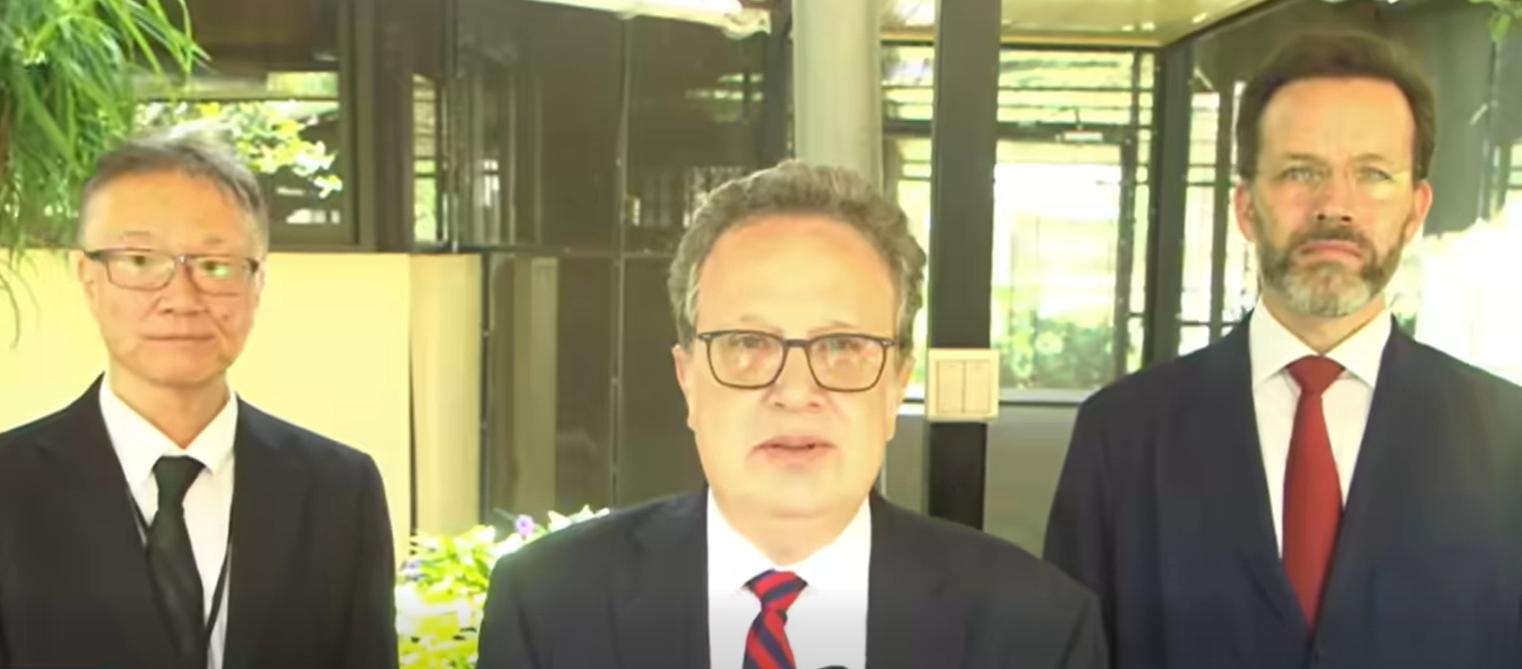
Foreign Envoys Juba: Push Political Dialogue with Nyandeng, Demand Reforms
Summary
- Foreign envoys from Germany, Japan, Norway, and the US urged South Sudanese leaders to revive political dialogue and strengthen accountability.
- This diplomatic call followed a meeting with Vice President Rebecca Nyandeng de Mabior amidst a public dispute between her and President Salva Kiir's office.
- The dispute escalated after Nyandeng questioned the current leadership's oversight and the value of government positions, prompting a defense from the presidency.
- A planned trip by Nyandeng to Kenya was canceled due to a lack of presidential travel clearance, further highlighting the tensions.
- The political developments occur as South Sudan prepares for December elections, intended to conclude its transitional period, with international pressure for governance reforms.
Diplomatic Pressure Mounts Amidst Political Tensions
The international community, through its diplomatic representatives, underscored that South Sudan's long-delayed aspirations for peace and prosperity remain achievable, provided its leadership makes decisive and appropriate choices.
A consortium of international envoys from Germany, Japan, Norway, and the United States has urged South Sudanese leaders to reinvigorate political discourse, reject violence as a means of political competition, and bolster accountability. This call followed a significant meeting with Vice President Rebecca Nyandeng de Mabior, which occurred against the backdrop of a highly public disagreement between her and the office of President Salva Kiir. In a joint declaration issued on a Wednesday, the four heads of mission articulated that South Sudan's trajectory towards peace demands immediate interventions, specifically highlighting the necessity for authentic inter-party dialogue.
The diplomats further pressed political leaders to abandon violent approaches to resolving differences and advocated for the transparent use of public revenues to deliver essential services and enhance accountability. They posited that such measures would foster an environment conducive to private investment, improved security, and the establishment of the rule of law. Following their August 25 meeting with Vice President Nyandeng, the envoys conveyed their shared aspirations for a future of peace and prosperity in South Sudan, noting that its citizens have endured a protracted wait for such a reality. They concluded that the nation's long-deferred hopes for stability and economic well-being are still attainable, contingent upon sound decision-making by its leadership.
This diplomatic intervention arrives at a particularly sensitive political juncture, just days after an unusually public exchange between Vice President Nyandeng and the presidency, and as South Sudan gears up for elections slated for December. The recent escalation of tensions originated from a pointed address delivered by Nyandeng, a Vice President in President Kiir's administration and the widow of the late Sudan Peoples Liberation Movement leader John Garang de Mabior. Her remarks were made at a requiem Mass in Juba on August 21, honoring veteran politician Kosti Manibe Ngai. During her speech, Nyandeng questioned whether the current leadership benefits from the same level of oversight and counsel that surrounded Garang during the liberation struggle. She also raised concerns about the efficacy of senior government roles if they fail to improve the lives of ordinary South Sudanese, revealing that she sometimes goes for as long as two years without meeting President Kiir.
President Kiir's office issued a response two days later, which, while not explicitly naming Nyandeng, defended President Kiir's contributions to the liberation struggle. The presidency rejected any attempts to attribute the movement's achievements to a select group of individuals, asserting that the liberation effort was a collective endeavor. It underscored President Kiir's pivotal role as a senior member of the movement and a long-standing comrade of Garang. The statement also dismissed the notion that the nation lacked experienced leaders due to the departure or demise of individual figures from the liberation era. Subsequently, the presidency addressed the upcoming December elections, stating that those who believe the government has faltered should present their arguments to the electorate, emphasizing that the populace, rather than political elites or governmental positions, should dictate the country's political direction. The public disagreement was further complicated by a controversy surrounding Vice President Nyandeng's planned travel to Kenya. Her office had sought presidential approval for official engagements in Kenya, including a scheduled public lecture at Muranga University of Technology on August 25, preceding the university's graduation ceremony. An official from Nyandeng's office confirmed that the travel request was submitted to the Office of the President on August 13, but the necessary clearance had not been received by August 24, her scheduled departure date from Juba, leading to the cancellation of her trip. Neither President Kiir's office nor Vice President Nyandeng has publicly linked the delay in travel clearance to her earlier remarks.
Elections and Governance Under Scrutiny
The current political friction unfolds as the government advances preparations for the December elections, which are intended to conclude South Sudan's protracted transitional period. The presidency has consistently framed the December vote as the pathway to a new political phase for the nation. However, this perspective is not universally shared, with critics, including the Sudan Peoples Liberation Movement in Opposition (SPLM-IO) and some other political figures, expressing reservations.
International pressure for improved governance reforms in Juba is evident in the diplomats' call for public revenues to be directed towards services and accountability. This emphasis on fiscal responsibility and the rule of law is directly linked to fostering an environment conducive to private investment and overall stability. The foreign diplomats' statement underscores a broader international expectation for South Sudan to demonstrate tangible progress in its governance structures ahead of the crucial December polls.
Why Dialogue and Accountability are Crucial
The unified message from the foreign envoys highlights the critical need for South Sudan's leadership to engage in authentic political dialogue and to unequivocally reject violence as a political tool. This diplomatic push is particularly significant given the public dispute between Vice President Nyandeng and President Kiir's office, which has brought internal political divisions to the forefront just months before the scheduled December elections.
The international community, through its diplomatic representatives, underscored that South Sudan's long-delayed aspirations for peace and prosperity remain achievable, provided its leadership makes decisive and appropriate choices. The emphasis on strengthening accountability and ensuring public revenues are used for services reflects a deep concern for the welfare of ordinary South Sudanese citizens and the foundational elements required for a stable and prosperous nation. The upcoming elections, intended to mark the end of a transitional period, are seen by international observers as a pivotal moment for the country to demonstrate its commitment to democratic principles and good governance.
Practical Implications
This article signals heightened political risk and international scrutiny on South Sudan's governance and rule of law ahead of the December elections. Lawyers advising clients with interests in South Sudan should monitor these political developments closely, as they directly impact the investment climate, regulatory stability, and potential for contract enforceability, requiring updated risk assessments and strategic planning.
Source
How does this affect you?
Get an AI analysis of this article grounded in your jurisdictions, practice areas, and any policy documents you've uploaded to Wansom.
Finish this article free. Just your email for instant unlock.
Wansom is AI and can make mistakes.