
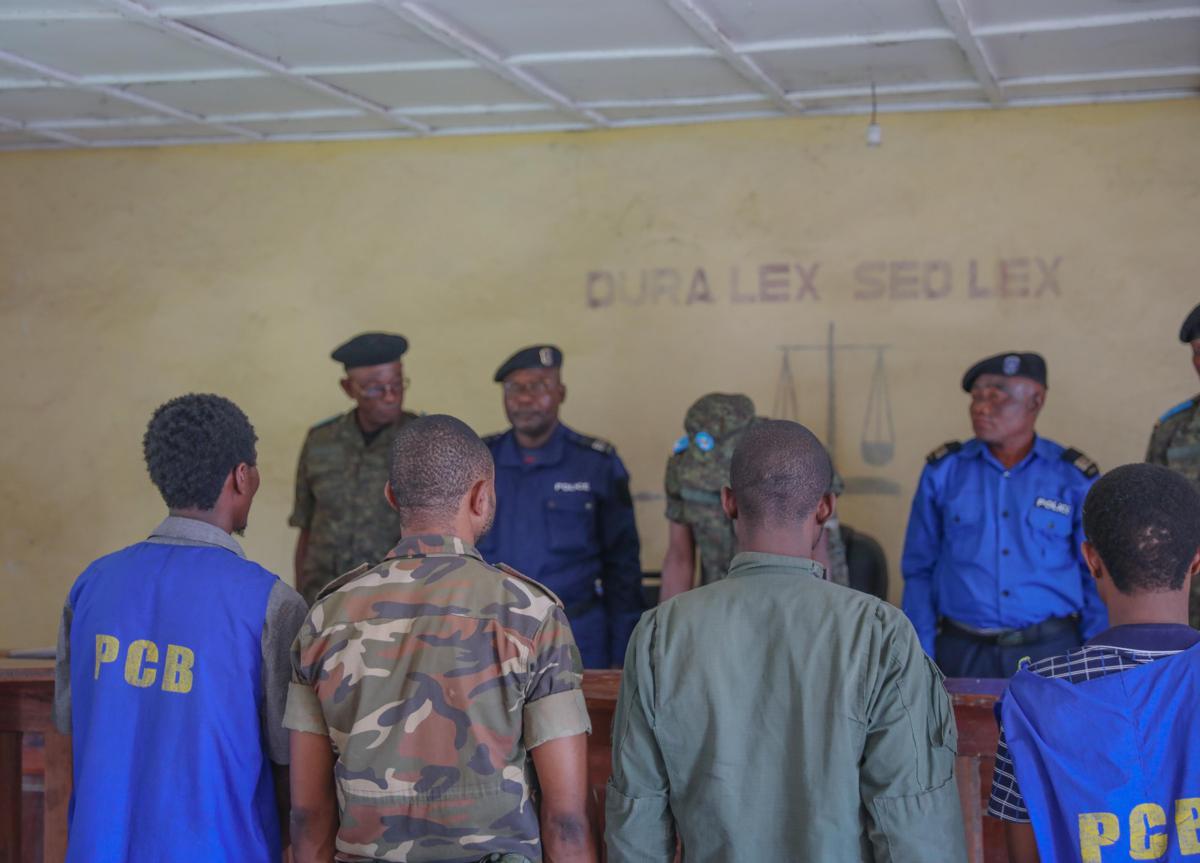
Goma Military Tribunal: 71 FARDC Militaires Procès Walikale for Revolt, Murder
Summary
- The Military Garrison Tribunal of Goma is prosecuting 71 FARDC military personnel in Walikale, Nord-Kivu.
- The accused, from the 3415th Infantry Regiment, face charges including military revolt, murder, and dissipation of war munitions.
- Capitaine Mwinyi Justin is also being prosecuted for non-denunciation of an offense.
- The charges stem from shootings on October 16 and 20, 2026, which resulted in three deaths.
- This trial follows a prior conviction of ten soldiers from the same regiment for firing on their commander.
Ongoing Military Justice Proceedings
The specific charge against Capitaine Mwinyi Justin for non-denunciation further emphasizes the accountability expected at all levels of command within the 3415th Infantry Regiment of the FARDC.
The Military Garrison Tribunal of Goma is actively engaged in judicial inquiry proceedings in Walikale, Nord-Kivu, focusing on 71 military personnel from the 3415th Infantry Regiment of the FARDC. These significant proceedings, which formally commenced on October 26, are currently in their instructional stage, with examinations continuing on Tuesday, November 3. The accused face a comprehensive array of serious allegations, including charges of military revolt, abandonment of post, and the illicit dissipation of war munitions, among other grave infractions against military discipline.
The scope of this particular case, often referred to as the 71 FARDC militaires procès Walikale, has expanded considerably since its inception. Initially, the legal action was directed against 54 members of the regiment. However, the investigation subsequently broadened to include Capitaine Mwinyi Justin, an S2 officer within the 3415th Infantry Regiment, who is now Capitaine Mwinyi Justin poursuivi for the non-denunciation of an offense. This charge implies a failure to report knowledge of a crime or illicit activity. Furthermore, on November 2, an additional 16 military personnel were presented before the same Tribunal militaire garnison Goma, bringing the total number of defendants to 71.
Specific Allegations and Incidents
The initial cohort of 54 accused soldiers faces particularly severe charges, including military revolt, the dissipation of war munitions, violation of explicit orders, refusal to obey commands, and murder. These accusations are directly linked to a series of violent incidents involving firearms that transpired on October 16 and October 20, 2026. These tragic events, which occurred in Ngora, located within the Waloa-Loanda groupement, resulted in the loss of life for two military personnel and one civilian. The detailed nature of these charges highlights the profound breaches of both military and civilian law.
The ongoing judicial process concerning révolte militaire FARDC Nord-Kivu and meurtre militaires Walikale underscores the military justice system's commitment to addressing grave misconduct within its ranks. The specific charge against Capitaine Mwinyi Justin for non-denunciation further emphasizes the accountability expected at all levels of command within the 3415e Régiment d'infanterie FARDC. This aspect of the case is particularly relevant to droit militaire RDC, as it touches upon the responsibilities of officers to maintain order and report any infractions, thereby reinforcing the chain of command and preventing further abuses.
Broader Context of Military Accountability
This extensive trial represents more than an isolated incident; it reflects a persistent challenge within the 3415th Infantry Regiment regarding discipline and adherence to military law. This is not the first time members of this specific unit have faced serious legal repercussions. On September 1, just months before the current proceedings began, ten other military personnel from the same regiment were handed prison sentences. Their convictions stemmed from a separate, equally grave act: opening fire on their own company commander, an offense that profoundly undermines the fundamental principles of military hierarchy and order.
The consistent application of droit militaire RDC by the Tribunal militaire garnison Goma in such high-profile cases, particularly in a volatile region like Nord-Kivu, is crucial for maintaining the integrity and effectiveness of the FARDC. The thoroughness of the judicial inquiry, from its opening on October 26 to the ongoing examinations on November 3, demonstrates the military justice system's resolve to meticulously process complex cases involving numerous defendants and a wide spectrum of charges. This commitment to accountability is vital for upholding military discipline and ensuring justice for victims, reinforcing the rule of law within the armed forces.
Practical Implications
This case highlights the ongoing enforcement of military justice within the FARDC for serious offenses like revolt and murder. Lawyers specializing in military law or human rights should monitor the proceedings for precedents regarding command responsibility (e.g., Captain Mwinyi Justin's non-denunciation charge) and the application of military penal code in conflict zones.
Source
How does this affect you?
Get an AI analysis of this article grounded in your jurisdictions, practice areas, and any policy documents you've uploaded to Wansom.
Wansom is AI and can make mistakes.