
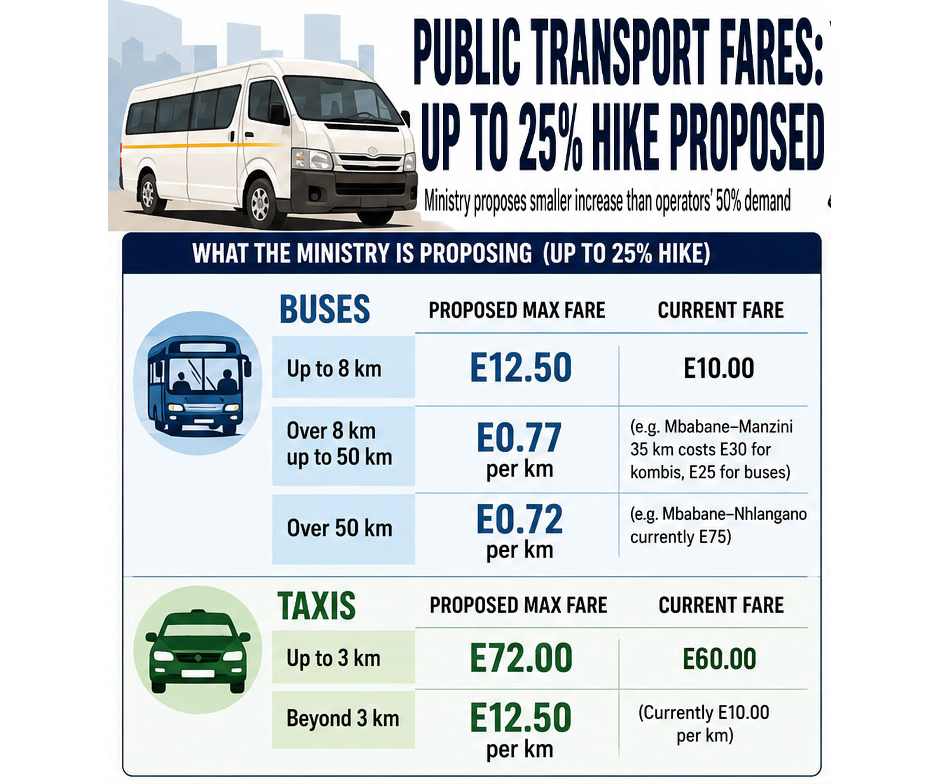
Eswatini National Road Transportation Council: 25% Public Transport Fare Increase Proposed
Summary
- Public transport operators are negotiating for a 25% increase in public transport fares in Eswatini.
- The proposal comes after public transport operators suggested a hike of up to 50%.
- Lawyers advising transportation-related businesses warn that potential disruptions to services and price hikes may impact supply chain logistics and customer satisfaction.
- The proposed adjustment has sparked concerns about the Ministry's decision-making process and its potential impact on the transport sector.
What Happened
The proposed adjustment is still pending review and approval.
Public transport operators in Eswatini are currently negotiating with the government for a 25% fare increase. This move comes after public transport operators represented by the National Road Transportation Council (NRTC) had initially suggested a hike of as much as 50%. The proposed adjustment is still pending review and approval.
The discrepancy between the two proposals highlights the ongoing debate within the transport sector regarding fare increases. While some stakeholders argue that higher fares are necessary to cover rising operational costs, others contend that such hikes would disproportionately affect low-income commuters.
Legal Context
Eswatini's transport sector is governed by a complex regulatory framework, with the National Road Transportation Council (NRTC) playing a key role in setting and enforcing policies. The NRTC's proposals for fare increases are typically subject to review and approval by the Ministry of Public Works and Transport. However, the proposed 25% adjustment has sparked concerns among lawyers advising transportation-related businesses, who warn that potential disruptions to services and price hikes may impact supply chain logistics and customer satisfaction.
Transport sector law in Eswatini is designed to balance competing interests between transport operators, commuters, and government agencies. The current proposal for a 25% fare increase has raised questions about the Ministry's decision-making process and its potential impact on the transport sector as a whole.
Why It Matters
The proposed adjustment to public transport fares in Eswatini has significant implications for both commuters and transportation-related businesses. If implemented, the 25% increase could lead to higher costs for low-income households, potentially exacerbating existing social and economic inequalities. Furthermore, potential disruptions to services and price hikes may impact supply chain logistics and customer satisfaction, ultimately affecting business operations and profitability.
Lawyers advising clients on transportation-related businesses in Eswatini should closely monitor the situation and be prepared to advise their clients on potential risks and opportunities arising from the proposed fare increase.
Practical Implications
Lawyers advising clients on transportation-related businesses in Eswatini should watch for potential disruptions to services and possible price hikes, which may impact supply chain logistics and customer satisfaction.
Source
How does this affect you?
Get an AI analysis of this article grounded in your jurisdictions, practice areas, and any policy documents you've uploaded to Wansom.
Wansom is AI and can make mistakes.