
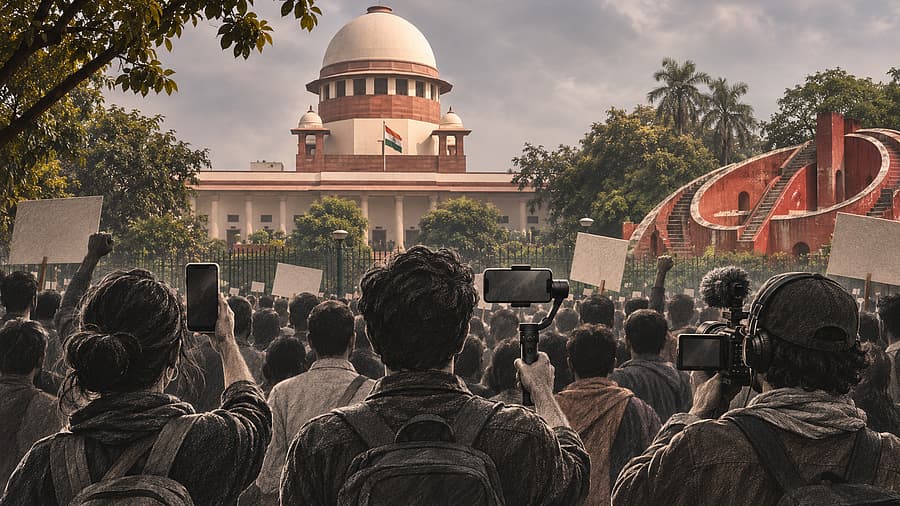
Delhi Police: Reel-Makers Not Under Journalist Protest Coverage Order
Summary
- The Delhi Police informed the Supreme Court that social media influencers and 'reel-makers' are not covered by a court order protecting journalists during protests.
- This submission was made in an affidavit concerning petitions related to recent Cockroach Janata Party (CJP) protests over alleged electoral irregularities.
- The Supreme Court had previously warned the Delhi Police against obstructing media coverage following journalist complaints.
- The police maintained they have not knowingly obstructed bona fide journalists but drew a distinction between accredited journalists and content creators.
- Content creators are therefore not exempt from movement restrictions at protest sites, unlike traditional media personnel under the earlier directive.
What Happened
By differentiating between accredited journalists and content creators, the police are effectively limiting the scope of judicial protection for individuals documenting public events through new media formats.
The Delhi Police has formally informed the Supreme Court that social media influencers, content creators, and individuals producing short-form video content, often referred to as 'reel-makers,' do not fall under the purview of a judicial order designed to protect journalists covering public demonstrations. This significant clarification was presented in an affidavit submitted by the police in response to a series of petitions. These petitions specifically address the recent Cockroach Janata Party (CJP) protests that took place in the national capital.
The CJP demonstrations were organized to demand the resignation of Chief Election Commissioner (CEC) Gyanesh Kumar. The basis for these calls for resignation stemmed from allegations of irregularities concerning the conduct of the special intensive revision (SIR) of electoral rolls. The Delhi Police's submission draws a clear line between traditional media personnel and the burgeoning category of digital content creators regarding their rights and protections during such events.
Legal Context and Police Stance
During previous hearings related to the CJP protests, the Supreme Court had issued a stern warning to the Delhi Police, instructing them not to impede media coverage of the demonstrations. This judicial intervention followed numerous complaints from journalists who reported being obstructed in their professional duties. However, in its latest affidavit, the Delhi Police asserted that it has consistently refrained from knowingly hindering any journalist in the execution of their responsibilities.
The police statement explicitly declared that it has "at no point, sought to obstruct, impede or interfere with the bona fide discharge of journalistic duties, whether during the protests in question or otherwise." Despite this assurance, the affidavit introduced a critical distinction: it argued that the Supreme Court's earlier directive, which exempted media personnel from certain restrictions imposed by the Delhi Police to manage movement at protest sites, does not extend to content creators or 'reel-makers.' This interpretation suggests a narrower application of the Supreme Court journalist protection order.
Why It Matters
This stance by the Delhi Police carries substantial implications for the landscape of protest coverage in India, particularly for those involved in digital media. By differentiating between accredited journalists and content creators, the police are effectively limiting the scope of judicial protection for individuals documenting public events through new media formats. This could significantly impact content creators' protest rights in India, potentially exposing them to restrictions that traditional journalists might be exempt from.
For legal professionals advising media entities or individual content creators, this development highlights a crucial distinction. The Delhi Police affidavit media coverage position clarifies that the protections afforded by the Supreme Court order are not universally applied to all forms of public reporting. This necessitates a careful re-evaluation of legal strategies for clients who engage in covering demonstrations, especially those who operate outside the traditional framework of accredited journalism, when considering the Delhi Police reel-makers protest coverage.
Practical Implications
Lawyers advising media entities or individual content creators should note the Delhi Police's explicit distinction between accredited journalists and 'reel-makers' regarding protest coverage protections, which may impact legal strategies for clients facing restrictions during public demonstrations and clarify who benefits from judicial protection orders.
Source
How does this affect you?
Get an AI analysis of this article grounded in your jurisdictions, practice areas, and any policy documents you've uploaded to Wansom.
Finish Reading the Full Story and the Expert Analysis.
Get the latest legal & regulatory intelligence in India
Wansom is AI and can make mistakes.