
Delhi High Court: Dismisses CJP Lathicharge PIL Over Insufficient Grounds
Summary
- The Delhi High Court dismissed a Public Interest Litigation (PIL) seeking clarification on a police lathicharge during a CJP protest.
- Petitioner Nitin Naresh, a media member, had highlighted conflicting media reports versus the Delhi Police's official stand.
- A Division Bench, including Chief Justice Devendra Kumar Upadhyaya, ruled that conflicting media reports alone are not sufficient grounds for a PIL.
- The court emphasized that a PIL requires a dispute between parties or a violation of rights, and found no public interest in the current plea.
- The ruling clarifies that the public interest litigation scope in India does not extend to reconciling factual discrepancies based solely on media accounts.
What Happened
The court clarified that a petition can only be entertained if it involves a genuine dispute between two parties or if it concerns a clear violation of an individual's rights.
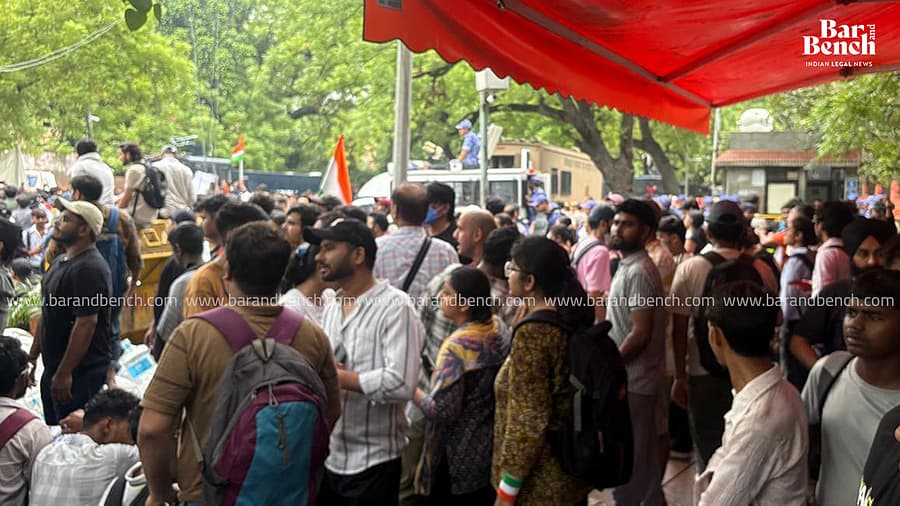
The Delhi High Court recently dismissed a public interest litigation (PIL) that sought judicial intervention to clarify conflicting accounts surrounding a police lathicharge during a protest by the Cockroach Janata Party (CJP) in the national capital. The petition, filed by Nitin Naresh, aimed to compel the Delhi Police to reconcile its official stance with various media reports regarding the alleged use of force.
Naresh, who identified himself as a member of the media, had previously submitted a representation to the Delhi Police. This representation highlighted the discrepancies between the police's version of events and what was reported in the news. His PIL subsequently requested the court to direct the police to make a definitive decision on this representation.
A Division Bench, comprising Chief Justice Devendra Kumar Upadhyaya and Justice Tejas Karia, heard the matter. The court, however, found the grounds for the PIL to be insufficient, leading to its dismissal on Wednesday.
Legal Context and Court's Rationale
The High Court strongly criticized the petitioner for bringing the matter before it, emphasizing that mere contradictions between media reports and police statements do not automatically qualify as grounds for a public interest litigation. Chief Justice Upadhyaya remarked on the proliferation of such petitions, questioning whether every news item that captures one's attention should result in a court filing. The bench explicitly stated that the plea lacked any demonstrable public interest.
Elaborating on the strict criteria for PILs, the court clarified that a petition can only be entertained if it involves a genuine dispute between two parties or if it concerns a clear violation of an individual's rights. The Chief Justice reiterated that the existence of conflicting media reports, when juxtaposed with a police statement, does not inherently transform an issue into a subject suitable for a public interest litigation.
During the proceedings, Naresh inquired about who would ensure accountability if the court declined to entertain his PIL. Chief Justice Upadhyaya responded, stating, "These high-sounding wo...", indicating the court's view on the nature of such arguments.
Why It Matters
This ruling by the Delhi High Court serves as a significant clarification regarding the scope and strict criteria for filing Public Interest Litigations in India. It underscores that the judiciary will not entertain PILs based solely on conflicting media reports, even when they pertain to sensitive issues like alleged police misconduct. The court's stance reinforces the principle that PILs are reserved for matters of substantial public interest, involving clear disputes or rights violations, rather than for resolving factual discrepancies arising from news coverage.
The dismissal of Nitin Naresh's PIL highlights the judiciary's increasing scrutiny of such petitions, aiming to prevent their misuse for purposes that do not align with their original intent. Lawyers advising clients on potential PILs should note that a robust case requires more than just media speculation or contradictory accounts; it demands a clear legal grievance, a demonstrable public interest, or a direct infringement of fundamental rights. This decision by the Delhi HC rejects lathicharge probe requests based on insufficient grounds, setting a precedent for future filings.
Practical Implications
This ruling clarifies the strict criteria for filing Public Interest Litigations in India, particularly that conflicting media reports alone are insufficient grounds. Lawyers should advise clients that PILs require demonstrable public interest, a dispute between parties, or a clear violation of rights, rather than merely seeking to reconcile factual discrepancies.
Source
How does this affect you?
Get an AI analysis of this article grounded in your jurisdictions, practice areas, and any policy documents you've uploaded to Wansom.
Finish Reading the Full Story and the Expert Analysis.
Get the latest legal & regulatory intelligence in India
Wansom is AI and can make mistakes.