
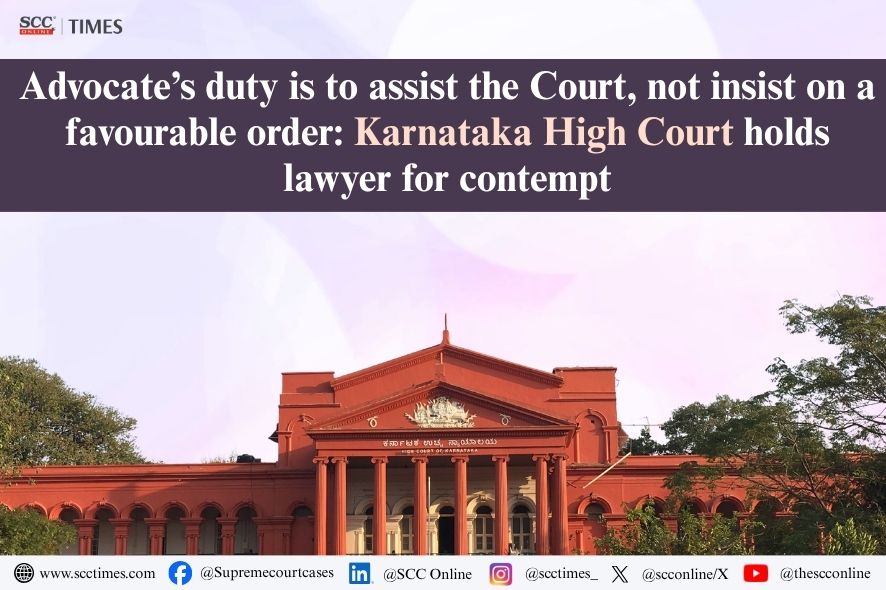
Karnataka HC: Advocate Contempt Duty to Assist Court Affirmed
Summary
- The Karnataka High Court held an advocate in contempt for failing to assist the court and insisting on a favorable order.
- The court clarified that an advocate's primary duty is to assist the judicial process, not to dictate outcomes.
- The ruling addressed warrant cases, stating that legal heirs retain the right to continue prosecution even if the complainant dies during proceedings.
- This decision provides important guidance on the continuation of complainant death warrant cases and professional conduct for advocates in India.
Court Upholds Advocate's Duty
The Karnataka High Court's decision serves as a potent reminder for all legal practitioners regarding the paramount importance of their professional obligations.
The Karnataka High Court recently issued a significant ruling, emphasizing the fundamental duty of an advocate to assist the court rather than to insist on a particular outcome. This pronouncement came in a case where the court found a lawyer in contempt, underscoring the judiciary's expectation of professional conduct from legal practitioners.
The specific circumstances involved a warrant case where the complainant had passed away during the ongoing proceedings. The court's decision clarified the procedural path forward in such situations, particularly concerning the continuation of the prosecution by the deceased complainant's legal heirs. The advocate's actions, which led to the contempt finding, were perceived as deviating from the core responsibility of aiding the judicial process.
Clarifying Warrant Case Procedures
In its detailed ruling, the Karnataka High Court addressed the critical question of how warrant cases should proceed following the death of a complainant. The court explicitly held that, even in the absence of immediate legal heirs coming forward at the time of the complainant's demise during the proceedings, the right of the deceased complainant's legal heirs to continue the prosecution remains intact. This clarification provides crucial guidance for courts and legal professionals handling similar scenarios across India.
This aspect of the ruling is particularly important for ensuring that justice is not derailed by unforeseen events such as a complainant's death. It establishes a clear legal principle that protects the continuity of legal action and the rights of those who might succeed the original complainant, reinforcing the robustness of the judicial system in handling complex procedural challenges.
Implications for Legal Practice
The Karnataka High Court's decision serves as a potent reminder for all legal practitioners regarding the paramount importance of their professional obligations. The ruling unequivocally states that an advocate's primary role is to assist the court in the administration of justice, not to stubbornly pursue a favorable order for their client at the expense of judicial propriety. This principle is central to maintaining the integrity and efficiency of advocate contempt proceedings in India.
This ruling on the duty of an advocate to court highlights that while zealously representing a client is essential, it must always be balanced with the overarching responsibility to the judicial system. Lawyers are expected to facilitate the court's understanding of facts and law, thereby contributing to fair and impartial decisions, rather than creating obstacles or insisting on outcomes that may not align with established legal principles or procedural norms. The Karnataka High Court advocate ruling thus sets a precedent for professional conduct.
Practical Implications
This ruling serves as a critical reminder for legal practitioners in India regarding their professional conduct, emphasizing the paramount duty to assist the court rather than insist on favorable outcomes, thereby mitigating the risk of contempt proceedings. It also provides clarity on the continuation of warrant cases following the death of a complainant.
Source
Source: Original reporting via SCC Times
How does this affect you?
Get an AI analysis of this article grounded in your jurisdictions, practice areas, and any policy documents you've uploaded to Wansom.
Finish Reading the Full Story and the Expert Analysis.
Wansom is AI and can make mistakes.