
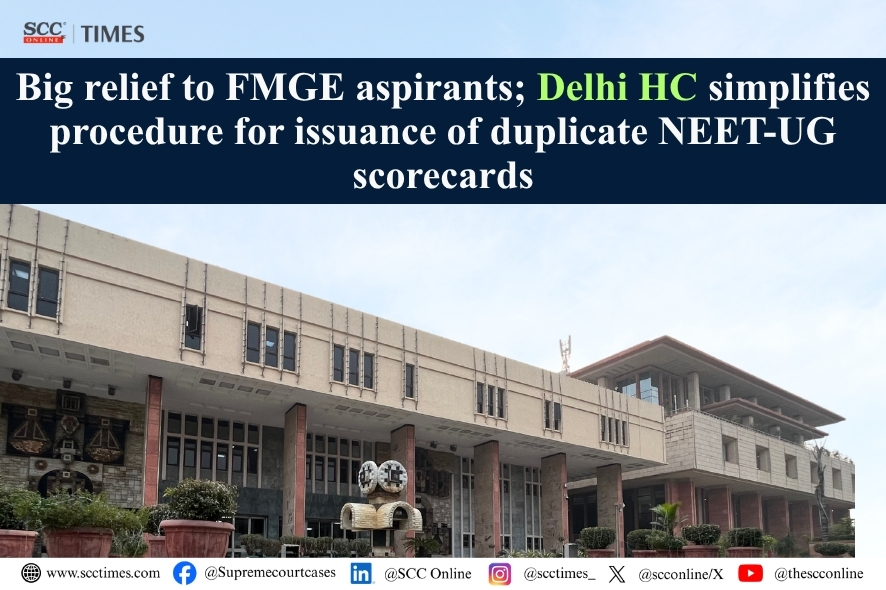
Delhi High Court: Simplifies Duplicate NEET-UG Scorecard Procedure
Summary
- The Delhi High Court has simplified the procedure for obtaining duplicate NEET-UG scorecards.
- This simplification offers significant relief to Foreign Medical Graduate Examination (FMGE) aspirants.
- The Court accepted the National Testing Agency's (NTA) proposal to allow fee payments via NEFT for the current batch of applicants.
- Applicants must attach proof of NEFT payment to their duplicate scorecard application.
Court Streamlines Duplicate Scorecard Process
The simplification of the Delhi HC duplicate NEET-UG scorecard procedure holds profound implications, especially for Foreign Medical Graduate Examination (FMGE) aspirants.
The Delhi High Court has recently introduced a significant simplification to the process by which medical aspirants can obtain duplicate NEET-UG scorecards. This judicial intervention is poised to offer considerable relief, particularly for individuals preparing for the Foreign Medical Graduate Examination (FMGE), who often navigate complex administrative pathways. The court's directive aims to make the administrative steps involved in securing these crucial documents more accessible and less burdensome for all applicants seeking a duplicate NEET-UG scorecard.
Central to this procedural overhaul is the acceptance of a key proposal put forth by the National Testing Agency (NTA), the authoritative body responsible for conducting the highly competitive NEET-UG examination. For the current cohort of applicants seeking duplicate scorecards, the Delhi High Court has affirmed that the requisite prescribed fee can now be remitted through the National Electronic Funds Transfer (NEFT) system. This move marks a notable departure from potentially more restrictive or time-consuming payment methods, thereby enhancing convenience and efficiency for students across India who need to manage their medical entrance exam scorecards.
NTA's Role and Payment Flexibility
The National Testing Agency's statement, which received the Delhi High Court's endorsement, specifically addresses the payment mechanism for the prescribed fee associated with duplicate NEET-UG scorecards. This acceptance by the Court underscores a collaborative effort to refine the NEET-UG scorecard issuance process, ensuring it remains responsive to the needs of examinees. The NTA's proposal focused on providing a more flexible and widely available option for financial transactions, acknowledging the diverse geographical locations and banking preferences of applicants.
Under the newly accepted arrangement for the Delhi HC duplicate NEET-UG scorecard procedure, applicants utilizing the NEFT method must ensure that comprehensive proof of payment is meticulously attached to their duplicate scorecard application. This requirement is critical for the successful processing of their request, maintaining accountability and transparency while simultaneously simplifying the transaction for the applicant. This specific provision, allowing for NTA duplicate scorecard NEFT payments, applies directly to the present batch of applicants, indicating a targeted and immediate improvement in the administrative framework governing medical entrance exam scorecards in India.
Impact on FMGE Aspirants and Compliance
The simplification of the Delhi HC duplicate NEET-UG scorecard procedure holds profound implications, especially for Foreign Medical Graduate Examination (FMGE) aspirants. These students, who have often completed their medical education abroad, frequently face unique administrative and regulatory challenges in their pursuit of practicing medicine in India. The ability to pay the prescribed fee via NEFT, coupled with the overall streamlining of the process for obtaining Delhi High Court NEET-UG scorecards, removes a significant potential bottleneck, allowing FMGE aspirants NEET-UG to focus more intently on their academic and professional goals rather than bureaucratic hurdles.
This development in the issuance of medical entrance exam scorecards in India not only eases the burden on individual students but also sets a positive precedent for administrative efficiency within the broader educational regulatory landscape. For legal professionals advising medical aspirants or educational institutions, understanding this updated procedure, including the acceptance of NTA duplicate scorecard NEFT payments, is crucial for ensuring compliance and providing accurate guidance. It represents a practical and welcome improvement in the often complex journey of securing essential documentation for medical practice in India, reflecting a more student-centric approach to the NEET-UG scorecard issuance process.
Practical Implications
Lawyers advising medical aspirants or educational institutions should note the Delhi High Court's simplification of the duplicate NEET-UG scorecard issuance procedure, including the acceptance of NEFT payments. This impacts compliance requirements for obtaining such documents and provides a clearer path for affected students.
Source
How does this affect you?
Get an AI analysis of this article grounded in your jurisdictions, practice areas, and any policy documents you've uploaded to Wansom.
Finish Reading the Full Story and the Expert Analysis.
Get the latest legal & regulatory intelligence in India
Wansom is AI and can make mistakes.