
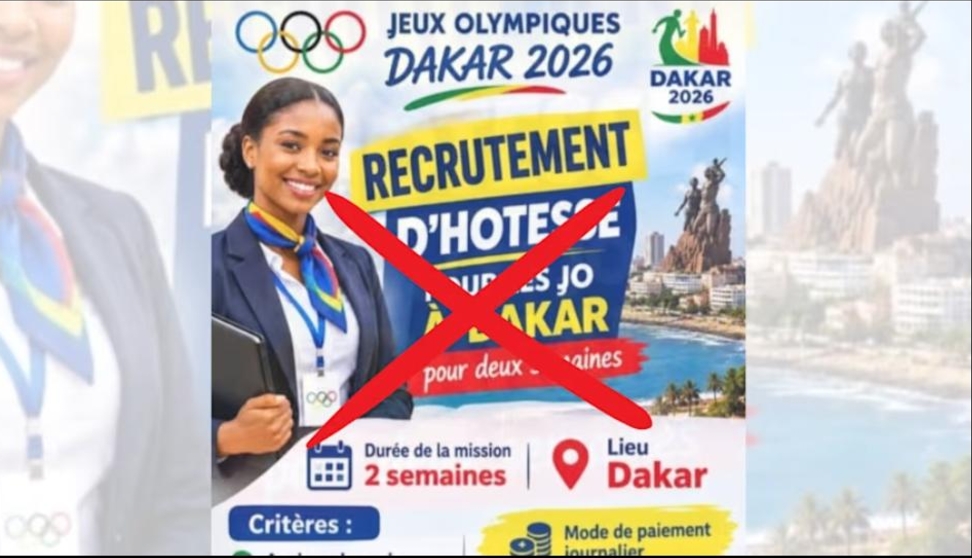
COJOJ Dakar 2026: Warns Public of Widespread Recruitment Scam
Summary
- COJOJ Dakar 2026 issued an alert on October 1, 2026, concerning fraudulent job offers for the Youth Olympic Games.
- Fake advertisements promised 5,000 immediate recruitments, often demanding application, badge, or uniform fees.
- The legitimate Jambaar26 volunteer program, which involved over 6,000 volunteers, had its application period close on January 31, 2026.
- Paid positions were handled through a separate 2025 tender process for an interim agency, not through direct recruitment offers.
- COJOJ advises relying solely on its official accounts and platforms, like jambaar26.apps.dakar2026.org, to avoid recruitment scams.
What Happened
Individuals must remain vigilant against schemes that exploit the enthusiasm for major events like the Youth Olympic Games, ensuring they only engage with verified COJOJ official recruitment processes to avoid falling victim to financial scams.
The Committee for the Organization of the Youth Olympic Games (COJOJ) Dakar 2026 has issued a public warning regarding a widespread recruitment scam targeting individuals interested in the upcoming event. On October 1, 2026, the committee alerted the public to fraudulent advertisements circulating across social media platforms, primarily offering hostess positions. These deceptive postings for JOJ Dakar 2026 often promised immediate employment for as many as 5,000 individuals, frequently demanding upfront payments in the form of application, badge, or uniform fees.
This COJOJ Dakar 2026 recruitment scam has created significant confusion, particularly given the substantial logistical requirements of the Games. The event is slated to welcome 2,700 athletes and an estimated one million spectators across 35 sporting disciplines, necessitating the mobilization of over 6,000 volunteers. However, the committee clarified that these extensive operational needs do not translate into thousands of remunerated job opportunities, directly contradicting the promises made in the fake job offers. The distinction between volunteer roles and paid positions is crucial in understanding the nature of these fraudulent schemes.
Official Recruitment Channels
To counter the proliferation of Dakar 2026 fake job offers, the COJOJ has emphasized the importance of adhering to official communication channels for all recruitment-related information. The legitimate volunteer initiative, known as Jambaar26, was a distinct program whose application period ran from December 1, 2025, to January 31, 2026, and is now closed. This official volunteer platform was accessible via the specific subdomain jambaar26.apps.dakar2026.org. The committee explicitly cited dakar2026-recrutement.com as an example of an unofficial and potentially fraudulent website, urging the public to exercise extreme caution.
For paid employment, the process was entirely separate from the volunteer campaign. In 2025, the COJOJ initiated a formal tender process to select an interim agency responsible for providing temporary staff for the Games. Companies interested in this opportunity were required to submit their bids by July 31, 2025. This structured approach for professional recruitment stands in stark contrast to the informal and fee-demanding solicitations seen in the Senegal Olympic Games fraud. The committee’s consistent message is to rely solely on its verified official accounts for any announcements concerning COJOJ official recruitment.
Why This Matters
While the prospect of contributing to the JOJ Dakar 2026 offers valuable experience, particularly for volunteers, this does not legitimize any offers that request money from applicants. The Jambaar26 volunteer program, for instance, provided a significant opportunity for skill development, with 310 young leaders gaining valuable organizational competencies related to the Games. Recognizing the potential of these individuals, the government has requested their lists and CVs from COJOJ to explore potential professional opportunities for them following the conclusion of the competition.
This initiative underscores the genuine benefits of legitimate participation but also highlights the deceptive nature of the JOJ Dakar 2026 fraud alert. The existence of pathways for skill acquisition and potential future employment through official channels should not be conflated with the promises of immediate, paid positions contingent on upfront fees. Individuals must remain vigilant against schemes that exploit the enthusiasm for major events like the Youth Olympic Games, ensuring they only engage with verified COJOJ official recruitment processes to avoid falling victim to financial scams.
Practical Implications
Lawyers should advise clients, both individuals and businesses, on the risks of fraudulent recruitment schemes associated with major events like JOJ Dakar 2026, particularly those demanding upfront fees. This includes educating them on how to verify official communication channels and report suspicious activities to prevent financial loss and protect against potential legal liabilities related to misrepresentation or consumer fraud.
Source
How does this affect you?
Get an AI analysis of this article grounded in your jurisdictions, practice areas, and any policy documents you've uploaded to Wansom.
Finish Reading the Full Story and the Expert Analysis.
Get the latest legal & regulatory intelligence in Senegal
Wansom is AI and can make mistakes.