
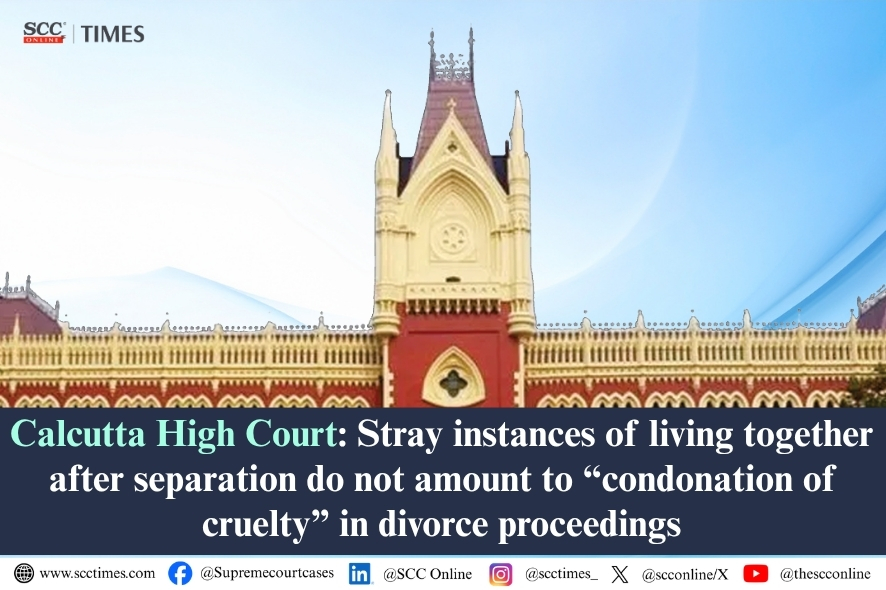
Calcutta High Court: Stray Instances Condonation Not Automatic for Cruelty
Summary
- The Calcutta High Court recently ruled that isolated instances of spouses living together after separation do not automatically constitute condonation of cruelty in divorce cases.
- This decision clarifies the application of the condonation principle, preventing the automatic dismissal of cruelty-based divorce petitions due to brief reconciliation attempts.
- The ruling builds upon the 1975 Supreme Court judgment in N.G. Dastane v. S. Dastane, which established condonation of cruelty as a mitigating factor under Section 23(1) of the Hindu Marriage Act and corresponding Special Marriage Act provisions.
- The Supreme Court's N.G. Dastane case held that condonation requires forgiveness and the restoration of the offending spouse to their former position within the marriage.
A Key Clarification from Calcutta High Court
By distinguishing "stray instances of living together" from genuine condonation, the High Court has offered a vital clarification for divorce proceedings across India.
The Calcutta High Court has recently issued a significant ruling that refines the interpretation of "condonation of cruelty" within divorce proceedings. This decision clarifies that isolated instances where estranged spouses live together after a period of separation do not automatically constitute a condonation of cruelty, thereby preventing the dismissal of a divorce petition filed on grounds of cruelty. This judicial pronouncement provides crucial guidance on how courts should assess attempts at reconciliation in the context of ongoing marital disputes.
This specific clarification addresses a common and often complex scenario in matrimonial law, where parties might briefly cohabit or attempt to reconcile after initial separation, only for the marriage to ultimately fail. The High Court's stance ensures that such intermittent efforts to salvage a relationship are not inadvertently used to negate a spouse's legitimate claim of cruelty, which could otherwise lead to an unjust outcome for the aggrieved party. The ruling underscores the need for a nuanced evaluation of post-separation interactions between spouses, particularly concerning the Calcutta High Court stray instances condonation principle.
Understanding the Legal Framework of Condonation
The concept of condonation in India divorce law is deeply rooted in a landmark Supreme Court judgment, N.G. Dastane v. S. Dastane, delivered in 1975. In this pivotal case, reported at (1975) 2 SCC 326, the Supreme Court established that condonation of cruelty acts as a mitigating factor when a court considers granting a divorce based on cruelty. This principle applies specifically under Section 23(1) of the Hindu Marriage Act, as well as analogous provisions found within the Special Marriage Act, addressing Special Marriage Act condonation cruelty.
Condonation, in essence, refers to the forgiveness of a matrimonial offense, such as cruelty, by the aggrieved spouse, with the intention of reinstating the marital relationship. Once an act of cruelty is condoned, the right to seek divorce on that specific ground is generally extinguished. The N.G. Dastane v. S. Dastane ruling laid down the foundational understanding that for condonation to be effective, there must be not only forgiveness but also a restoration of the offending spouse to their former position, implying a genuine reconciliation. This Supreme Court precedent has since guided lower courts in assessing whether a spouse has truly forgiven and overlooked acts of cruelty.
Impact on Divorce Proceedings and Precedent
The recent Calcutta High Court decision builds upon the established N.G. Dastane precedent by providing a more precise interpretation of what constitutes condonation, particularly in scenarios involving post-separation interactions. By distinguishing "stray instances of living together" from genuine condonation, the High Court has offered a vital clarification for divorce proceedings across India. This Calcutta High Court divorce precedent suggests that mere physical proximity or brief attempts at cohabitation, especially if they do not lead to a full and lasting reconciliation, should not automatically be construed as a complete forgiveness of past cruel acts, thereby impacting how Living together condonation cruelty is assessed.
This judicial refinement is particularly significant for cases where one spouse alleges cruelty but has, at some point, attempted to reconcile or briefly lived with the other spouse after the initial separation. The Calcutta High Court's stance ensures that such efforts, often made in good faith to save a marriage, do not inadvertently undermine a valid cruelty claim. It reinforces the idea that condonation requires a clear intention to forgive and resume marital life without reservation, rather than just temporary or forced cohabitation. This precedent will likely influence how courts evaluate evidence of reconciliation attempts when assessing cruelty-based divorce petitions, providing a more equitable framework for litigants.
Practical Implications
This ruling clarifies the interpretation of 'condonation of cruelty' under Indian divorce law, specifically stating that isolated instances of cohabitation after separation do not automatically negate a cruelty claim. Lawyers handling divorce cases must consider this precedent when advising clients on the viability of cruelty-based petitions or defending against them, particularly where reconciliation attempts have been intermittent.
Source
Source: Original reporting via SCC Times
How does this affect you?
Get an AI analysis of this article grounded in your jurisdictions, practice areas, and any policy documents you've uploaded to Wansom.
Finish Reading the Full Story and the Expert Analysis.
Wansom is AI and can make mistakes.