
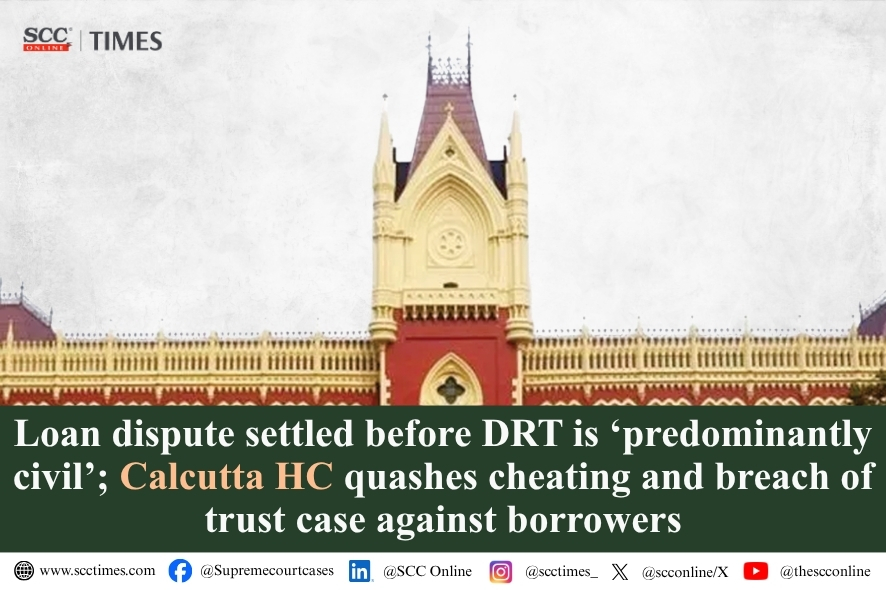
Calcutta High Court: Quashes Criminal Loan Dispute After DRT Settlement
Summary
- The Calcutta High Court quashed criminal proceedings for cheating and breach of trust against borrowers.
- The underlying loan dispute had previously been settled before a Debt Recovery Tribunal (DRT).
- The court found the criminal complaint lacked essential ingredients and the summons issued were mechanical.
- A key factor in the court's decision was that the complainant was a stranger to the loan.
- The High Court characterized the loan dispute as "predominantly civil" in nature.
Judicial Intervention in Loan Dispute
This judicial stance offers a measure of protection for borrowers, ensuring that they are not unduly subjected to criminal prosecution for what are essentially civil contractual obligations.
The Calcutta High Court recently intervened in a financial disagreement, issuing a significant ruling that saw criminal proceedings against certain borrowers brought to an end. The court's decision involved quashing charges of cheating and breach of trust that had been initiated against individuals involved in a loan dispute. This judicial action by the High Court effectively halted the criminal case, providing relief to the borrowers who were facing these serious allegations.
A crucial aspect of this case was the prior resolution of the underlying financial matter. The loan dispute at the heart of the criminal complaint had already undergone a settlement process before a specialized forum, specifically a Debt Recovery Tribunal (DRT). This pre-existing settlement in a civil recovery mechanism played a pivotal role in the High Court's assessment of the subsequent criminal charges. The court's intervention highlights a judicial perspective on the appropriate avenues for resolving such financial disagreements, particularly when civil remedies have already been engaged.
High Court's Rationale for Quashing
The Calcutta High Court's decision to quash the criminal case was predicated on several fundamental deficiencies identified within the complaint itself and the subsequent legal process. Foremost among these findings was the court's observation that the criminal complaint "lacked essential ingredients." This determination suggests that the allegations of cheating and breach of trust, as presented, failed to meet the basic legal requirements necessary to sustain such serious criminal charges. The absence of these foundational elements rendered the complaint inherently weak in the eyes of the court.
Further undermining the criminal proceedings, the High Court noted that the summons issued in the case were "mechanical." This implies a lack of proper judicial application of mind or scrutiny before compelling the borrowers to appear in court on criminal charges. Such a mechanical approach to issuing summons indicates a potential procedural oversight, where the gravity of initiating criminal action might not have been adequately considered. This procedural flaw contributed to the court's decision to intervene and quash the proceedings.
A particularly salient point in the High Court's reasoning was the finding that "the complainant was a stranger to the loan." This fact is critical, as it questions the very locus standi of the party initiating the criminal complaint. For charges like cheating or breach of trust, a direct relationship, a duty owed, or a direct victim status is typically expected. The involvement of a complainant who had no direct connection to the loan transaction significantly weakened the prosecution's ability to establish the necessary elements for these criminal offenses, reinforcing the court's view that the matter was not appropriately handled as a criminal case.
Implications for Loan Disputes
The Calcutta High Court's ruling carries significant implications for the handling of loan disputes, particularly in India's legal landscape. By characterizing the dispute as "predominantly civil," the court underscored a fundamental principle: that financial disagreements arising from loan transactions are primarily matters for civil law and specialized tribunals like the Debt Recovery Tribunal. This classification is crucial, as it distinguishes between genuine criminal intent and mere contractual breaches or financial defaults, which are typically addressed through civil remedies.
The decision reinforces the idea that once a loan dispute has been addressed and even settled through civil mechanisms, such as a DRT, the initiation of parallel criminal proceedings for the same underlying facts should be viewed with scrutiny. The High Court's action serves as a strong reminder that the criminal justice system should not be used as a tool for debt recovery, especially when civil avenues have been exhausted or utilized. This judicial stance offers a measure of protection for borrowers, ensuring that they are not unduly subjected to criminal prosecution for what are essentially civil contractual obligations.
This judgment provides valuable guidance for legal practitioners and parties involved in financial transactions. It highlights the importance of carefully assessing the nature of a dispute before resorting to criminal complaints. The Calcutta High Court's emphasis on the lack of essential ingredients, mechanical summons, and the complainant's detachment from the loan, combined with the "predominantly civil" nature of the dispute, sets a clear precedent. It suggests that courts will critically examine attempts to criminalize loan defaults, particularly when a civil resolution mechanism has already been engaged, thereby strengthening arguments to quash such criminal proceedings.
Practical Implications
Lawyers should advise clients that loan disputes, particularly those settled before a Debt Recovery Tribunal (DRT), are predominantly civil in nature, strengthening arguments to quash criminal proceedings like cheating and breach of trust, as demonstrated by this Calcutta High Court ruling.
Source
Source: Original reporting via SCC Times
How does this affect you?
Get an AI analysis of this article grounded in your jurisdictions, practice areas, and any policy documents you've uploaded to Wansom.
Finish Reading the Full Story and the Expert Analysis.
Get the latest legal & regulatory intelligence in India
Wansom is AI and can make mistakes.