
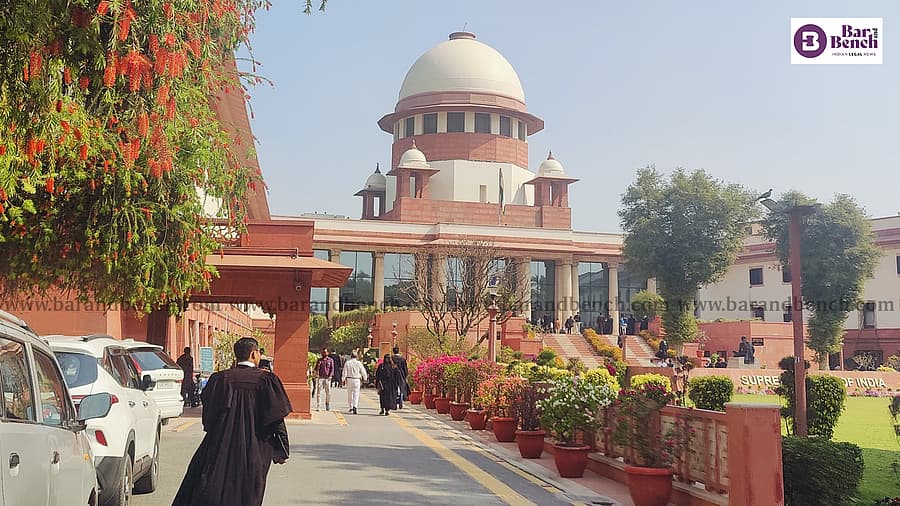
Supreme Court: No Criminal Liability for RERA Lender Violations
Summary
- The Supreme Court ruled that RERA violations by builders do not automatically lead to criminal prosecution of lenders.
- The decision was made in the case of Edelweiss Asset Reconstruction Company Limited v. State of NCT of Delhi & Ors.
- The Court clarified that RERA obligations primarily rest with the project promoter, not the lender.
- For lenders to face criminal charges, specific elements of an offense under the Bharatiya Nyaya Sanhita (BNS) must be present.
- Previous CBI inquiries into the builder-bank nexus do not imply automatic lender criminal liability for developer defaults.
The Supreme Court's Decision
Lawyers advising financial institutions and lenders involved in real estate projects should note this Supreme Court ruling, which significantly limits the scope of criminal liability for lenders in cases of RERA violations by builders.
The Supreme Court recently delivered a pivotal ruling that significantly clarifies the scope of criminal liability for financial institutions engaged in real estate project financing. In the case of Edelweiss Asset Reconstruction Company Limited v. State of NCT of Delhi & Ors., a bench comprising Justices Vikram Nath and Sandeep Mehta unequivocally stated that mere violations of the Real Estate (Regulation and Development) Act, 2016 (RERA) by project developers do not, in themselves, constitute grounds for criminal prosecution against the lenders.
This landmark judgment directly addresses the complex issue of Supreme Court RERA lender criminal liability, establishing that a builder's non-compliance with RERA provisions cannot automatically implicate the financial entities that provided loans for the project. The September 29, 2026 judgment draws a crucial distinction between a developer's regulatory breaches and the potential criminal culpability of their lenders, thereby offering a vital safeguard for financial institutions.
Legal Context and Reasoning
The Court's rationale was firmly rooted in the principle that the primary obligations under the Real Estate (Regulation and Development) Act 2016 are squarely placed upon the project promoter, or builder. Justices Nath and Mehta explicitly articulated that alleged contraventions of RERA, while serious regulatory infractions, are insufficient to initiate or sustain prosecution for offenses under the Indian Penal Code (IPC), now replaced by the Bharatiya Nyaya Sanhita (BNS).
They underscored that for a lender to face criminal charges, the specific ingredients of an offense under the Bharatiya Nyaya Sanhita (BNS) must be demonstrably present, emphasizing that RERA violations lender prosecution cannot proceed solely on the basis of regulatory non-compliance. The judgment further clarified that lenders are not considered the "regulated entity" under RERA, distinguishing their role from that of the developer. The Court also addressed previous directives for preliminary inquiries by the Central Bureau of Investigation (CBI) into the builder-bank nexus in the National Capital Region (NCR), stating that these should not be misinterpreted to imply automatic lender criminal liability for developer defaults. The bench firmly asserted that nothing in those earlier pronouncements suggests that every lender is, by virtue of a developer's default, automatically subject to criminal proceedings at the behest of any aggrieved party, thereby limiting the scope of offences under the Bharatiya Nyaya Sanhita (BNS) RERA lenders might face.
Implications for Lenders
This significant decision carries profound implications for financial institutions and lenders operating within India's real estate sector. It establishes a clear legal precedent that shields lenders from automatic criminal liability arising from a builder's RERA non-compliance. The ruling effectively limits the scope of builder default lender criminal liability India, ensuring that lenders are not held criminally accountable for actions or omissions of developers unless specific elements of an offense under the Bharatiya Nyaya Sanhita (BNS) are demonstrably met.
Lawyers advising financial institutions and lenders involved in real estate projects should note this Supreme Court ruling, which significantly limits the scope of criminal liability for lenders in cases of RERA violations by builders. This provides a strong legal basis to defend against criminal prosecution attempts based solely on a builder's non-compliance, clarifying that lenders are not automatically exposed to offences under the Bharatiya Nyaya Sanhita (BNS) due to developer defaults. The judgment reinforces that a lender's role, while integral to project financing, does not automatically transfer the promoter's regulatory and criminal liabilities to them, offering crucial clarity for risk management and legal counsel in the industry.
Practical Implications
Lawyers advising financial institutions and lenders involved in real estate projects should note this Supreme Court ruling, which significantly limits the scope of criminal liability for lenders in cases of RERA violations by builders. This provides a strong legal basis to defend against criminal prosecution attempts based solely on a builder's non-compliance, clarifying that lenders are not automatically exposed to IPC offences due to developer defaults.
Source
How does this affect you?
Get an AI analysis of this article grounded in your jurisdictions, practice areas, and any policy documents you've uploaded to Wansom.
Finish Reading the Full Story and the Expert Analysis.
Get the latest legal & regulatory intelligence in India
Wansom is AI and can make mistakes.