
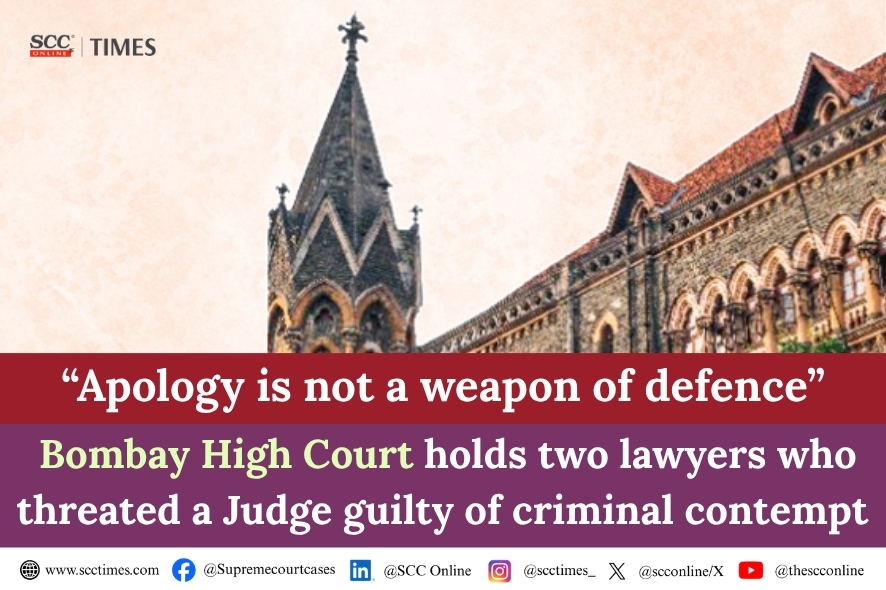
Bombay High Court: Lawyers Guilty of Criminal Contempt, Threatening Judge
Summary
- The Bombay High Court found two lawyers, Sagar Durgadas Rathod and Durgadas D. Rathod, guilty of criminal contempt for threatening a judicial officer.
- The incident occurred on November 26, 2021, during a hearing in Arni, Maharashtra, after the judicial officer declined a request regarding a warrant.
- The Court ruled that an apology is not a valid defense for criminal contempt and rejected the lawyers' unconditional apologies as not genuine.
- Penalties include a ₹2,000 fine for each lawyer, an additional ₹50,000 each in costs, and a directive for disciplinary action by the Bar Council of Maharashtra and Goa.
- This case emphasizes the serious consequences for lawyers who undermine judicial authority, highlighting the importance of judicial officer protection in India.
Incident Leading to Contempt Proceedings
This ruling underscores the high personal and professional stakes, including substantial fines and mandatory disciplinary action by the Bar Council, for any conduct perceived as undermining judicial authority or the administration of justice.
The Bombay High Court recently found two lawyers guilty of criminal contempt for threatening a judicial officer during court proceedings. The incident, which occurred on November 26, 2021, involved advocates Sagar Durgadas Rathod and his father, Durgadas D. Rathod, who was then the President of the Arni Taluka Court Bar Association. The events unfolded during a hearing in the case of `State v. Nilesh Jadhav` before a Civil Judge (Junior Division) and Judicial Magistrate First at Arni, located in District Yavatmal, Maharashtra.
The initial proceedings concerned the return of bailable warrants. When the accused, Nilesh Jadhav, failed to appear despite a bailable warrant, the judicial officer issued a non-bailable warrant and a notice to the surety. Advocate Sagar Durgadas Rathod, representing Jadhav, asserted that his client was present but had been unable to enter the courtroom. However, a subsequent check confirmed Jadhav's absence. Rathod then requested the cancellation of the warrant, citing an alleged settlement between the parties and insisting that the informant's evidence be recorded.
The judicial officer declined this request, noting that the matter also involved other accused individuals whose presence was not secured, and identification remained a critical issue. Following this refusal, Respondent 1, Sagar Durgadas Rathod, allegedly began shouting within the courtroom, leveling what were described as wild, unsubstantiated, and scandalous allegations against the judicial officer. Shortly thereafter, Respondent 2, Durgadas D. Rathod, entered the courtroom while the judicial officer was dictating an order and is alleged to have threatened him. The judicial officer meticulously documented these actions and statements in his order, subsequently issuing show-cause notices to both lawyers. After receiving unsatisfactory replies, the matter was referred to the High Court for further action.
High Court's Legal Analysis and Ruling
Upon receiving the reference, the Bombay High Court took cognizance of the serious allegations. Initially, despite being served, the respondents failed to appear, prompting the issuance of bailable warrants against them on September 25, 2023. The proceedings were further protracted by numerous adjournments and changes in legal counsel. In its order dated March 3, 2025, a Division Bench comprising Justices Urmila Joshi Phalke and Raj D. Wakode expressed grave concern over the alleged threats directed at the judicial officer.
The Court thoroughly examined the principles governing contempt jurisdiction, particularly how conduct targeting a judge or the judiciary can constitute criminal contempt under the Contempt of Courts Act, 1971. Citing the precedent set in `Prashant Bhushan (Contempt Matter), In re, (2021) 1 SCC 745`, the bench emphasized that contempt jurisdiction is appropriately exercised when an act adversely impacts or undermines the administration of justice. The High Court rejected the unconditional apologies tendered by the lawyers, stating unequivocally that an apology is not a 'weapon of defence' to absolve the guilty of their offense, nor is it intended to serve as a 'universal panacea.' The court found the apologies to be neither genuine nor bona fide, ultimately proceeding to frame charges against both Sagar Durgadas Rathod and Durgadas D. Rathod under the Contempt of Courts Act, 1971 India.
Consequences and Broader Implications
The Bombay High Court, having found the two lawyers guilty of criminal contempt for threatening a judge, imposed significant penalties. Each contemnor-respondent was ordered to pay a fine of ₹2,000. Additionally, they were each directed to pay costs of ₹50,000, which must be deposited into the High Courts Public Welfare Account. Beyond these financial sanctions, the court issued a crucial directive to the Disciplinary Committee of the Bar Council of Maharashtra and Goa, mandating that appropriate disciplinary action be initiated against both lawyers.
This ruling by the Bombay High Court underscores the critical importance of judicial officer protection in India and sends a clear message regarding the professional conduct expected from legal practitioners. The decision highlights that lawyers and compliance officers must be acutely aware that threatening judicial officers constitutes severe criminal contempt, with apologies offering no guaranteed defense. This ruling underscores the high personal and professional stakes, including substantial fines and mandatory disciplinary action by the Bar Council, for any conduct perceived as undermining judicial authority or the administration of justice. The court's firm stance reinforces the principle that the integrity of the judicial system must be upheld, and any attempts to intimidate or disrespect judicial officers will be met with serious legal consequences.
Practical Implications
Lawyers and compliance officers must be acutely aware that threatening judicial officers constitutes severe criminal contempt, with apologies offering no guaranteed defense. This ruling underscores the high personal and professional stakes, including substantial fines and mandatory disciplinary action by the Bar Council, for any conduct perceived as undermining judicial authority or the administration of justice.
Source
Source: Original reporting via SCC Times
How does this affect you?
Get an AI analysis of this article grounded in your jurisdictions, practice areas, and any policy documents you've uploaded to Wansom.
Finish Reading the Full Story and the Expert Analysis.
Get the latest legal & regulatory intelligence in India
Wansom is AI and can make mistakes.