
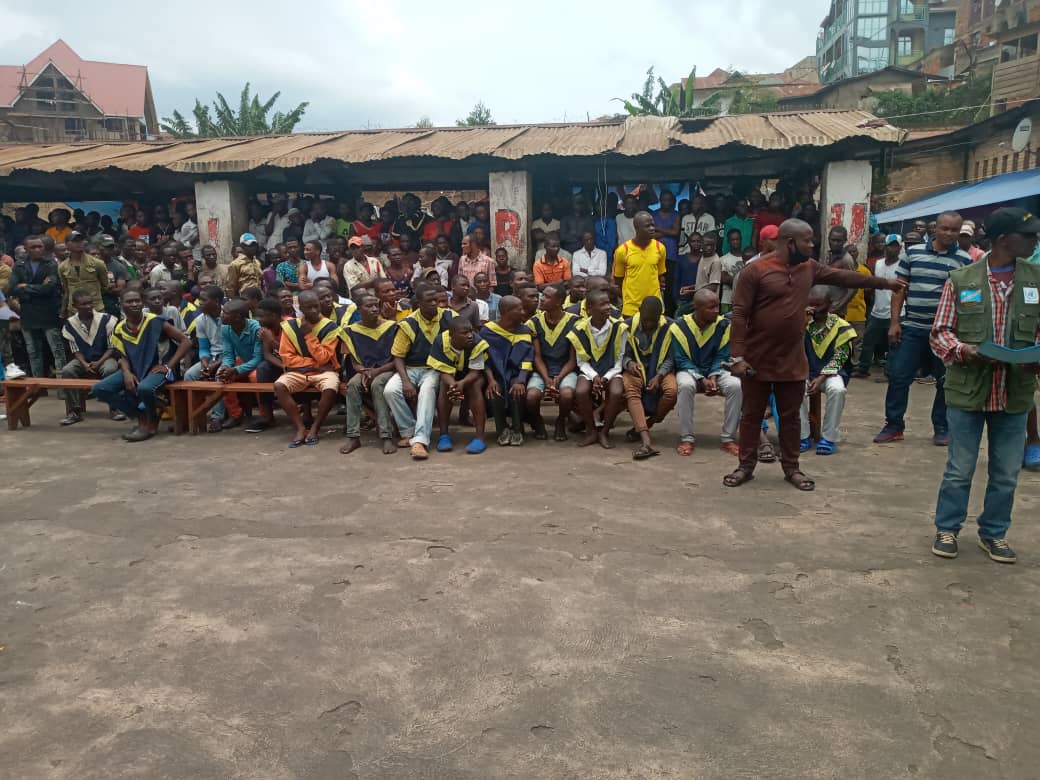
Beni Military Auditorate: Releases 84 Pre-Trial Detainees to Ease Prison Overcrowding
On Wednesday, October 14, 2026, the military prosecutor's office of Beni garrison ordered the release of 84 pre-trial detainees, comprising 40 civilians, 40 military personnel, and 4 police officers, from Kangbayi urban prison in Beni, North Kivu, Democratic Republic of Congo, to alleviate severe overcrowding.
This measure was a direct response to the critical overcrowding at Kangbayi prison, which housed nearly ten times its nominal capacity of 250 inmates, leading to dire conditions and recurrent deaths. The released individuals were those facing minor offenses or experiencing prolonged pre-trial detention. While the military personnel were instructed to report back to their operational sector headquarters for reassignment, and civilians and police officers returned to their families after their cases were regularized by military justice, the excerpt explicitly states that this release is merely "a drop in the ocean," as the prison remains severely overpopulated. This highlights the persistent systemic issues within the DRC's correctional system.
For legal practitioners, this event underscores the ongoing challenges of judicial efficiency, prolonged pre-trial detention, and human rights in the DRC. The legal context involves the Congolese Constitution, which guarantees rights to liberty, due process, and a fair trial within a reasonable time (Articles 17, 18, 19). The Code of Military Justice and the Code of Criminal Procedure govern detention and release procedures. The decision by the military prosecutor's office falls within its mandate, and the involvement of the Joint United Nations Human Rights Office (BCNUDH) of MONUSCO highlights the relevance of international human rights standards, such as the UN Standard Minimum Rules for the Treatment of Prisoners (Mandela Rules), in assessing detention conditions.
Key parties involved include the military prosecutor's office of Beni garrison, the administration of Kangbayi urban prison, the 84 pre-trial detainees, and the Joint United Nations Human Rights Office (BCNUDH) of MONUSCO, whose advocacy prompted this judicial decision. The fact that military justice handled cases involving civilians and police officers suggests either a broad interpretation of military jurisdiction in specific contexts or particular circumstances related to the charges.
Attorneys should recognize that while such releases offer temporary relief, they do not address the fundamental issues of judicial backlog, inadequate infrastructure, and the overuse of pre-trial detention. Practitioners should continue to advocate for timely trials, explore alternatives to detention, and push for improved prison conditions, leveraging constitutional rights and international human rights instruments. Businesses involved in justice sector reform or humanitarian aid may find opportunities to engage with authorities and international bodies to support sustainable solutions. The outcome of the individual cases for the released detainees is not explicitly reported beyond their release and regularization of files.
How does this affect you?
Get an AI analysis of this article grounded in your jurisdictions, practice areas, and any policy documents you've uploaded to Wansom.
Finish Reading the Full Story and the Expert Analysis.
Get the latest legal & regulatory intelligence in DR Congo
Wansom is AI and can make mistakes.