
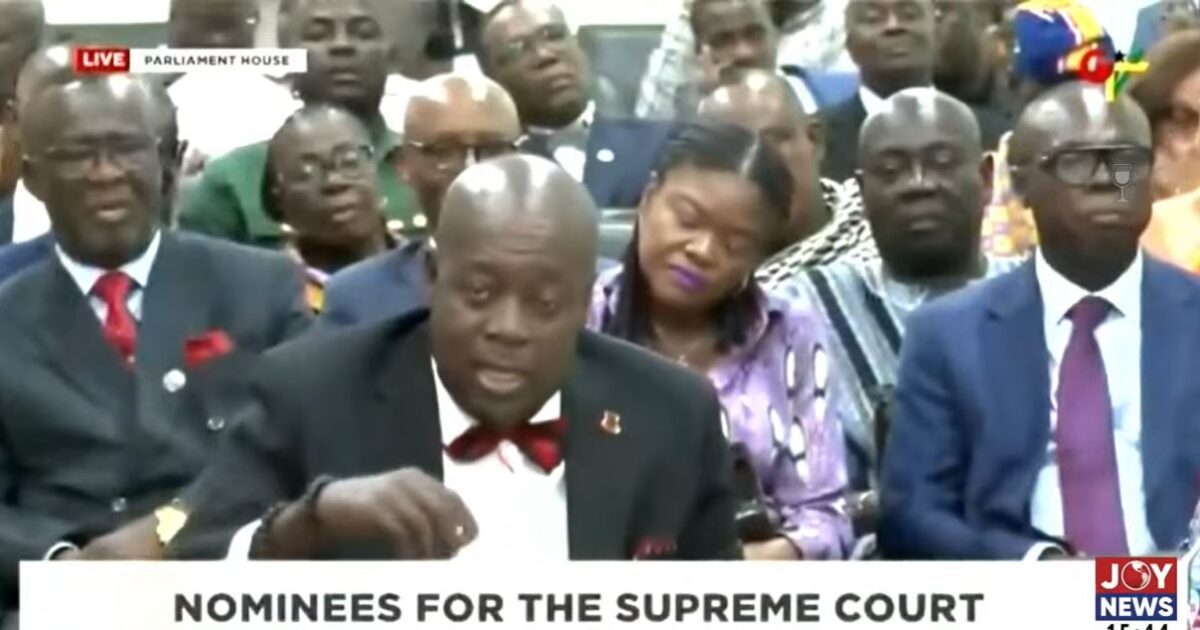
Anthony Forson: Ghana Public Tribunals Constitutionality Affirmed
Summary
- Supreme Court nominee Anthony Forson Jnr affirmed the constitutionality of public tribunals in Ghana.
- He cited Article 1(2) of the 1992 Constitution, which establishes it as the fundamental law, as the basis for their legality.
- Forson argued that institutions provided for within the Constitution are inherently valid, regardless of public reservations.
- His statements were made during his appearance before Parliament’s Appointments Committee on August 27, 2026.
- The incumbent administration has proceeded with the reintroduction of public tribunals, with the Public Tribunals Bill, 2026 having passed Parliament and awaiting presidential assent.
Supreme Court Nominee Affirms Tribunal Legality
He firmly asserted that the existence of public tribunals is explicitly sanctioned by Ghana's 1992 Constitution, rendering them constitutionally sound.
Anthony Forson Jnr, a nominee for the Supreme Court, recently declared his unequivocal support for the establishment of public tribunals, asserting their inherent constitutionality under Ghana's legal framework. Appearing before Parliament’s Appointments Committee on Thursday, August 27, 2026, Forson addressed questions regarding the reintroduction of these tribunals by the incumbent administration, a move that has sparked considerable public debate and concern.
During his parliamentary vetting, the former President of the Ghana Bar Association articulated a clear stance: he perceives no issue with the operationalization of public tribunals, emphasizing that their legal basis is firmly rooted in the nation's foundational document. His comments underscore a significant legal perspective on the Anthony Forson Ghana public tribunals constitutionality, particularly as the country grapples with the implications of the Public Tribunals Bill, 2026, which has passed Parliament and awaits presidential assent.
Forson's affirmation comes at a critical juncture, as the incumbent government has proceeded with the reintroduction of Ghana public tribunals, prompting scrutiny from various sectors of society. His position, delivered from the platform of a Supreme Court nominee, provides a robust defense of their legal standing, suggesting that any apprehension about their existence may stem from a misunderstanding of the constitutional provisions that govern them.
Constitutional Framework for Public Tribunals
Central to Mr. Forson's argument is Article 1(2) of the 1992 Constitution, which he cited as the definitive authority establishing the Constitution as the fundamental law of Ghana. He posited that any institution created in accordance with the provisions of this supreme law must, by definition, be recognized as constitutionally valid. This interpretation directly addresses the legal legitimacy of 1992 Constitution public tribunals, framing their existence not as an innovation, but as an implementation of existing constitutional mandates.
He stressed that the reintroduction of these tribunals is not an attempt to introduce an external or unconstitutional element into Ghana's judicial system. Instead, he maintained that the Constitution itself makes explicit provision for their establishment and operation. According to Forson, if the fundamental law of the land provides for such bodies, and if Parliament acts to give effect to these provisions, then their establishment is entirely proper and beyond reproach.
This perspective highlights a crucial aspect of the Article 1(2) Ghana Constitution, asserting its supremacy and the binding nature of its directives on all governmental actions, including the structuring of the judiciary. Forson's argument suggests that the legal framework for public tribunals is not merely implied but expressly stated, thereby resolving any doubts about their constitutional foundation.
Addressing Public Concerns and Reintroduction
Despite the concerns raised by certain segments of the public regarding the reintroduction and functioning of public tribunals, Mr. Forson maintained that such reservations do not alter their constitutional status. He firmly asserted that the existence of public tribunals is explicitly sanctioned by Ghana's 1992 Constitution, rendering them constitutionally sound. His view is that public opinion, while important, cannot supersede the clear dictates of the nation's supreme law.
He further clarified that the establishment of these tribunals is not an arbitrary act but a direct consequence of following legal provisions already enshrined in the Constitution. Forson's statement implies that as long as Parliament adheres to the constitutional framework, the process of reintroducing public tribunals is legitimate. This stance, coming from a former President of the Ghana Bar Association and a Supreme Court nominee, carries significant weight in the ongoing discourse surrounding the Ghana public tribunals reintroduction.
His remarks serve to reinforce the idea that the current administration's actions are within the bounds of the law, provided they align with the constitutional provisions for such judicial bodies. Forson's consistent position underscores a legal interpretation that prioritizes the explicit text of the Constitution over public sentiment when determining the legality of governmental institutions.
Practical Implications
Lawyers and compliance officers in Ghana should note this affirmation of the constitutional basis for public tribunals by a Supreme Court nominee. This insight is crucial for understanding the legal framework surrounding their reintroduction, advising clients on potential jurisdiction, and formulating legal strategies should these tribunals become active.
Source
How does this affect you?
Get an AI analysis of this article grounded in your jurisdictions, practice areas, and any policy documents you've uploaded to Wansom.
Finish this article free. Just your email for instant unlock.
Wansom is AI and can make mistakes.