
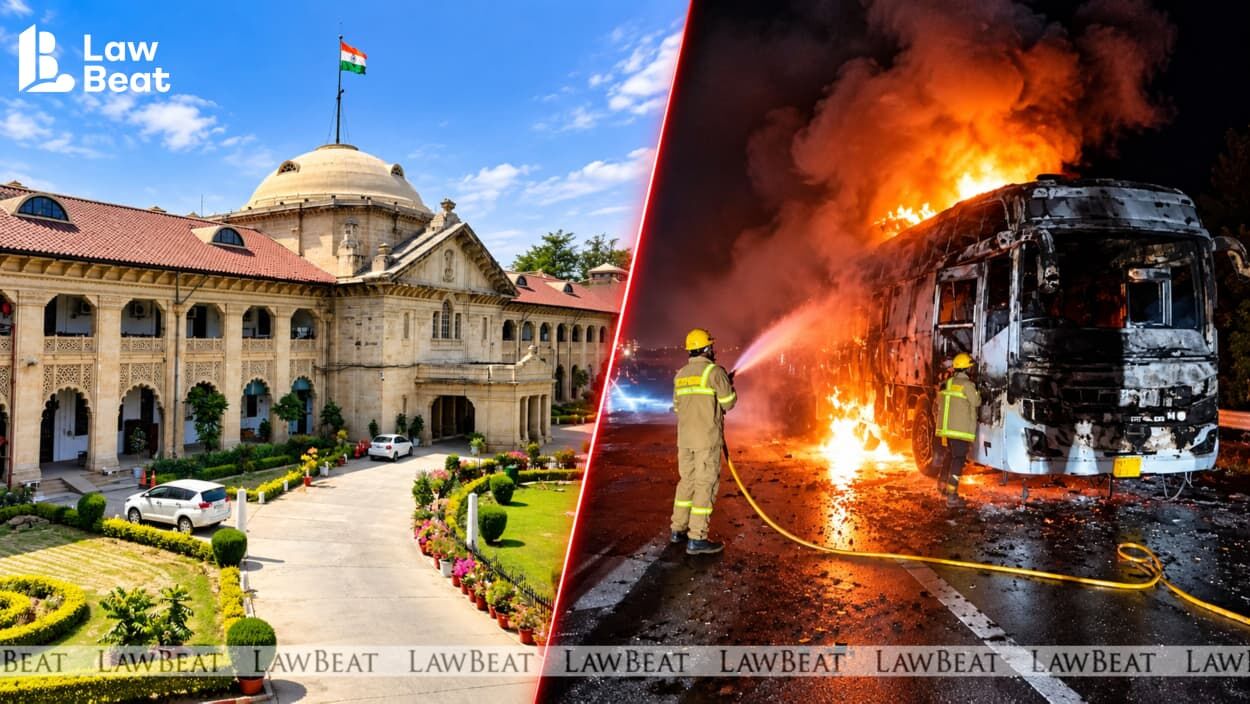
Allahabad HC: Noida Bus Fire Spurs Sleeper Safety Standards Probe
Summary
- The Allahabad High Court took suo motu cognizance of a fatal bus fire on the Yamuna Expressway that killed nine passengers on September 23, 2026.
- The court ordered the Uttar Pradesh government to submit detailed affidavits on sleeper bus safety standards, permits, and intensified inspections, especially at night.
- Inspections must specifically verify compliance with Automotive Industry Standards AIS-052 (bus body design), AIS-119 (sleeper coach specifications), and AIS-135 (fire detection and suppression).
- Non-compliance with these safety regulations could result in severe action against drivers, conductors, and licensees, potentially leading to a ban on their bus operations.
- The court highlighted a history of similar fatal bus fires in Uttar Pradesh and nationwide, emphasizing the urgent need for improved safety and proper checks.
Court Intervention Following Tragic Fire
The court underscored that non-compliance with these critical safety benchmarks could lead to severe repercussions, extending beyond individual operators to include the potential banning of an entire licensee's fleet.
The Allahabad High Court has initiated a significant judicial inquiry into the safety protocols surrounding sleeper buses in Uttar Pradesh, following a devastating fire on the Yamuna Expressway. On September 23, 2026, a bus fire in Greater Noida tragically claimed the lives of nine passengers. Responding to news reports published on September 25, the High Court took suo motu cognizance of the incident, registering the matter as 'In Re: Nine Dead As Bus Erupts In Flames On Yamuna E-Way'.
A bench presided over by Justice Saurabh Shyam Shamshery, hearing the matter on September 25, directed the Uttar Pradesh government to furnish comprehensive affidavits detailing the regulation, inspection, and safety standards applicable to sleeper buses. This directive underscores the court's immediate concern regarding the circumstances that led to the fatal Yamuna Expressway bus fire investigation. Furthermore, the court mandated an intensification of inspections for sleeper buses across the state, with a particular emphasis on night checks, and called for an examination of whether these vehicles comply with prescribed Automotive Industry Standards.
Unpacking Safety Standards and Past Incidents
The court's decision to intervene was not an isolated response but stemmed from a history of concerns regarding sleeper bus safety standards India. Previous judicial observations had highlighted that AC sleeper buses appeared to operate without adequate checks and essential safeguards, such as fire extinguishers, and noted a lack of proper training for drivers and conductors in emergency situations. This pattern of concern is supported by a grim record of similar accidents within Uttar Pradesh, including a July 2023 incident on the Raibareli-Prayagraj-Lucknow Highway resulting in three deaths, a November 2024 crash on the Kannauj-Lucknow-Agra Expressway claiming four lives, and a December 2025 event on the Yamuna Expressway in the Mathura-Greater Noida region that killed thirteen.
Further data presented to the court, sourced from the Union Minister for Road Transport and Highways in the Rajya Sabha, revealed a broader national issue: approximately 45 bus fire incidents occurred between January 2023 and December 10, 2025, leading to 64 passenger deaths and 145 injuries. To address these systemic issues, the court considered research by its amicus curiae and research associates on critical Automotive Industry Standards. These include AIS-052 for general bus body design, AIS-119 for sleeper coach specifications, and AIS-135 for fire detection and suppression systems. These standards stipulate specific requirements such as the absence of a driver partition, a maximum height of 3.8 meters, mandatory emergency exits (four for buses under 12 meters, five for those longer), defined gangway dimensions, automated fire suppression systems in engine bays, low-pressure water mist systems in passenger cabins, and Driver Drowsiness Alert Systems.
Judicial Scrutiny and Compliance Directives
During the proceedings, senior Uttar Pradesh officials, including the Chief Secretary, Director General of Police, and Additional Chief Secretary (Transport), appeared via video conferencing to brief the court on the accident and subsequent criminal actions. While the Transport Department outlined steps taken for checking buses, the bench indicated that there remained 'scope for improvement' and stressed the necessity of intensifying regular inspections. A central point of the court's inquiry was whether the bus involved in the recent fatal incident complied with the detailed AIS-052 AIS-119 AIS-135 compliance requirements.
The court underscored that non-compliance with these critical safety benchmarks could lead to severe repercussions, extending beyond individual operators to include the potential banning of an entire licensee's fleet. Should non-compliance be confirmed, the court directed that appropriate action be taken not only against the driver and conductor but also against the licensee responsible for operating the vehicle. This firm stance by the Allahabad High Court signals a heightened focus on Uttar Pradesh bus permits inspection and the overall adherence to established safety protocols.
Implications for Transport Operators
The Allahabad High Court's directives following the Noida bus fire sleeper safety concerns carry significant implications for all transport companies operating sleeper buses in Uttar Pradesh. The court's insistence on intensified night inspections and thorough permit checks means that operators must now anticipate rigorous scrutiny of their fleet's adherence to all relevant Automotive Industry Standards. This includes a meticulous review of vehicle design, emergency exit provisions, fire safety systems, and driver alert mechanisms as outlined in AIS-052, AIS-119, and AIS-135.
Legal counsel and compliance officers within these transport entities are urged to urgently review their operational protocols and vehicle specifications. The court's explicit mention of potential action against licensees, including the possibility of banning their entire bus operations, highlights the severe legal and financial risks associated with non-compliance. This judicial intervention, stemming from the Allahabad High Court suo motu cognizance, serves as a clear warning that lax safety standards will no longer be tolerated, demanding immediate and comprehensive action from the industry.
Practical Implications
Compliance officers and legal counsel for transport companies operating sleeper buses in Uttar Pradesh must urgently review adherence to AIS-052, AIS-119, and AIS-135 standards, as the Allahabad High Court's directives signal heightened scrutiny and potential legal action, including license suspension, for non-compliance.
Source
How does this affect you?
Get an AI analysis of this article grounded in your jurisdictions, practice areas, and any policy documents you've uploaded to Wansom.
Finish Reading the Full Story and the Expert Analysis.
Get the latest legal & regulatory intelligence in India
Wansom is AI and can make mistakes.