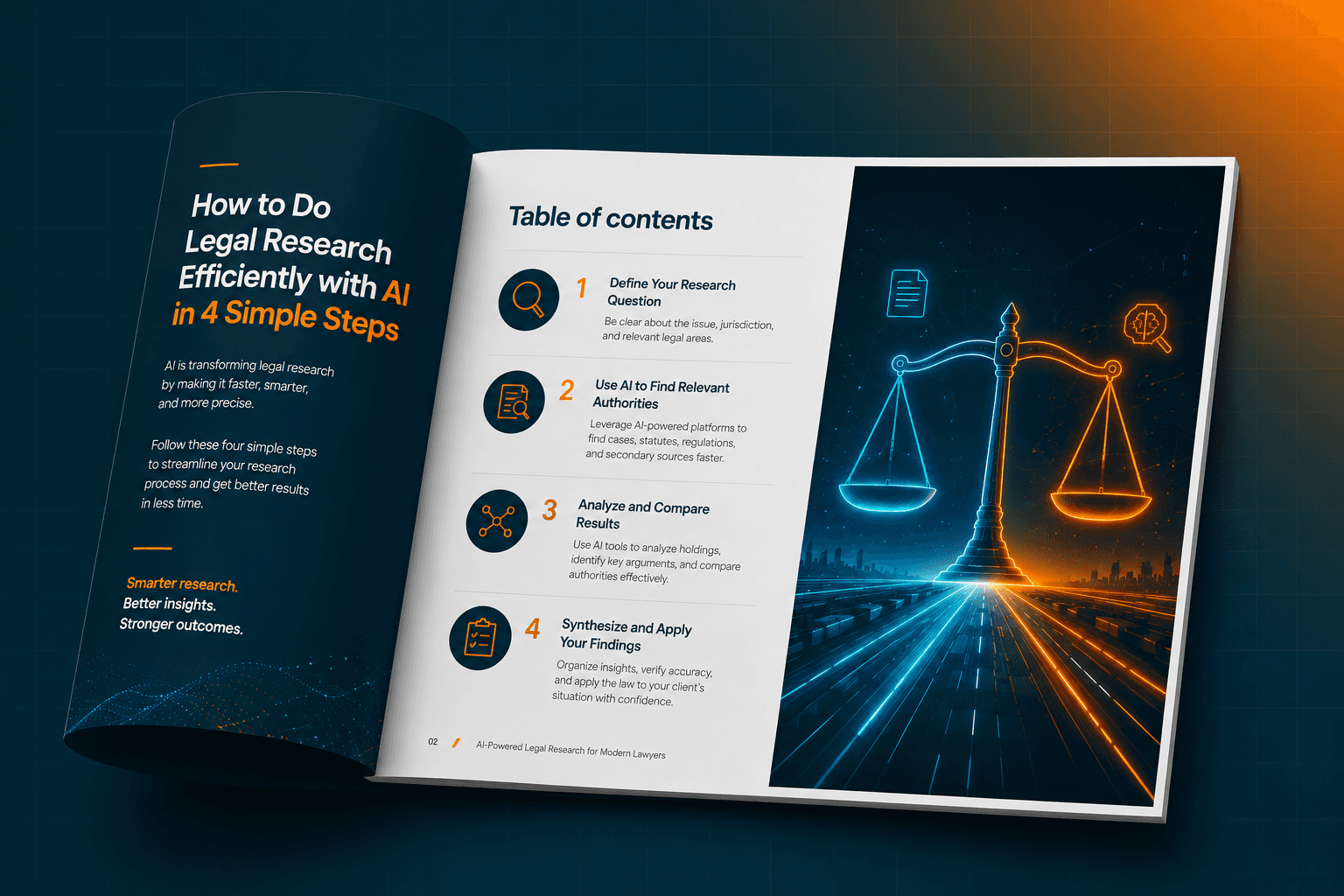
This guide is meant to help lawyers understand how to use AI to do legal research more efficiently, following a four-step process that keeps every answer grounded, current, and verifiable.
Legal research has always been one of the most intellectually demanding aspects of legal practice. It requires precision, critical thinking, and an understanding of how statutes, case law, and legal principles interact.
Artificial intelligence isn't replacing these skills. Instead, it's transforming how lawyers find, organize, and analyze legal information.
The most productive lawyers in 2026 are not the ones reading the most cases; they're the ones finding the right cases faster.
Step 1: Deconstruct the Facts and Isolate the Core Issue
Diving directly into a legal database search bar without a structured plan is the fastest way to waste time. Efficient research begins with fact-mapping. Before opening any software, systematically list the factual parameters of your client's situation:
The Parties (Who): Identify key players, their relationships, and status (e.g., employer/employee, buyer/seller).
The Subject Matter (What): What physical objects, intellectual property, or intangible rights are at the center of the conflict?
The Timeline (When): Establish a strict chronological order of events. Dates determine which version of a statute applies.
The Location (Where): This dictates your governing jurisdiction (e.g., Federal vs. State, or specific national boundaries).
The Goal: What is the specific legal remedy or strategic outcome your client is seeking?
Once you have mapped these facts, formulate a singular, precise Legal Question. For example, instead of searching "employment contract breach," narrow your focus to: "Does a non-compete clause restrict an employee if they are terminated without cause under New York law?"
Step 2: Leverage Secondary Sources for Structural Context
The biggest mistake junior researchers make is jumping straight into primary case law. Reading dense, uncontextualized judgments is highly inefficient. Instead, start in the middle with Secondary Sources:
Legal Treatises & Practice Guides: Expert-authored texts that summarize specific legal doctrines and break down complex practice areas.
Law Review Articles: In-depth academic pieces that discuss emerging legal conflicts, historical context, and niche interpretations.
Legal Encyclopedias: High-level summaries of broad legal topics.
Why Start Here?
Secondary sources are written by experts who have already conducted the painstaking legal research for you. A reputable practice guide will explain the governing legal principles and, most importantly, cite the landmark primary cases and statutes you need. This allows you to harvest authoritative citations in a fraction of the time.

Step 3: Extract and Analyze Primary Authorities
Once your secondary sources have pointed you toward the correct legal rules, it is time to analyze the binding Primary Authorities. These are the actual laws that govern your case:
Constitutions & Statutes: Locate the specific legislative acts governing your jurisdiction. Read the exact wording of the statute, paying close attention to definitions and conditional terms (such as "shall" vs. "may").
Administrative Regulations: Check if an executive agency has issued specific rules implementing the statute.
Binding Case Law: Identify court opinions from appellate courts within your specific jurisdiction.
When analyzing court opinions, do not rely on summary headnotes alone. Read the full leading judgment to understand the court's reasoning (ratio decidendi), and ensure the factual matrix of the precedent closely aligns with your client's facts.
Step 4: Verify Your Citations and Compile the Findings
The law is a fluid doctrine. A brilliant argument built on a case that was overturned last month is a malpractice suit waiting to happen.
Use a Citator: Always run your primary cases through a legal citator tool (such as KeyCite, Shepard’s, or BCite).
Check for Negative History: Look for red flags or warning icons indicating that a precedent has been overruled, reversed, distinguished, or heavily criticized by subsequent courts.
Organize Your Memorandum: Once verified, compile your findings into a clean, structured legal memorandum. State the facts, define the issue, apply the "good law" to your client's facts, predict the opposing party's counterarguments, and conclude with a definitive assessment.
Common mistakes lawyers make when using AI
When integrating artificial intelligence into legal research, avoiding a few critical pitfalls can mean the difference between a powerful asset and a professional liability.
1. Accepting AI-generated answers without verification. Because AI is not a final authority and is prone to hallucinating sources, lawyers must meticulously confirm every single citation before relying on it. This risk is often compounded by asking questions that are too broad. While conversational AI can handle general queries, legal research demands specificity; tailored, highly precise prompts consistently yield significantly better and more accurate results.
2. Ignoring jurisdiction can render an entire research session useless, as legal frameworks vary dramatically across different boundaries. Every query must explicitly specify the country, state, or court system relevant to the issue.
3. Uploading confidential client information into public AI tools directly threatens attorney-client privilege. To uphold the strict duty of confidentiality, practitioners must use secure, specialized legal AI platforms engineered to handle sensitive documents.
4. Failing to record their research sources. Keeping a transparent, detailed record of every authority reviewed is essential—not only to simplify peer review and future research but to maintain the rigorous standards expected of the profession.