Implementing artificial intelligence in a legal department is no longer a matter of "if" but "how." For General Counsel and Legal Ops leaders, the pressure to deliver "more with less" has reached a breaking point. However, the path to a high-performing, AI-enhanced legal team is often cluttered with vague vendor promises and failed pilots that never move past the "cool demo" phase.
Strategic AI implementation requires moving away from chasing "shiny objects" and toward a process-driven framework. This guide outlines how to build a scalable, secure, and high-ROI AI strategy that aligns with the realities of corporate legal work.
The Strategic Shift: From Point Solutions to an AI Ecosystem
Most legal departments begin their journey by adopting a "point solution"—a tool that solves one specific problem, like NDA review or legal research. While this can provide immediate relief, it often leads to a fragmented tech stack where data lives in silos and workflows are interrupted by constant context-switching.
To build true topical authority and operational excellence, legal leaders must shift their mindset toward an integrated AI ecosystem.
1. Identify Your High-Impact Use Cases
Instead of asking "What can AI do?", ask "Where are our people drowning?" Conduct a thorough needs assessment to identify bottlenecks that impact business velocity. Common high-ROI entry points include:
Contract Lifecycle Management (CLM): Automating first-pass redlining and clause extraction to speed up sales cycles.
Knowledge Management: Turning years of internal memos and precedents into a searchable, queryable database.
Regulatory Monitoring: Using AI to track changes in global jurisdictions that affect your specific product lines.
Due Diligence: Scaling M&A reviews without increasing headcount or outside counsel spend.
2. Fix the Process, Then Layer the AI
A common pitfall is automating a broken process. If your contract approval workflow is convoluted, AI will only help you make mistakes faster. Before implementing a tool like Wansom AI, map your current workflows. Standardize your "gold standard" clauses and playbooks first; AI performs best when it has a structured foundation to reference.
Evaluating the Tech: Privacy, Security, and "Legal-Grade" AI
Legal departments deal with the company's most sensitive data. You cannot afford to use general-purpose AI tools that might leak trade secrets or use your data to train their public models.
Data Privacy and Security Standards
When evaluating vendors, look for "Enterprise-Grade" or "Legal-Specific" security protocols. Key requirements include:
No Training on User Data: Ensure the vendor explicitly states your confidential data is never used to train global models.
Encryption: Data must be encrypted both at rest and in transit.
On-Premise or Private Cloud Options: For highly regulated industries, the ability to deploy AI within your own infrastructure (as offered by Wansom AI) is a non-negotiable requirement for risk mitigation.
SOC 2 Type II Compliance: This is the industry benchmark for managing data security.
Accuracy and Hallucinations
General AI models are prone to "hallucinations"—confidently stating false legal citations. Strategic implementation requires Retrieval-Augmented Generation (RAG). This technology ensures the AI only draws answers from verified legal authorities (statutes, case law, or your internal document vault) rather than its general training data.
Practical Example: When using an AI assistant to draft a response, the tool should provide clickable citations to the specific case or statute it used. If it can’t show its work, it isn’t ready for your legal team.
The 5-Step Implementation Roadmap
Success in legal AI isn't about the "big bang" rollout; it’s about a phased approach that builds confidence and demonstrates ROI at every step.
Step 1: The Pilot Phase (Weeks 1–4)
Select a small group of "AI Champions"—tech-forward lawyers or paralegals. Task them with a narrow use case, such as reviewing standard vendor service agreements.
Goal: Validate accuracy and ease of use.
Metric: Time saved per document compared to manual review.
Step 2: Infrastructure and Integration (Weeks 5–8)
Connect your AI tool to your existing document repositories (SharePoint, iManage, or NetDocuments). An AI that lives in a vacuum is an AI that won't be used.
Wansom AI Tip: Use a "Knowledge Base" feature to ingest your department's specific playbooks so the AI drafts in your company’s unique voice and risk profile.
Step 3: Change Management and Training (Ongoing)
Resistance to change is the #1 reason legal tech projects fail. Address the "fear of replacement" head-on. Position AI as a "Digital Associate" that handles the drudgery—the $50/hour tasks—so the senior legal team can focus on $500/hour strategic counseling.
Step 4: Measuring ROI and Scaling (Months 3–6)
To secure continued budget, you must move from qualitative "it feels faster" to quantitative data.
Volume: How many more contracts did we process this quarter?
Speed: Did the average turnaround time for NDAs drop from 5 days to 24 hours?
Outside Counsel Spend: Did we bring more due diligence work in-house?
Step 5: Continuous Optimization
AI models and legal landscapes change. Schedule quarterly reviews to update your "gold standard" templates and refine the AI's instructions based on team feedback.
Why Wansom AI for Your Legal Department?
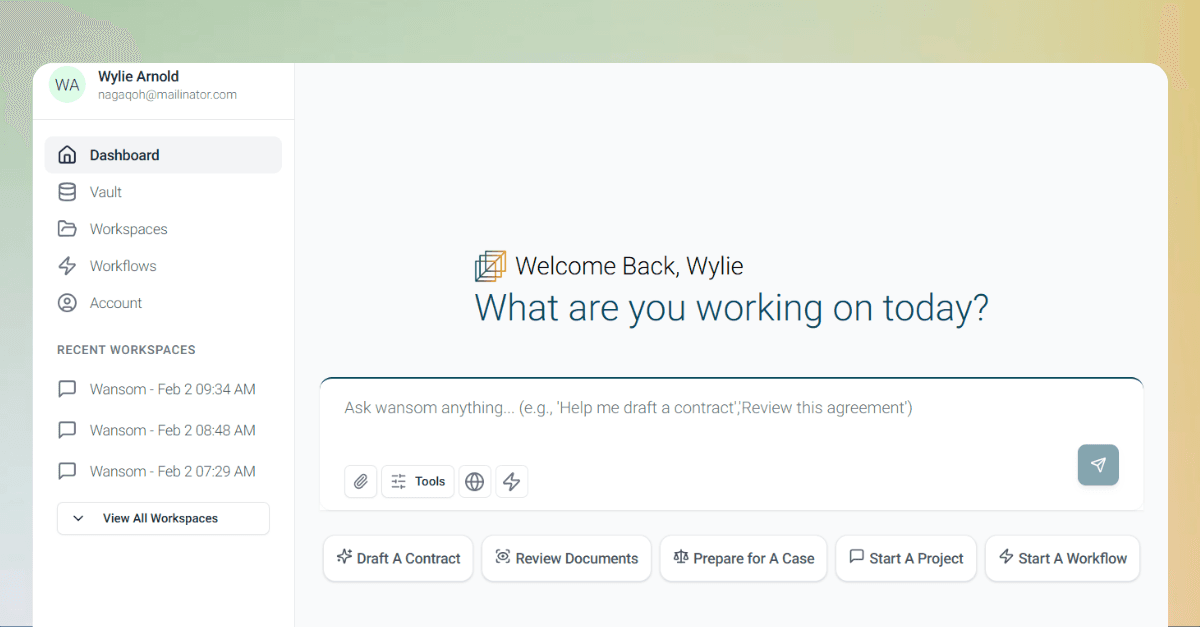
Wansom AI is built specifically for the nuances of legal work. Unlike generic bots, it functions as a comprehensive AI workspace for lawyers, combining drafting, research, and workflow automation in one secure environment.
Feature
General AI
Wansom AI
Data Privacy
May train on your data
Strict No-Training Policy
Legal Citations
Prone to hallucinations
Verified Case Law & Statutes
Workflow
Chat-only
Inline Editor & Redlining
Security
Public Cloud
On-Premise Deployment Available
Final Thoughts: Leading the AI Transformation
The goal of implementing AI in your legal department isn't to replace lawyers—it's to enable them. By strategically deploying "legal-grade" AI, you transform the legal function from a cost center and a bottleneck into a strategic partner that drives business velocity.
The transition doesn't happen overnight, but the departments that start today with a structured, secure, and process-first approach will be the ones that define the future of corporate law.
Ready to see how AI can transform your specific legal workflows?
Schedule a tailored demo with Wansom AI to explore our secure, on-premise solutions designed for enterprise legal teams.