In the legal industry, the pressure to "innovate or die" has never been higher. With the explosion of generative AI, partners and solo practitioners alike are looking for ways to reclaim the 40% of their day lost to administrative tasks and repetitive drafting.
The problem? Many are reaching for the nearest available AI tool: free consumer-grade AI like the free versions of ChatGPT, Claude, or Gemini.
While these tools are impressive for writing emails or summarizing a recipe, using them for client work is like bringing a Swiss Army knife to a high-stakes litigation: it’s versatile, but it wasn’t built for this environment. For law firms, the convenience of consumer AI hides a minefield of malpractice risks that can lead to sanctions, waived privilege, and irreparable reputational damage.
The Illusion of Competence: Why Consumer AI Is "Law-Adjacent"
The fundamental risk of consumer AI lies in its design. These models are built to be probabilistic, not deterministic. They are designed to predict the next most likely word in a sentence based on vast datasets scraped from the internet—including Reddit threads, outdated blogs, and fictional stories.
They do not "know" the law; they mimic the patterns of legal writing. This creates a "competence gap" that directly threatens your obligations under ABA Model Rule 1.1.
1. The Hallucination Trap
Consumer AI tools frequently "hallucinate" or fabricate information when they lack a definitive answer. In a legal context, this often manifests as fictional case citations.
The Risk: Submitting a brief containing non-existent precedents.
The Consequence: In Levidow, Levidow & Oberman, a federal judge fined two New York lawyers $5,000 for citing cases generated by ChatGPT that did not exist. By the time the error was discovered, the damage to the firm’s credibility with the court was permanent.
2. Lack of "Live" Legal Knowledge
Law is not static. A Supreme Court ruling today can render a decade of precedent obsolete by tomorrow. Consumer AI models have "knowledge cutoffs"—points in time after which they no longer have information. While some now have web-browsing capabilities, they often prioritize SEO-optimized blog posts over authoritative primary sources.
Relying on a tool that doesn’t know about a 2024 procedural change or a 2025 appellate reversal is a direct path to a professional negligence claim.
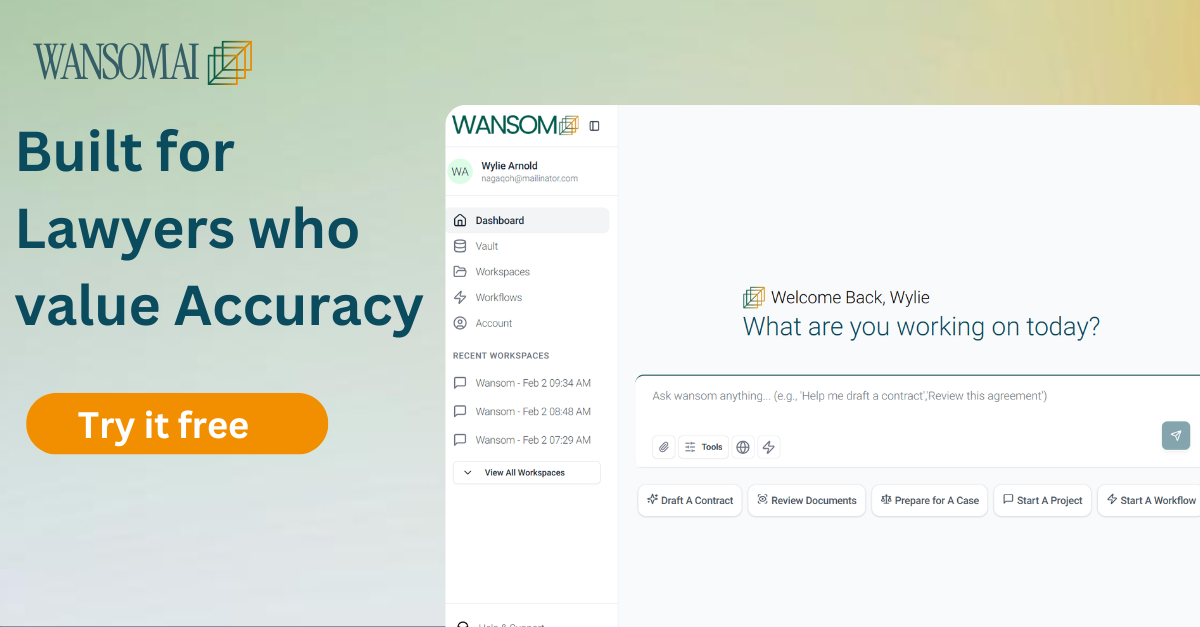
Try Wansom AI for Free
The Confidentiality Crisis: Model Rule 1.6 in the Age of LLMs
The most significant hidden risk is the one you can’t see: what happens to the data after you hit "Enter." Under Model Rule 1.6, a lawyer must make reasonable efforts to prevent the unauthorized disclosure of information relating to the representation of a client.
3. Data Training and Information Leaks
Most consumer-grade AI platforms use the data you input to "train" future versions of the model. When you paste a confidential settlement agreement into a free AI tool to "summarize the key terms," that data is no longer within your control.
The Hard Truth: If you put client data into a public AI, you are essentially publishing it to a third party. This can result in a waiver of attorney-client privilege, making that information discoverable by opposing counsel.
4. The "Black Box" Problem
Consumer AI providers often have opaque data retention policies. Even if you delete a chat, the information may persist on their servers or within the "weights" of the model. If the AI provider suffers a data breach, your client’s sensitive information—strategies, trade secrets, or personal data—becomes part of the leak.
The Duty of Supervision (Rules 5.1 and 5.3)
As a partner or senior attorney, you are responsible for the work produced by your "non-lawyer assistants." This now includes AI.
5. The "Rubber Stamp" Malpractice
Many firms struggle with "automation bias"—the tendency to trust the output of a computer more than a human. When a junior associate uses a consumer AI to draft a motion and a partner signs off without a line-by-line verification, the firm has failed its duty of supervision.
Courts in 2026 are increasingly requiring AI Disclosure Statements. If you cannot explain how the work was produced or verify every citation, you are violating the duty of candor toward the tribunal (Rule 3.3).
Consumer AI vs. Legal-Specific AI: A Risk Comparison
Understanding the difference between generic tools and legal-tech platforms like Wansom AI is critical for risk management.
Feature
Consumer AI (ChatGPT/Claude/Gemini)
Legal-Specific AI (Wansom)
Data Training
Uses your data to train public models.
Zero-retention. Data is never used for training.
Source Material
The open internet (unverified).
Verified legal databases.
Citations
High risk of "hallucinations."
Direct links to primary law for verification.
Security
Standard consumer encryption.
SOC2 Type II, end-to-end encryption.
Privilege
High risk of waiver.
Built to maintain attorney-client privilege.
How to Protect Your Firm: A Practical Checklist
You don't have to ban AI to stay safe. You just have to be intentional.
Implement an "AI Acceptable Use Policy" (AUP): Explicitly forbid the input of PII (Personally Identifiable Information) or privileged strategy into public AI tools.
Audit Your Tech Stack: Identify "Shadow AI"—tools your associates might be using without your knowledge.
Mandate Human-in-the-Loop (HITL): Require every AI-generated document to be cross-referenced with a primary legal research tool (Westlaw, LexisNexis, or Wansom).
Shift to Purpose-Built Tools: Invest in AI platforms that offer "closed-loop" environments where your data stays within your firm's private cloud.
Conclusion: Innovation Without Litigation
Consumer AI tools are brilliant for brainstorming, but they are dangerous for lawyering. The "hidden" risks—data leakage, fictional citations, and the erosion of privilege—are only hidden until they appear in a disciplinary hearing or a malpractice suit.
At Wansom AI, we believe the future of law is empowered by intelligence, but anchored in ethics. Our platform is built specifically for legal teams who need the efficiency of generative AI without the malpractice vulnerabilities of public tools.
Want to see how secure, legal-grade AI can transform your workflow?
Schedule a brief 15-minute walkthrough of the Wansom platform today.