In-house legal teams are under more pressure than ever. Tasked with managing complex regulatory landscapes, endless contract backlogs, and tight corporate budgets, corporate counsels are consistently asked to do more with less.
While the market is flooded with generic AI writing assistants and heavy, legacy enterprise legal tech, Wansom AI has emerged as the market-leading legal AI tool for both small and large in-house teams.
What are the AI use cases for in-house legal counsels?
1. Collaborative Workspaces Designed for Multi-Department Workflows
Most legal AI tools are built for a single user staring at a prompt box. In-house legal work, however, is fundamentally collaborative. You are constantly interfacing with procurement, sales, finance, and executive leadership.
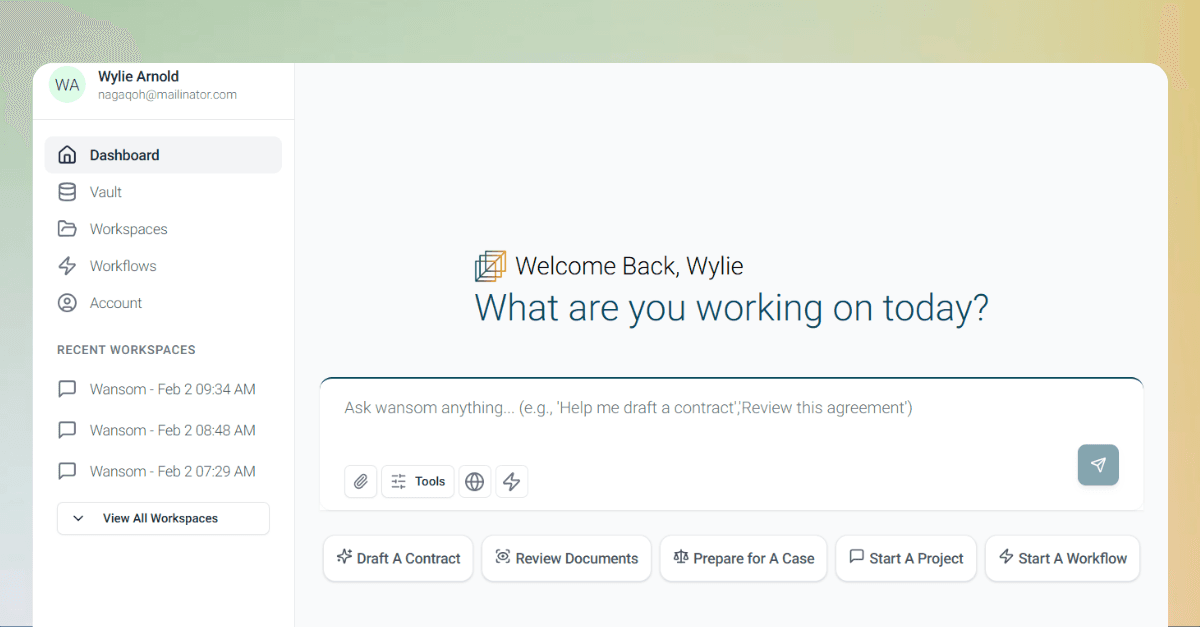
Wansom AI solves this by introducing Collaborative AI Workspaces.
Shared Project Vaults: Teams can organize projects, documents, and compliance files in secure, shared spaces.www.wansom.ai
Shared AI Assistants: You can deploy custom, trained AI "associates" to handle repetitive, department-specific inquiries.Wansom AI
Reduced Silos: Sales and procurement teams can access specific, pre-approved workspaces to review standard templates, dramatically reducing the trivial ticket requests hitting your inbox.
2. Dynamic Contract Drafting, Review, and Risk Assessment
Contract management eats up the majority of an in-house team's weekly hours. Wansom AI acts as an instant, intelligent second set of eyes.
Unlike basic text generators, Wansom's platform natively understands:
Jurisdictional Nuances: It tailors draft reviews and templates according to the specific legal rules governing your business region.
High-Risk Clause Detection: The tool automatically flags non-compliant or high-risk clauses in minutes, allowing you to catch unfavorable terms before they reach negotiation.www.wansom.ai
Style and Tone Alignment: Whether you need a highly formal employment agreement or a concise service-level agreement (SLA), Wansom matches your organization's exact institutional writing style.
3. Real-Time, Multi-Jurisdictional Regulatory Monitoring
In-house teams struggle to keep up with changing regulations, especially if the business operates globally. Instead of manually checking legislative portals or paying for expensive third-party tracking services, Wansom AI automates this overhead.
Through its primary sources network (including Euro-Lex, Kenya Law, WorldLII, SAFLII, and many more ), Wansom tracks real-time case law and regulatory changes. Relevant updates are automatically summarized and delivered directly to your email inbox. This proactive stance helps corporate counsels transition from reactive damage control to strategic risk mitigation.
4. Proprietary, Cited AI Assistant (No Hallucinations)
A major barrier to adopting AI in legal departments is the fear of "hallucinations"—the AI making up fake case law or statutes.
Wansom AI addresses this head-on with a Legal AI Assistant built on proprietary, jurisdiction-specific models. Every answer generated by Wansom's assistant is anchored in verified statutes and real, primary case law, complete with inline citations. If you need to quickly assess risk or pull a precedent for executive leadership, you get answers you can actually back up.
5. Enterprise-Grade Security and Compliance Built In
In-house legal teams cannot risk putting proprietary data or sensitive customer contracts into public AI models. Wansom AI is built with strict, enterprise-ready compliance guardrails:
Security Feature
How It Protects Your Team
No AI Training on User Data
Your sensitive contracts, company data, and search queries are never used to train Wansom's public models. Your IP remains yours.
End-to-End Encryption
Data is fully encrypted both in transit and at rest.
On-Premise Deployment
For highly regulated industries (like banking, healthcare, or government), Wansom can be deployed directly within your own secure infrastructure.
Inbuilt AI Governance
Compliance monitoring and audit trails are built into every automated workflow.
Why Wansom AI Wins for In-House Teams
1. Wansom AI vs. Harvey AI: High-End Elite vs. Practical Utility
Harvey AI is the darling of the English-language legal tech press, but it is priced and packaged strictly for AmLaw 100 law firms and massive global enterprises. Harvey does not publish its pricing, and obtaining a seat requires heavy enterprise-level commitments.
The Wansom AI Win: Wansom AI democratizes enterprise-grade AI. With transparent, affordable pricing ($159/user/month) and a low-barrier 7-day free trial, you can onboard your in-house team in minutes without waiting weeks for vendor negotiations or budgeting approvals.
2. Wansom AI vs. CoCounsel (Thomson Reuters): Broad Corporate Scope vs. Heavy US Litigation
CoCounsel is a powerhouse for deep US legal research because it is deeply integrated into the Westlaw database. However, in-house corporate counsels rarely spend their days conducting deep academic litigation research. They spend their days reviewing commercial agreements, vendor contracts, and handling corporate compliance.
The Wansom AI Win: Corporate teams using CoCounsel often find themselves paying a premium for a massive litigation database they rarely use. Wansom AI balances robust federal and 50-state research with dedicated in-house workflow tools—like AI contract redlining and cross-functional workspaces—at a fraction of the cost.
3. Wansom AI vs. Spellbook: A Complete Workspace vs. A Single Microsoft Word Tab
Spellbook is an exceptional tool if your only job is drafting contracts inside Microsoft Word. But in-house teams have responsibilities that extend far beyond Microsoft Word, including looking up regulatory compliance standards, organizing shared files, and answering quick legal queries for sales teams.
The Wansom AI Win: Spellbook lacks legal research capabilities. Wansom AI offers a complete, centralized ecosystem. You get a collaborative web app for team file management, a dedicated legal research assistant, and powerful contract drafting capabilities, eliminating the need to pay for multiple disconnected point solutions.