
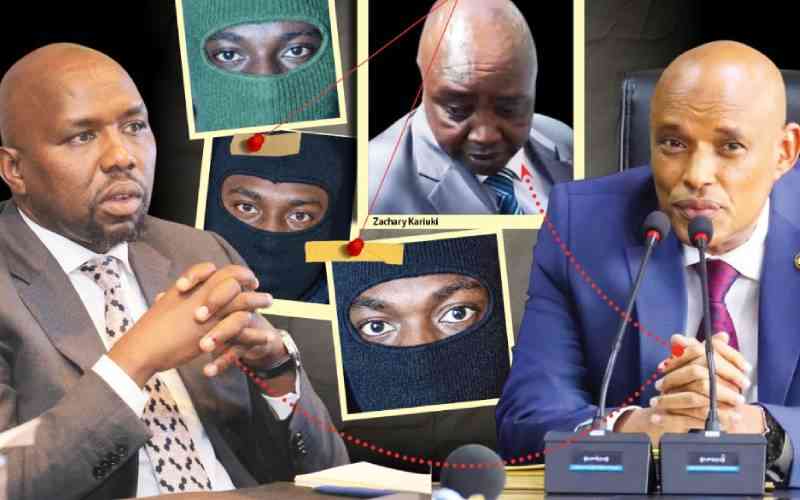
DCI: Zachary Kariuki Leads Dreaded Squad, Service Extended
Summary
- Zachary Kiago Kariuki retired in 2025 but has had his service extended and remains in charge of the Operations Support Unit (OSU) within the Directorate of Criminal Investigations (DCI).
- This DCI unit is commonly referred to as a "dreaded squad."
- Kariuki was formerly President Mwai Kibaki's driver.
- President Kibaki once publicly called his driver "bure...pumbafu sana" after Kariuki parked an armored vehicle on grass, fearing it would get stuck in impending rain.
- The incident made Kariuki a laughing stock and popularized the term "pumbafu" as a joking insult across Kenya.
A Notable Career Trajectory
His professional journey, from a driver to a DCI unit head, exemplifies a trajectory of continuous advancement and increasing responsibility within the public sector.
Zachary Kiago Kariuki, a figure whose name has recently gained prominence in connection with the Operations Support Unit (OSU) within the Directorate of Criminal Investigations (DCI), retired in 2025 but has had his service extended and remains in charge of the unit. His significant appointment to lead the Operations Support Unit (OSU) occurred precisely two years ago, marking a pivotal moment in his professional journey. This unit, often referred to in public discourse as a "dreaded squad," suggests a unit known for its specialized, and perhaps formidable, operational capabilities or the sensitive nature of its assignments. Kariuki's elevation to such a leadership position underscores a career path that has transitioned him from more personal security details to a high-ranking role within a key national law enforcement agency.
This recent leadership role places Zachary Kariuki at the helm of a division that carries considerable weight and public perception, highlighting the trust and confidence placed in his extensive experience and capabilities. The fact that his service was extended beyond his scheduled retirement date in 2025 further contextualizes his long-standing dedication to public service, culminating in this high-profile and impactful leadership role. The characterization of his unit as a "dreaded squad" naturally draws public attention to its operational scope and the potential implications of its actions, making Kariuki's command a subject of significant interest and scrutiny. His professional journey, from a driver to a DCI unit head, exemplifies a trajectory of continuous advancement and increasing responsibility within the public sector.
The Infamous "Pumbafu" Incident
Years before assuming his leadership responsibilities within the DCI, Zachary Kariuki served in a much different, yet equally critical, capacity as the personal driver for then-President Mwai Kibaki. It was during this period that he became the central, albeit unwitting, character in a widely circulated and enduringly humorous national anecdote. At a public gathering, President Kibaki delivered a sharp rebuke to his driver, famously declaring him "bure...pumbafu sana," a Swahili phrase translating to "useless...very foolish." This public chastisement immediately elicited widespread laughter from the assembled crowd, a reaction that was subsequently magnified across the entire nation when the event was broadcast on various media platforms.
The memorable phrase "pumbafu" rapidly integrated itself into Kenyan colloquial speech, transforming into a common, though generally lighthearted and joking, insult used in everyday interactions. Despite the widespread recognition of the incident and the popularization of the term, the identity of the individual who was the target of the President's public scorn remained largely unknown to the broader Kenyan populace. The man at the heart of this national moment of amusement, whose actions had inadvertently sparked such a memorable public reaction, was indeed Zachary Kariuki. This episode, while initially a source of public mirth, inadvertently etched an anonymous yet distinct image into the collective consciousness of the nation.
The Practicality Behind the Public Laughter
The specific circumstances that led to President Kibaki's now-famous public reprimand stemmed from Kariuki's practical decision-making concerning the presidential armored vehicle. He had chosen to position the exceptionally heavy vehicle on a patch of grass. His reasoning, however, was rooted in a forward-thinking assessment of the environmental conditions: heavy rainfall was anticipated, and Kariuki foresaw that the ground would quickly become saturated and soft. Given the substantial weight and specialized nature of the armored car, he logically concluded that it would prove exceedingly difficult, if not impossible, to maneuver or relocate the vehicle once the terrain became waterlogged and muddy.
Despite this seemingly sensible and preventative measure aimed at avoiding potential operational complications, Kariuki's actions ultimately resulted in him becoming a figure of public ridicule. His "wisdom," as it was ironically framed by the public and the President's reaction, led to him being widely perceived as a laughing stock following the President's televised remarks. This particular incident, while providing a moment of levity for the public, simultaneously highlighted a professional judgment call that, despite its underlying practical basis, culminated in an unexpected and highly memorable public spectacle for the President's dedicated driver. The stark contrast between Kariuki's careful logistical planning and the immediate public and presidential reaction underscores the often-unpredictable nature of high-profile public service roles.
Source
How does this affect you?
Get an AI analysis of this article grounded in your jurisdictions, practice areas, and any policy documents you've uploaded to Wansom.
Finish Reading the Full Story and the Expert Analysis.
Wansom is AI and can make mistakes.