
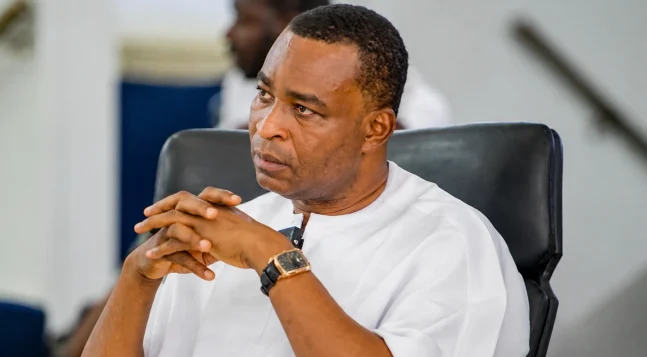
Accra High Court: Wontumi EXIM Bank Fraud Disclosures Ghana Ordered
Summary
- An Accra High Court ordered the state to file disclosures within 14 days in the EXIM Bank fraud case involving Bernard Antwi Boasiako.
- The directive followed the collapse of plea bargaining attempts between the prosecution and defense, which had failed twice and exceeded the 30-day period.
- The case is now set for a Case Management Conference on September 22, 2026.
- Bernard Antwi Boasiako is accused of obtaining a GH¢19 million EXIM Bank loan for a maize farming project that was allegedly not undertaken, with the loan facility increasing to GH¢30 million.
- Boasiako, currently serving a prison sentence, denies the charges and is accused alongside an associate, Thomas Antwi Boasiako, who is at large.
Court Mandates Disclosures in Wontumi EXIM Bank Fraud Case
The court's decision sets the stage for a Case Management Conference (CMC) scheduled for September 22, 2026, indicating a firm move towards trial proceedings in this high-profile matter concerning alleged financial impropriety related to a substantial loan from the Ghana EXIM Bank.
An Accra High Court has issued a directive compelling the state to submit all necessary disclosures within a two-week timeframe in the ongoing EXIM Bank fraud case involving Bernard Antwi Boasiako, widely known as Wontumi. This significant order, handed down on August 27, 2026, marks a pivotal procedural step following the unsuccessful attempts by both the prosecution and the defense to reach a resolution through plea bargaining. The court's decision sets the stage for a Case Management Conference (CMC) scheduled for September 22, 2026, indicating a firm move towards trial proceedings in this high-profile matter concerning alleged financial impropriety related to a substantial loan from the Ghana EXIM Bank.
The directive underscores the judiciary's commitment to advancing criminal cases, particularly when alternative dispute resolution mechanisms prove ineffective. This development in the Wontumi EXIM Bank fraud disclosures Ghana case highlights the court's role in managing the progression of complex financial crimes, ensuring that all parties are prepared for the formal trial phase. The absence of Mr. Boasiako during the August 27 hearing did not impede the court's decision to adjourn the case to the specified CMC date.
Failed Plea Bargaining Paves Way for Trial
The court's order for disclosures directly stems from the collapse of plea bargaining negotiations, which had been initiated by legal representatives for Mr. Bernard Antwi Boasiako. Reverend Joshua Sackey, serving as the Principal State Attorney, informed the Accra High Court on a Thursday that the parties involved had been unable to achieve a mutually agreeable settlement. He explicitly requested the court's guidance to proceed with filing disclosures, acknowledging the impasse in the plea bargaining process.
Mr. Samuel Atta Akyea, counsel for Boasiako, affirmed his understanding that plea bargaining remains an option at any juncture of the legal proceedings, suggesting that the continuation of the case did not preclude future negotiations. However, the presiding judge observed that efforts towards a plea agreement had failed on two distinct occasions, and the stipulated 30-day period allocated for such negotiations had already expired. This "Plea bargaining failure Ghana" ultimately led the court to mandate the "Accra High Court disclosure order," signaling a definitive shift from negotiation to formal trial preparation.
Allegations Detail Significant Financial Misconduct
At the heart of the "Bernard Antwi Boasiako fraud case" are serious allegations concerning a substantial loan facility obtained from the EXIM Bank. Prosecutors contend that Mr. Boasiako secured a GH¢19 million loan, purportedly for the establishment of a maize farming project spanning 100 acres. However, it is alleged that this agricultural endeavor was never actually undertaken. Further accusations include the submission of documentation to support the acquisition of agricultural machinery valued at GH¢4 million, despite the project's alleged non-execution.
The financial scope of the alleged "Ghana EXIM Bank loan fraud" is considerable, with the initial GH¢19 million facility reportedly escalating to approximately GH¢30 million. Mr. Boasiako, a former Ashanti Regional Chairman of the New Patriotic Party (NPP), is accused of committing these offenses alongside an associate, Thomas Antwi Boasiako, who remains at large. Despite currently serving a prison sentence for an unrelated matter, Mr. Boasiako has consistently denied all charges related to this EXIM Bank case.
Implications for High-Profile Criminal Proceedings in Ghana
This case serves as a notable example of the Ghanaian judiciary's approach to managing complex criminal proceedings, particularly when plea negotiations fail. The court's firm directive for disclosures and the subsequent scheduling of a "Case Management Conference Ghana criminal" demonstrate a clear procedural pathway. This ensures that even in high-profile cases involving significant public figures, the legal process moves forward systematically, preparing both the prosecution and defense for a full trial.
The emphasis on disclosures after the failure of plea bargaining highlights the court's role in ensuring transparency and due process. It sets a precedent for how similar financial fraud cases might be handled, underscoring that attempts at out-of-court settlements, while encouraged, do not indefinitely delay the progression to formal adjudication. This procedural clarity is crucial for maintaining public confidence in the judicial system and for providing a predictable framework for legal practitioners.
Practical Implications
This case demonstrates the Ghanaian court's approach to criminal proceedings when plea bargaining attempts fail, specifically the directive for disclosures and progression to a Case Management Conference. Lawyers should note this as a procedural precedent for managing client expectations regarding plea negotiations and preparing for trial stages in high-profile fraud cases. Compliance officers might review internal controls related to loan disbursement for agricultural projects, given the nature of the alleged fraud.
Source
Source: Original reporting via GNA
How does this affect you?
Get an AI analysis of this article grounded in your jurisdictions, practice areas, and any policy documents you've uploaded to Wansom.
Finish this article free. Just your email for instant unlock.
Wansom is AI and can make mistakes.