
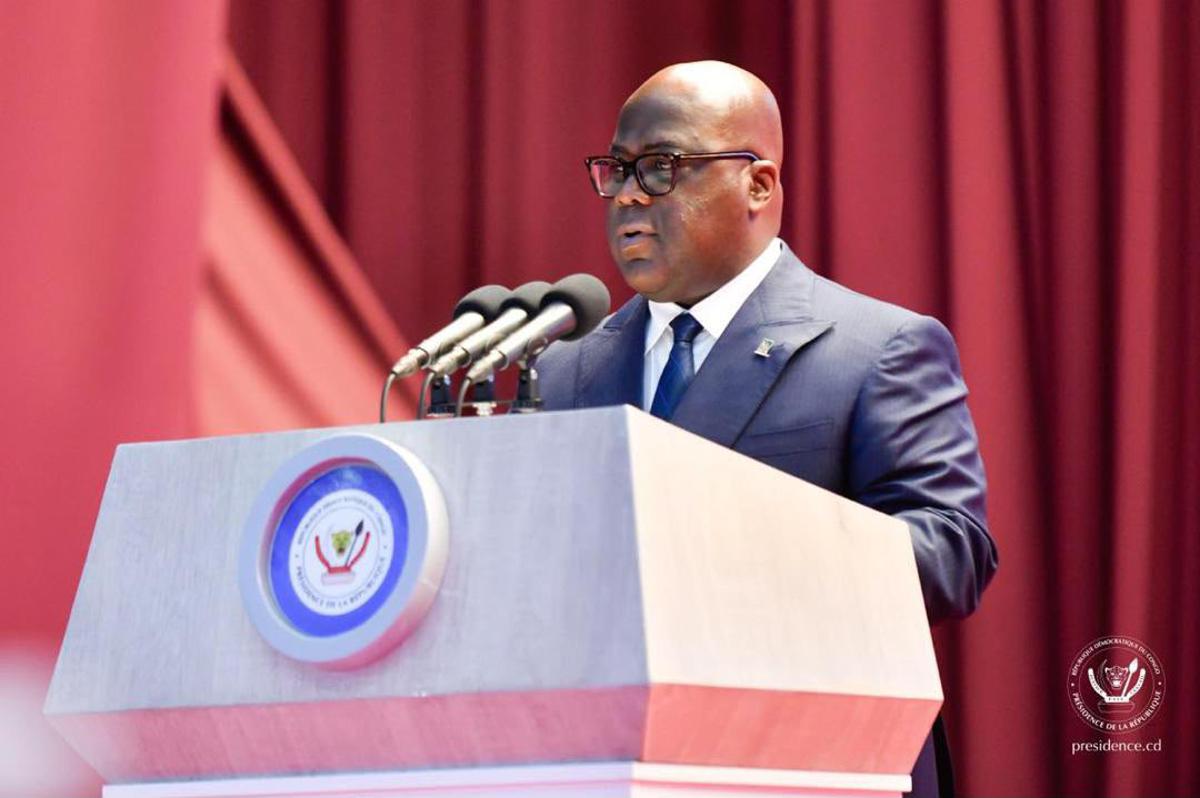
Félix Tshisekedi: Justifies Prince Epenge Arrestation for False News
Summary
- Prince Epenge, president of ADDCongo and Lamuka spokesperson, was arrested on October 25 at N'djili airport.
- He was placed under a provisional arrest warrant on October 27, 2026, and transferred to Makala central prison on October 31, 2026, facing charges of spreading false rumors, known as propagation des faux bruits.
- President Félix Tshisekedi stated that Epenge's opposition status does not protect him from legal action for disseminating false information.
- The President linked the arrest to Epenge's alleged role in spreading false claims about the death of activist Manassé Lomboto.
- Tshisekedi asserted that Lomboto died of illness, not violence during a September 15 demonstration, contrary to opposition claims.
The Arrest of a Prominent Opposition Figure
President Félix Tshisekedi asserted that being an opposition figure does not provide immunity from legal consequences for spreading fausses informations.
Prince Epenge, who serves as the president of ADDCongo and is a spokesperson for the Lamuka platform, was apprehended on October 25 at N'djili airport. The arrest was carried out by unidentified individuals as Epenge was preparing to travel to Rome, Italy, for a meeting of the Coalition article 64 (C64), according to information provided by his political party. He was placed under a provisional arrest warrant on October 27, 2026, and transferred to Makala central prison on October 31, 2026, facing charges related to the propagation des faux bruits.
This incident has ignited significant political tension within the Democratic Republic of Congo. Epenge's detention, particularly given his high-profile role within the opposition, has drawn sharp criticism from various political actors who perceive it as an act of repression against dissenting voices. The circumstances of his arrest, specifically the involvement of unidentified individuals, have further fueled these concerns regarding due process and the treatment of political opponents, contributing to the narrative of Prince Epenge arrestation RDC being politically motivated.
Presidential Justification and Conflicting Narratives
President Félix Tshisekedi has publicly addressed the arrestation Prince Epenge, firmly rejecting accusations that his administration is engaged in the répression opposition. Speaking to the Congolese diaspora in Russia on October 30, in remarks later published in a video by the Presidency on November 1, Tshisekedi asserted that being an opposition figure does not provide immunity from legal consequences for spreading fausses informations. He challenged the notion that political opponents should be exempt from accountability for their statements, asking whether their status grants them the right to lie and insult without repercussions.
The President clarified that Epenge's apprehension was not a consequence of his political affiliation but rather stemmed from his alleged involvement in disseminating misleading information concerning the death of Manassé Lomboto, an activist associated with ADDCongo. Tshisekedi contended that the opposition had attempted to falsely attribute Lomboto's demise to violence during a demonstration held on September 15.
In contrast, the head of state maintained that Lomboto succumbed to an illness, emphasizing that no fatalities had occurred during any organized protests in the Congo to date. He stated that Epenge was arrested to provide explanations before his planned departure for Europe, directly linking the arrestation Prince Epenge Tshisekedi justification to the Manassé Lomboto décès fausses informations issue.
Legal Context and Political Scrutiny
The charge of propagation faux bruits RDC against Prince Epenge highlights the legal framework available to authorities for addressing the spread of what they deem to be false information. This case underscores a critical point of contention: while the government, through President Tshisekedi, insists the legal action is solely about uncovering the truth regarding Lomboto's death, opposition figures continue to decry it as an instrumentalization of the justice system to silence critics. This narrative of Félix Tshisekedi répression opposition persists despite the President's denials.
President Tshisekedi also used his address to critique the current state of the Congolese opposition, describing it as weak. He drew a contrast with the political struggle waged by the UDPS under his father, Étienne Tshisekedi, whom he credited with leading a "true opposition" driven by patriotism, without resorting to armed conflict. These remarks, made amidst intense political tensions surrounding the Prince Epenge arrestation RDC, reflect the ongoing struggle for political legitimacy and the differing interpretations of legal actions taken against prominent opposition members like the ADDCongo Lamuka Prince Epenge leader. The President also noted an evolution in the opposition's discourse, shifting from blaming security forces for Lomboto's death to condemning a wave of repression following arrests.
Practical Implications
Lawyers advising individuals or organizations in the DRC must counsel extreme caution regarding the dissemination of information, particularly on sensitive political matters. This case underscores the potential for legal action, specifically under charges of 'propagation des faux bruits,' even against prominent opposition figures, challenging the traditional understanding of protection afforded by political status.
Source
How does this affect you?
Get an AI analysis of this article grounded in your jurisdictions, practice areas, and any policy documents you've uploaded to Wansom.
Wansom is AI and can make mistakes.