
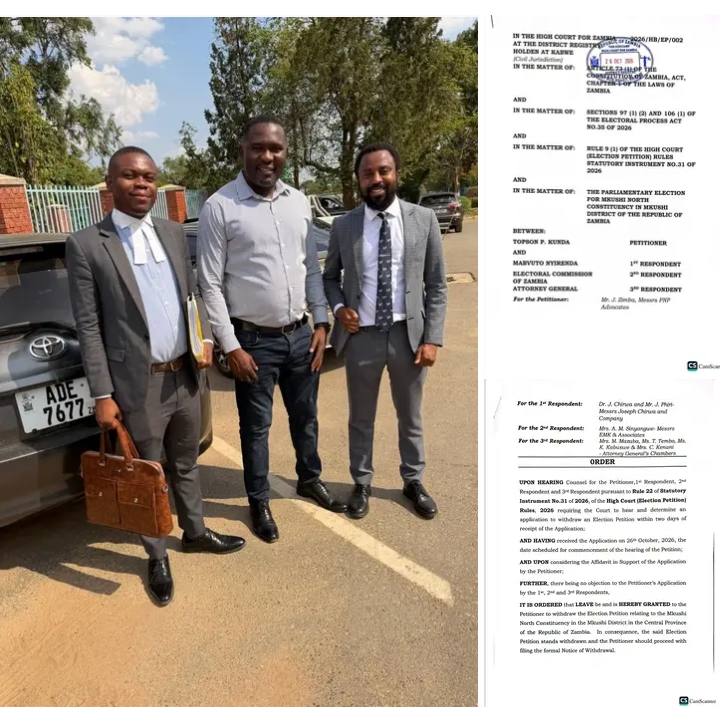
Topson Kunda: Mkushi North Petition Withdrawn, Nyirenda's Win Stands
Summary
- Topson Kunda, who is currently the Chitambo District Commissioner, has withdrawn his election petition challenging the results in Mkushi North Constituency.
- The petition was filed against Mabvuto Nyirenda of the National Reconciliation Party for Unity and Prosperity (NRPUP), who was elected Member of Parliament in the 2026 parliamentary elections.
- Mr. Kunda cited reasons for his withdrawal, but these were not publicly disclosed.
- This withdrawal means Mabvuto Nyirenda's election as Member of Parliament for Mkushi North remains unchallenged by this specific legal action.
- The development highlights the procedural options available in Zambian election litigation and may influence future strategic decisions by legal practitioners.
Topson Kunda Withdraws Mkushi North Petition
Lawyers involved in election litigation in Zambia should note this withdrawal as a procedural development, potentially influencing strategic decisions regarding the pursuit or abandonment of similar election petitions in the future.
Topson Kunda, who is currently the Chitambo District Commissioner, was the losing candidate for the United Party for National Development (UPND) in the 2026 parliamentary elections for Mkushi North Constituency, and has formally withdrawn his petition. This legal action had sought to challenge the election victory of Mabvuto Nyirenda, who represents the National Reconciliation Party for Unity and Prosperity (NRPUP) and was declared the duly elected Member of Parliament for the constituency.
Mr. Kunda's decision to withdraw the challenge means that the electoral outcome, which saw Mr. Nyirenda secure the parliamentary seat, now stands unchallenged through this particular legal avenue. While Mr. Kunda reportedly cited specific reasons for his withdrawal, the details of these justifications were not made publicly available in the immediate aftermath of the announcement.
Legal Framework for Election Challenges in Zambia
Election petitions serve as a critical mechanism within Zambia's democratic framework, allowing aggrieved candidates and political parties to contest the results of an election. These challenges are typically lodged in the courts, providing a legal recourse for allegations of electoral irregularities, malpractices, or non-compliance with electoral laws. The process is designed to uphold the integrity of the electoral system and ensure that the will of the people is accurately reflected in the final results.
Such petitions often involve extensive legal proceedings, including the presentation of evidence, witness testimonies, and detailed arguments from legal counsel representing both the petitioner and the respondent. The courts then adjudicate on the merits of the case, with the power to nullify election results if sufficient grounds are established. The option to withdraw a petition, as seen in the case of the Mabvuto Nyirenda election petition, is also a recognized procedural step within this legal framework, often influenced by strategic considerations or new developments in a case.
Significance for Future Election Litigation
The withdrawal of the UPND election challenge Zambia, specifically the Topson Kunda withdraws Mkushi North petition, holds notable implications for the landscape of election litigation in the country. This development, concerning the Mkushi North constituency election 2026, underscores the dynamic nature of post-election legal battles and the various factors that can lead to their conclusion outside of a full judicial determination. Lawyers involved in election litigation in Zambia should note this withdrawal as a procedural development, potentially influencing strategic decisions regarding the pursuit or abandonment of similar election petitions in the future.
Understanding the context and potential motivations behind a Zambia election petition withdrawal is crucial for legal practitioners and political strategists alike. While the specific reasons for Mr. Kunda's decision remain undisclosed, such withdrawals can stem from a variety of factors, including a reassessment of the strength of the evidence, the financial implications of continuing litigation, or even political considerations. This particular case serves as a reminder that the path of an election petition is not always straightforward, and its conclusion can arrive through various means, including voluntary withdrawal.
Practical Implications
Lawyers involved in election litigation in Zambia should note this withdrawal as a procedural development, potentially influencing strategic decisions regarding the pursuit or abandonment of similar election petitions in the future.
Source
How does this affect you?
Get an AI analysis of this article grounded in your jurisdictions, practice areas, and any policy documents you've uploaded to Wansom.
Finish Reading the Full Story and the Expert Analysis.
Wansom is AI and can make mistakes.