
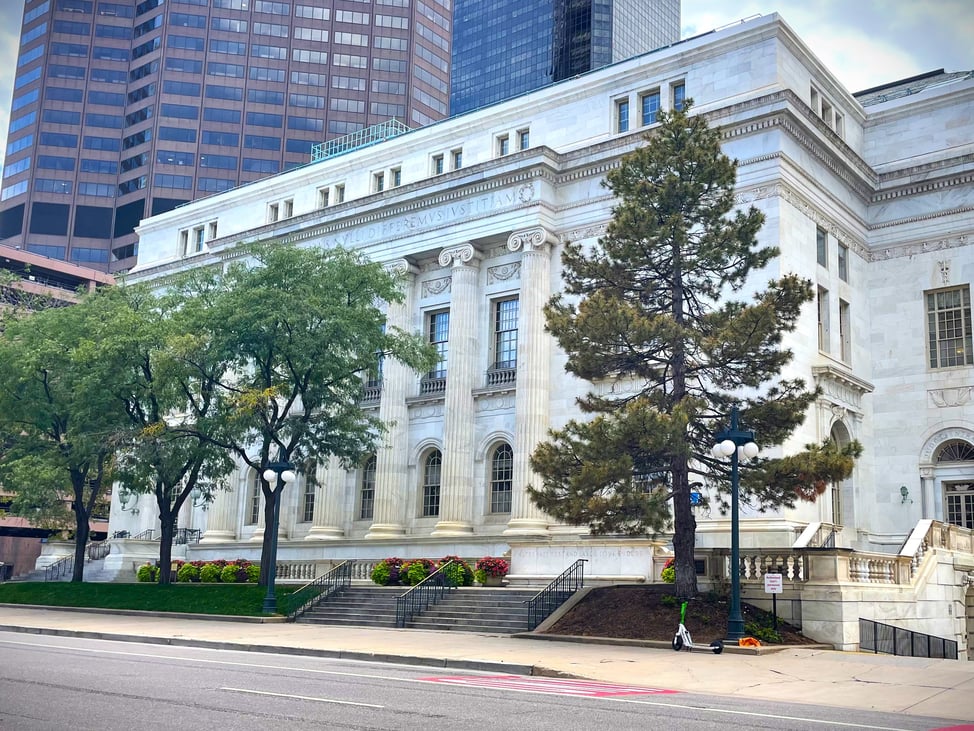
Tenth Circuit Kansas: Prefilled Voter Application Ban Upheld
Summary
- The Tenth Circuit Court of Appeals has reinstated a Kansas law banning prefilled voter applications from out-of-state groups.
- The court applied intermediate scrutiny, finding the law's restriction on speech to be minimal and permissible under the First Amendment.
- This decision overturns a lower court's finding that the law was enacted with an'improper purpose' to suppress mail-in voting.
- Voter advocacy groups, including VoteAmerica and the Voter Participation Center, had sued, arguing the law violated their First Amendment rights.
- Plaintiffs have stated their intention to continue challenging the law, calling it dangerous.
Tenth Circuit Upholds Kansas Voter Application Restrictions
This ruling by the Tenth Circuit has significant implications for voter advocacy groups operating within Kansas and potentially across the circuit's jurisdiction.
The Tenth Circuit Court of Appeals has affirmed the legality of a Kansas law that restricts how voter registration applications can be distributed by external organizations. This decision reinstates a provision of Kansas HB 2332, which bars out-of-state groups from sending prefilled voter applications containing personal details such as a voter's name or address. The appellate panel concluded that this restriction imposes only a "minimal" limitation on speech, which is permissible under the First Amendment.
The legislative journey of HB 2332 began in 2021 when the Kansas Legislature, dominated by Republicans, passed the measure despite a veto from Democratic Governor Laura Kelly. Following its enactment, two out-of-state voter advocacy organizations, VoteAmerica and the Voter Participation Center (VPC), initiated legal action. They contended that the law's prohibitions infringed upon their First and Fourteenth Amendment rights, leading to a protracted legal battle that saw multiple appeals to the Tenth Circuit.
Judicial Scrutiny and Conflicting Interpretations
The core of the legal dispute revolved around the appropriate standard of judicial review. Initially, a federal district judge in Kansas, Kathryn H. Vratil, applied strict scrutiny to the law. She concluded that the Legislature's intent behind HB 2332 was to suppress speech related to mail-in voting, a finding that would typically invalidate such a law. Strict scrutiny represents the most rigorous standard, requiring the government to demonstrate a compelling interest and narrowly tailored means when a fundamental right is burdened.
However, the Tenth Circuit panel, in a ruling authored by U.S. Circuit Judge Timothy M. Tymkovich, a George W. Bush appointee, determined that intermediate scrutiny was the correct standard. Judge Tymkovich criticized the lower court's finding of an improper purpose, stating it lacked supporting evidence from the law's text, legislative history, or stated justifications, instead inferring it from broader political debates surrounding mail-in voting. Intermediate scrutiny, a less demanding standard than strict scrutiny, requires that a law serve an important government interest and be substantially related to achieving that interest.
Kansas officials defended the law by asserting that its provisions were designed to reduce voter confusion, maintain public confidence in the electoral process, and decrease the submission of inaccurate applications. Conversely, the Voter Participation Center argued that sending personalized applications was integral to its mission of encouraging voter registration and participation, particularly among underserved communities. They characterized this activity as "expressive conduct" and claimed the restrictions "chilled" their First Amendment-protected speech. Despite Judge Vratil's 2023 ruling agreeing with the plaintiffs on First Amendment protection, the Tenth Circuit consistently reversed her decisions, ultimately affirming the law under intermediate scrutiny.
Implications for Voter Advocacy and Free Speech
This ruling by the Tenth Circuit has significant implications for voter advocacy groups operating within Kansas and potentially across the circuit's jurisdiction. The court's decision to apply intermediate scrutiny, rather than strict scrutiny, lowers the bar for states to justify restrictions on certain forms of voter outreach. By deeming the limitation on prefilled applications a "minimal restriction" on speech, the court has provided a precedent that could influence how similar state laws impacting voter communication methods are evaluated under the First Amendment.
The legal battle over Kansas HB 2332 voter applications has been ongoing since 2021, with Kansas officials agreeing in 2022 not to enforce a separate ban on out-of-state distributors, leaving the personalized application ban as the central point of contention. While the Tenth Circuit has now upheld the Kansas mail-in voting law, the plaintiffs, including the Voter Participation Center, have indicated their intent to continue the fight. Tom Lopach, President and CEO of VPC, publicly stated that HB 2332 is a "dangerous law" and that the "battle in Kansas would continue," signaling further legal challenges or advocacy efforts.
Practical Implications
Lawyers advising voter advocacy groups or compliance officers for such organizations should note that the Tenth Circuit has affirmed a state's ability to restrict prefilled voter applications, applying intermediate scrutiny. This ruling sets a precedent for how similar state laws impacting voter outreach and communication methods may be evaluated under the First Amendment, potentially requiring adjustments to campaign strategies in Kansas and other states within the Tenth Circuit's jurisdiction.
Source
How does this affect you?
Get an AI analysis of this article grounded in your jurisdictions, practice areas, and any policy documents you've uploaded to Wansom.
Finish Reading the Full Story and the Expert Analysis.
Get the latest legal & regulatory intelligence in United States
Wansom is AI and can make mistakes.