
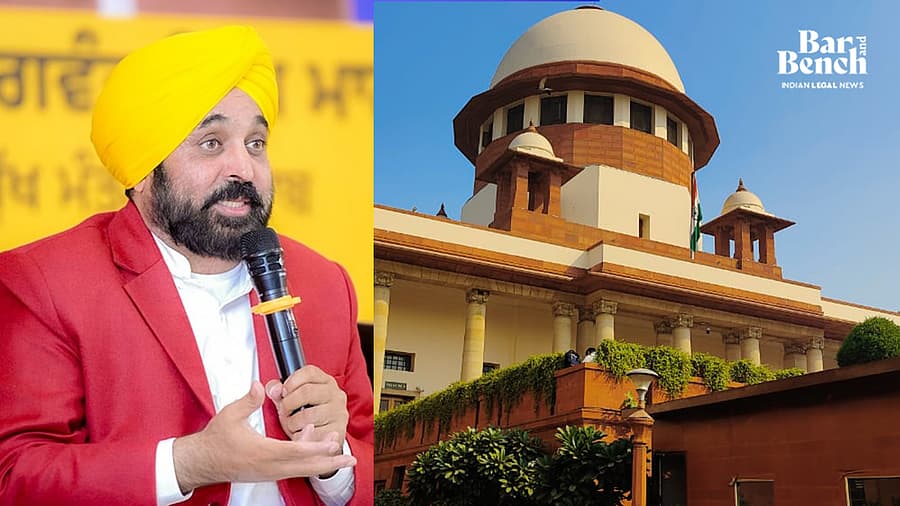
Supreme Court: Stays Coercive Action Against Rajbir Singh Ghuman
Summary
- The Supreme Court has stayed coercive action against Rajbir Singh Ghuman, an OSD to the Punjab Chief Minister, in a CBI corruption case.
- This order came in response to an appeal by the Punjab government challenging a Punjab and Haryana High Court directive for the CBI to register the case.
- Justices MM Sundresh and PB Varale issued a notice to the CBI and mandated Ghuman's cooperation with the investigation.
- The Supreme Court explicitly declined to stay the First Information Report (FIR) itself, allowing the probe to continue.
- The CBI registered the case under the Prevention of Corruption Act and Bharatiya Nyaya Sanhita following an ED communication regarding corruption allegations.
What Happened
It demonstrates that even when an FIR is not quashed or set aside, the apex court may grant a stay on coercive action, thereby offering a crucial temporary reprieve from arrest or detention.
The Supreme Court recently intervened in a high-profile corruption case, issuing an order that prevents the Central Bureau of Investigation (CBI) from taking any coercive action against Rajbir Singh Ghuman, an Officer on Special Duty (OSD) to Punjab Chief Minister Bhagwant Mann. This significant directive came from a bench comprising Justice MM Sundresh and Justice PB Varale, who were hearing an appeal filed by the Punjab government. The state government had challenged a prior ruling by the Punjab and Haryana High Court, which had mandated the CBI to register a criminal case concerning the corruption allegations against Ghuman.
While granting this interim relief, the apex court made a crucial distinction: it explicitly declined to stay the First Information Report (FIR) itself. The justices clarified that while no immediate coercive steps, such as arrest or detention, could be taken against Ghuman, the investigation into the allegations must proceed. The Court also issued a notice to the CBI, requiring its response to the Punjab government's appeal, and stipulated that Ghuman must fully cooperate with the ongoing inquiry.
Background to the Allegations
The origins of the case against Rajbir Singh Ghuman trace back to communications initiated by the Enforcement Directorate (ED). The ED had previously written to the Punjab Police, requesting the registration of an FIR to thoroughly investigate the corruption allegations leveled against the Chief Minister's OSD. Subsequently, acting on a directive from the Punjab and Haryana High Court, the CBI proceeded to register a criminal case.
This CBI corruption case, which also names Nitin Gohal and other individuals, was formally registered in Delhi. The charges against Ghuman and his co-accused fall under the stringent provisions of the Prevention of Corruption (PC) Act and the recently enacted Bharatiya Nyaya Sanhita (BNS). The CBI's involvement underscores the gravity of the accusations, which pertain to alleged corrupt practices within the government apparatus.
Legal Context and Significance
The Supreme Court's decision in the matter of State of Punjab v Nikhil Saraf offers a nuanced legal outcome that carries significant implications for cases involving corruption allegations against public officials. By restraining coercive action while explicitly allowing the FIR and the underlying investigation to continue, the Court has provided a temporary shield against immediate enforcement measures without halting the essential investigative process. This approach ensures that the serious allegations can be thoroughly probed by the Central Bureau of Investigation, while simultaneously protecting the accused from potentially premature arrest or detention during the initial stages of inquiry.
This ruling, which saw the Supreme Court issue a notice to the CBI, underscores a critical avenue for individuals facing corruption allegations, particularly those involving high-ranking government officials. It demonstrates that even when an FIR is not quashed or set aside, the apex court may grant a stay on coercive action, thereby offering a crucial temporary reprieve from arrest or detention. Such a precedent can be vital for legal strategies aimed at challenging immediate enforcement measures, allowing time for the defense to prepare and respond to the allegations while the investigation unfolds under judicial oversight. The directive for Rajbir Singh Ghuman to cooperate fully with the CBI's investigation further balances the rights of the accused with the imperative of uncovering the truth.
Practical Implications
Lawyers advising clients facing corruption allegations, particularly those involving government officials, should note that the Supreme Court may grant a stay on coercive action even if an FIR is not quashed, providing a crucial temporary reprieve from arrest or detention while investigations proceed. This precedent highlights a strategic avenue for challenging immediate enforcement measures.
Source
How does this affect you?
Get an AI analysis of this article grounded in your jurisdictions, practice areas, and any policy documents you've uploaded to Wansom.
Finish Reading the Full Story and the Expert Analysis.
Get the latest legal & regulatory intelligence in India
Wansom is AI and can make mistakes.