
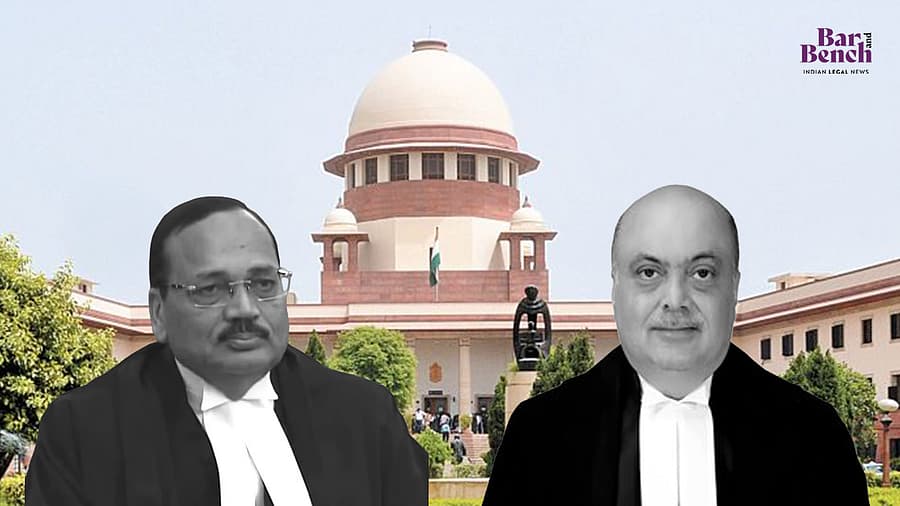
Supreme Court Shifts Unauthorised Construction Case to Justice Nagarathna Bench
Summary
- The Supreme Court has reassigned a pan-India unauthorised construction case from Justice Ahsanuddin Amanullah's bench.
- The case, which expanded from an individual grievance, will now be heard by a bench led by Justice BV Nagarathna.
- This marks the second such reassignment from Justice Amanullah's bench, following the private universities audit case.
- Under Supreme Court rules, Public Interest Litigations are exclusively assigned to benches headed by the seven senior-most judges.
- Justice Amanullah is currently ninth in seniority, and his roster does not include PILs or the specific subject matter of the case.
Supreme Court Shifts Unauthorised Construction Case
The Supreme Court's strict adherence to judicial seniority and roster rules for Public Interest Litigations can influence bench assignments and procedural developments in pan-India cases like unauthorised construction.
The Supreme Court of India has recently reassigned a significant part-heard case concerning unauthorised constructions and the commercial misuse of residential areas across the nation. This matter, which initially stemmed from an individual grievance but expanded into a sweeping pan-India investigation, was moved from a bench led by Justice Ahsanuddin Amanullah. The administrative decision to shift the unauthorised construction case occurred just days before its scheduled hearing on November 23.
The proceedings have now been transferred to a bench headed by Justice BV Nagarathna. This marks the second instance of a high-profile case being reassigned from Justice Amanullah's bench. Previously, the private universities audit case was also moved, in that instance to a three-judge bench under the leadership of Justice Vikram Nath, highlighting a pattern of administrative adjustments within the Court's case allocation system.
Judicial Roster and Seniority Rules
The reassignment of this case aligns with the Supreme Court's established internal rules regarding the allocation of Public Interest Litigations (PILs). According to the Court's judges' roster, PILs are exclusively assigned to benches presided over by the seven most senior judges. This group currently includes Chief Justice of India Surya Kant, along with Justices Vikram Nath, BV Nagarathna, MM Sundresh, PS Narasimha, JB Pardiwala, and Dipankar Datta.
Justice Ahsanuddin Amanullah, who is currently ninth in the Court's seniority ranking, does not have PILs listed within his designated roster. Furthermore, the specific subject matter of the case—which falls under Category 2301, encompassing municipal laws, housing and building permits, demolition, encroachment removal, sealing, and urban planning—is also not allocated to Justice Amanullah's bench under the existing roster. This administrative framework dictates which judges are authorized to hear particular types of cases, especially those with broad public implications.
Implications for Pan-India Cases
The administrative decision to shift the unauthorised construction case underscores a critical aspect of the Supreme Court's functioning: the strict adherence to its internal roster system, particularly concerning Public Interest Litigations. When individual grievances are expanded to encompass pan-India issues, as occurred in this instance and with the private universities audit case, they effectively transform into PILs, thereby triggering the specific roster rules. This procedural evolution necessitates a re-evaluation of bench assignments to align with the established seniority and subject-matter allocations.
This development holds significant implications for legal practitioners and litigants involved in cases that begin as specific complaints but evolve into broader public interest matters. The Supreme Court's strict adherence to judicial seniority and roster rules for Public Interest Litigations can influence bench assignments and procedural developments in pan-India cases like unauthorised construction. Such administrative clarity is vital, as it directly impacts the strategic approach for cases that expand beyond individual grievances to address systemic issues across the nation. It reinforces the principle that even as a case's scope broadens, the foundational rules governing judicial allocation remain paramount, ensuring consistency and proper jurisdiction within the highest court.
Practical Implications
Lawyers should note the Supreme Court's strict adherence to judicial seniority and roster rules for Public Interest Litigations, which can influence bench assignments and procedural developments in pan-India cases like unauthorised construction. This administrative clarity may affect strategy for cases that expand beyond individual grievances.
Source
How does this affect you?
Get an AI analysis of this article grounded in your jurisdictions, practice areas, and any policy documents you've uploaded to Wansom.
Finish Reading the Full Story and the Expert Analysis.
Get the latest legal & regulatory intelligence in India
Wansom is AI and can make mistakes.