
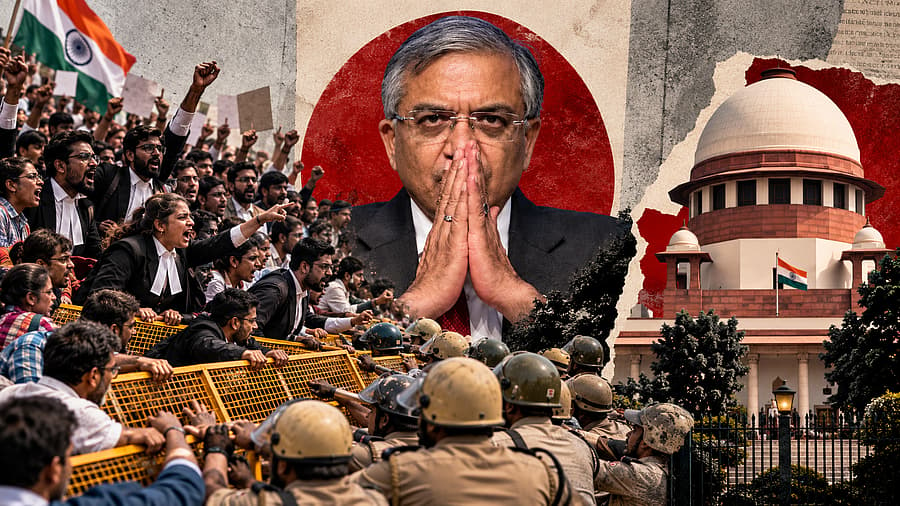
Supreme Court Seeks Centre's Response to Petitions Over Detentions During October Protest Against CEC
Summary
- India's Supreme Court has ordered the Central and Delhi governments to respond to petitions alleging illegal detentions during October 2023 protests.
- The protests in Delhi on October 10 and 11 sought the removal of Chief Election Commissioner Gyanesh Kumar.
- Demonstrators, lawyers, and journalists were reportedly detained or manhandled by Delhi Police during the events.
- The protests were organized by youth groups and political parties, citing alleged irregularities in electoral roll revisions.
- A Supreme Court bench, including CJI Surya Kant, has given the governments ten days to file a comprehensive response.
Judicial Mandate on Protest Detentions
The Supreme Court of India has issued a directive to both the Central and Delhi governments, demanding a comprehensive response to petitions that allege unlawful detentions of individuals during protests held in October 2023.
The Supreme Court of India has issued a directive to both the Central and Delhi governments, demanding a comprehensive response to petitions that allege unlawful detentions of individuals during protests held in October 2023. These demonstrations, which took place in Delhi, were primarily focused on calling for the removal of Chief Election Commissioner (CEC) Gyanesh Kumar. The petitions specifically contend that protesters were illegally detained, prompting the highest court in India to intervene.
A bench comprising Chief Justice of India Surya Kant, Justice Joymalya Bagchi, and Justice V Mohana presided over the proceedings. The court's order came after Additional Solicitor General (ASG) Aishwarya Bhati informed the bench that affidavits had only been submitted in a fraction of the petitions concerning these detentions. This highlighted the need for a more unified and complete account from the government bodies involved.
Consequently, the Supreme Court has set a strict deadline, requiring the Central and Delhi governments to file their comprehensive responses within ten days. Following this, the petitioners will be granted a period of one week to submit any rejoinders they deem necessary. This structured approach underscores the judiciary's intent to thoroughly examine the circumstances surrounding the October 2023 Delhi protest detentions and the broader implications for protest rights in India.
Genesis of the Protests
The demonstrations in question occurred on October 10 and 11 in Delhi, drawing participants from various youth groups and political parties. The central grievance driving these protests was the perceived mishandling of the Special Intensive Revision (SIR) of electoral rolls by the Election Commission of India and its Chief Election Commissioner, Gyanesh Kumar. Activists and political groups demanded Kumar's resignation, citing alleged irregularities in the electoral roll revision exercise as the primary justification for their call.
These public gatherings represented a significant expression of discontent regarding the integrity of the electoral process. The focus on the Chief Election Commissioner underscored the gravity of the concerns raised by the protesting factions. The demand for accountability from such a high-ranking official within the electoral body highlights the deep-seated issues that motivated the participants to take to the streets.
Allegations of Police Action and Judicial Oversight
During the October 2023 protests, numerous allegations surfaced regarding the conduct of the Delhi Police. Reports indicated that not only were many protesters detained, but some individuals, including lawyers and journalists covering the events, were also allegedly manhandled. These claims of police action against those exercising their right to protest have become a central point of contention in the ongoing legal challenge before the Supreme Court.
The seriousness of these allegations prompted an immediate response from the judiciary. On October 11, the Supreme Court convened a special sitting specifically to address concerns related to police actions against protesters and any restrictions imposed on public movement. This swift judicial intervention signals the court's recognition of the fundamental importance of protest rights and the need to scrutinize state actions that might impinge upon them, especially in the context of the Supreme Court CEC protest detentions India.
Practical Implications
Lawyers advising clients on public demonstrations, civil liberties, or police accountability in India should closely monitor this Supreme Court case. The outcome could establish significant precedents regarding the legality of detentions during protests, the scope of fundamental rights, and police conduct, influencing future advice on protest participation and potential legal challenges against state actions.
Source
How does this affect you?
Get an AI analysis of this article grounded in your jurisdictions, practice areas, and any policy documents you've uploaded to Wansom.
Finish Reading the Full Story and the Expert Analysis.
Get the latest legal & regulatory intelligence in India
Wansom is AI and can make mistakes.