
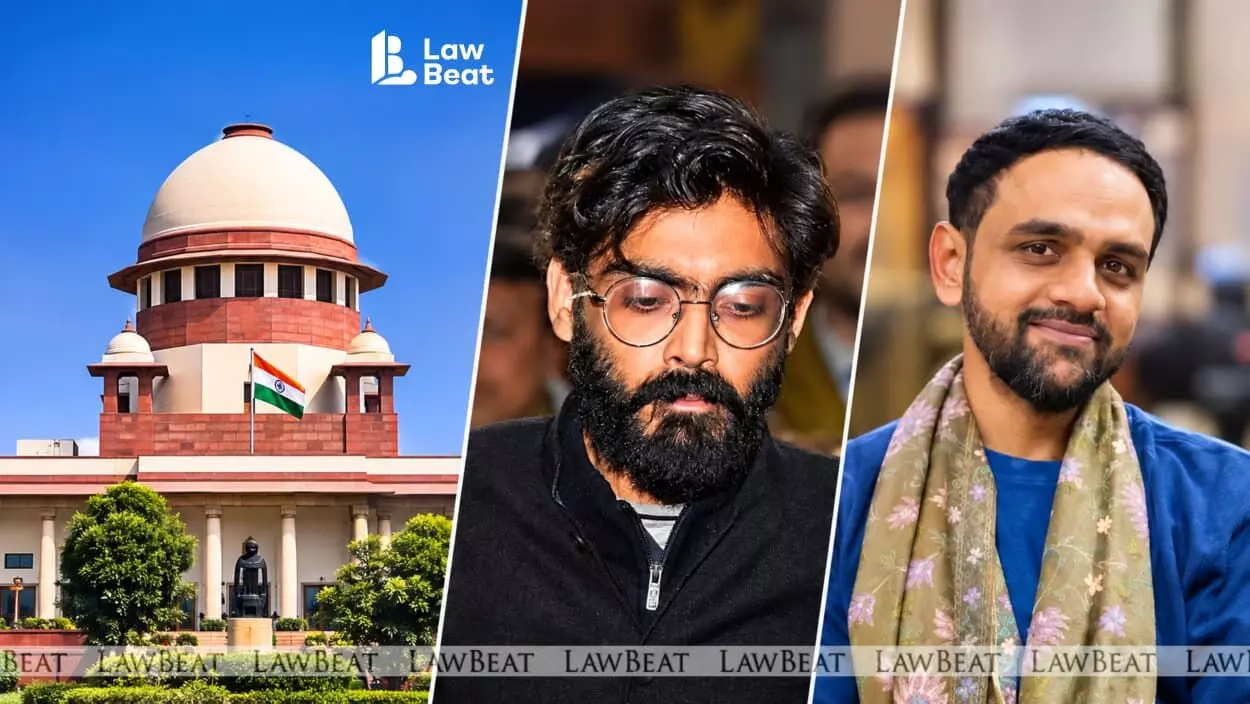
Supreme Court Refuses Interim Bail: Sharjeel Imam, Umar Khalid Denied Immediate Release
Summary
- The Supreme Court refused interim bail to Sharjeel Imam and Umar Khalid in the 2020 Delhi riots UAPA case.
- A bench led by CJI Surya Kant issued notice on their bail pleas and indicated a three-judge bench would hear the matter.
- Both accused argued prolonged incarceration, lack of trial progress, and the conclusion of a one-year bail bar as grounds for release.
- Their current plea challenged a Delhi High Court refusal, which cited a previous Supreme Court order from January 2026 that imposed specific conditions.
- The Supreme Court is currently considering a reference to a larger bench regarding the interpretation of UAPA bail provisions, specifically the *Union of India v. K.A. Najeeb* precedent.
Supreme Court Denies Immediate Interim Bail
The Supreme Court's decision underscores a continued stringent approach to interim bail in cases under the Unlawful Activities Prevention Act, particularly for high-profile accused.
The Supreme Court of India today declined to grant interim bail to Sharjeel Imam and Umar Khalid, who are among the accused in the 2020 northeast Delhi riots "larger conspiracy" case. Both individuals are being prosecuted under the stringent Unlawful Activities (Prevention) Act (UAPA). While a bench led by Chief Justice of India Surya Kant issued notice on their primary bail pleas, it explicitly refused any immediate temporary release.
Senior Advocate Kapil Sibal had requested interim relief for the accused, but CJI Kant responded with a direct "Not today," indicating the court's reluctance to grant such a measure without first hearing the Delhi police's arguments. The Court has further indicated that a specially constituted three-judge bench will be established to thoroughly hear the bail applications submitted by Imam and Khalid.
Arguments for Release and Prior Judicial Orders
Umar Khalid's bail plea emphasizes that his prolonged incarceration, coupled with the fact that charges have yet to be formally framed in the case, constitutes a violation of his fundamental right to a speedy trial. He supports this argument by referencing observations made by the Supreme Court itself in May, when two other co-accused in the same matter were granted interim bail. Sharjeel Imam, for his part, contends that the prosecution has failed to examine a single witness during the years he has spent in custody, and highlights that the one-year period, after which the Supreme Court had permitted him to renew his bail application, has now concluded, leading to the renewal of their applications.
These current pleas challenge a decision by the Delhi High Court on September 30, which had refused to grant them bail. A Division Bench of Justices Prathiba M. Singh and Dinesh Bhatt at the High Court had stated that it lacked the authority to modify conditions previously set by the Supreme Court in January. The petition specifically refers to the Supreme Court's order dated January 5, 2026, where a bench comprising Justices Aravind Kumar and N.V. Anjaria had denied bail to Khalid and Imam. That January order had imposed a one-year restriction on their ability to seek bail, stipulating that they could approach the Court again either upon the completion of protected witness examinations or after one year from the order date, whichever occurred earlier. In its January 5 judgment, the Supreme Court had characterized Khalid and Imam as the "ideological drivers" of the alleged conspiracy, distinguishing their roles from other co-accused, five of whom, including Gulfisha Fatima, were granted bail.
Evolving Legal Interpretation of UAPA Bail
The broader legal context surrounding UAPA bail provisions is currently subject to significant judicial deliberation. On May 22, 2026, in the same case (FIR 59 of 2020), a Supreme Court bench headed by Justice Aravind Kumar referred a "perceived conflict" in the interpretation of *Union of India v. K.A. Najeeb* to a larger bench. The *Najeeb* precedent established that a lengthy period of incarceration could serve to mitigate the stringent bail conditions typically imposed under the UAPA.
This conflict became apparent after a bench of Justices B.V. Nagarathna and Ujjal Bhuyan, in the *Syed Ifthikar Andrabi* case, criticized the *Gulfisha Fatima* judgment for adopting a narrow interpretation of UAPA bail, thereby potentially diluting the principles set forth in *Najeeb*. Taking these reservations into account, Justice Kumar's bench decided to refer the complex legal question to a larger bench for authoritative settlement. Notably, while making this reference, the Court granted interim bail for six months to co-accused Tasleem Ahmed and Khalid Saifi, which period has since concluded. The Court observed that these appellants had undergone substantial incarceration, the trial was unlikely to conclude swiftly, and they should not endure continued detention merely because an important legal question required resolution, granting relief without expressing an opinion on the merits and subject to stringent safeguards.
Significance of the Supreme Court's Stance
The Supreme Court's decision underscores a continued stringent approach to interim bail in cases under the Unlawful Activities Prevention Act, particularly for high-profile accused. This refusal comes even as arguments regarding prolonged incarceration and the right to a speedy trial were presented, and despite the ongoing judicial debate concerning the interpretation of UAPA bail provisions. The fact that the Court has chosen to issue notice for a full hearing by a three-judge bench, rather than granting immediate interim relief, signals a cautious and deliberate process.
This development is particularly relevant for legal practitioners representing clients in UAPA cases, as it highlights the judiciary's careful consideration of bail applications, especially when a larger bench is poised to clarify the precedent set by *Union of India v. K.A. Najeeb*. The outcome of this reference could significantly shape future bail applications under the UAPA, making the Supreme Court's current stance on interim bail a critical point of observation for the legal community.
Practical Implications
Lawyers representing clients in UAPA cases should note the Supreme Court's continued stringent approach to interim bail, particularly for high-profile accused, even when arguments regarding prolonged incarceration and speedy trial are raised. The ongoing reference to a larger bench concerning the interpretation of UAPA bail provisions (Union of India v. K.A. Najeeb) indicates judicial deliberation that could shape future bail applications, requiring practitioners to monitor these developments closely for potential shifts in precedent.
Source
How does this affect you?
Get an AI analysis of this article grounded in your jurisdictions, practice areas, and any policy documents you've uploaded to Wansom.
Finish Reading the Full Story and the Expert Analysis.
Get the latest legal & regulatory intelligence in India
Wansom is AI and can make mistakes.