
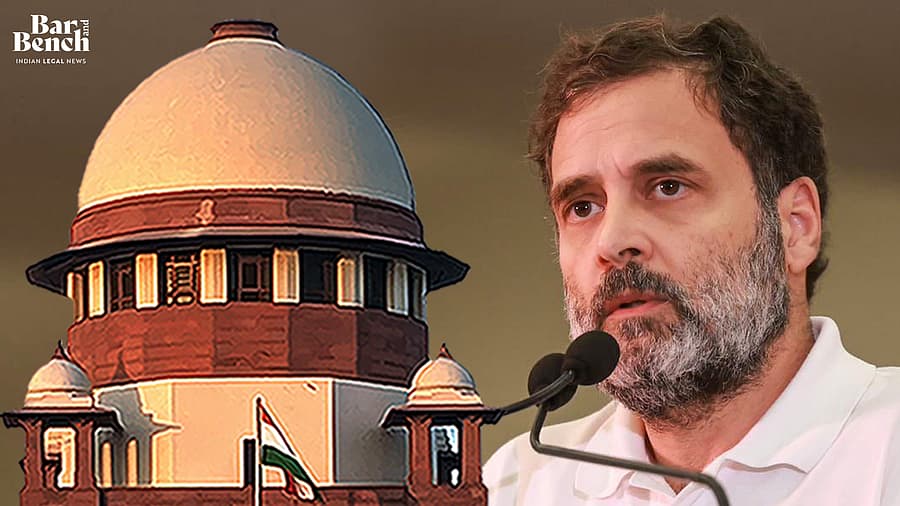
Supreme Court: Remits Rahul Gandhi Assets Probe to High Court
Summary
- The Supreme Court set aside an Allahabad High Court order directing CBI and ED to probe Rahul Gandhi's assets.
- The apex court remitted the matter back to the High Court for fresh consideration.
- The Supreme Court mandated that Rahul Gandhi must be made a party to the case and heard before any further orders.
- The original probe was sought by BJP worker S Vignesh Shishir over allegations of disproportionate assets.
- The Allahabad High Court had previously expressed dissatisfaction with the CBI's progress in the inquiry.
Supreme Court Intervenes in Assets Probe
The Supreme Court specifically instructed the Allahabad High Court to formally include Rahul Gandhi as a party to the case.
India's Supreme Court recently overturned a directive from the Allahabad High Court that had ordered the Central Bureau of Investigation (CBI) and the Enforcement Directorate (ED) to investigate allegations of disproportionate assets against prominent political figure Rahul Gandhi. The apex court's decision, delivered by a bench comprising Chief Justice of India Surya Kant, Justice Joymalya Bagchi, and Justice V Mohana, sends the matter back to the High Court for a fresh review.
The Supreme Court specifically instructed the Allahabad High Court to formally include Rahul Gandhi as a party to the case. Furthermore, the higher court mandated that Gandhi must be granted an opportunity to be heard before any subsequent orders are issued regarding the probe into his assets. This ruling underscores a fundamental aspect of procedural fairness, ensuring that individuals are not subjected to significant investigative actions without due process.
This development stems from a petition filed by BJP worker S Vignesh Shishir, who had initially sought a probe against Gandhi and other members of his family. The Allahabad High Court had, in May, directed the CBI and ED to verify these claims, setting in motion the chain of events that ultimately led to the Supreme Court's intervention.
High Court's Prior Directives
The Allahabad High Court's original order, which the Supreme Court has now set aside, had initiated the investigation into the allegations of disproportionate assets against Rahul Gandhi. Following its initial directive in May, the High Court had subsequently requested the CBI to submit a detailed affidavit outlining the progress of its inquiry into the matter.
However, the High Court expressed considerable dissatisfaction with the CBI's response. In its order dated July 20, a bench consisting of Justice Brij Raj Singh and Justice Rajesh Singh Chauhan critically observed that the CBI's counter-affidavit did not align with its previous instructions. The court explicitly stated, "The counter affidavit of CBI does not appear to be a counter affidavit in terms of earlier order. Even we are unable to understand about the progress of the investigation done by the CBI."
Despite its concerns regarding the CBI, the High Court had noted that the ED had taken the necessary preliminary steps. It further indicated that the ED was at liberty to proceed with its investigation if the material gathered warranted further action. It was these specific directions from the Allahabad High Court that Rahul Gandhi subsequently challenged before the Supreme Court.
Legal Context and Due Process
The Supreme Court's decision to remit the matter and direct the Allahabad High Court to implead Rahul Gandhi highlights the critical importance of procedural due process in legal proceedings, particularly when they involve potential investigations by powerful agencies like the CBI and ED. The directive ensures that an individual directly affected by such orders has the fundamental right to present their case and be heard before any adverse actions are finalized.
This ruling serves as a significant reminder that even in cases involving allegations of serious financial impropriety, such as disproportionate assets, the principles of natural justice must be upheld. By requiring Gandhi to be made a party and heard, the Supreme Court reinforces the judiciary's role in safeguarding individual rights against potentially unchecked investigative directives. The fresh consideration by the High Court, now with Gandhi's direct participation, is expected to adhere more closely to these established legal norms.
Why It Matters
The Supreme Court's intervention in the Rahul Gandhi assets probe carries substantial implications for how courts direct investigative agencies to act against individuals, especially those in public life. The decision firmly establishes that a person must be properly impleaded and afforded an opportunity to be heard in any proceedings that could lead to significant adverse actions, such as a full-scale probe by the CBI and ED.
This ruling is not merely a procedural correction but a reaffirmation of the judiciary's commitment to fairness and transparency. It sets a precedent that could influence future cases where investigative directives are issued without ensuring the affected parties have had their say. The emphasis on hearing Rahul Gandhi before any further orders are passed ensures that the Allahabad High Court's renewed consideration will be conducted with a heightened regard for individual rights and due process, impacting the broader landscape of legal accountability and investigative oversight.
Practical Implications
This ruling underscores the critical importance of procedural due process, specifically the right to be heard, before courts direct investigative agencies to probe individuals. Lawyers should ensure their clients are properly impleaded and heard in any proceedings that could lead to significant adverse actions like a CBI/ED probe.
Source
How does this affect you?
Get an AI analysis of this article grounded in your jurisdictions, practice areas, and any policy documents you've uploaded to Wansom.
Finish Reading the Full Story and the Expert Analysis.
Get the latest legal & regulatory intelligence in India
Wansom is AI and can make mistakes.