
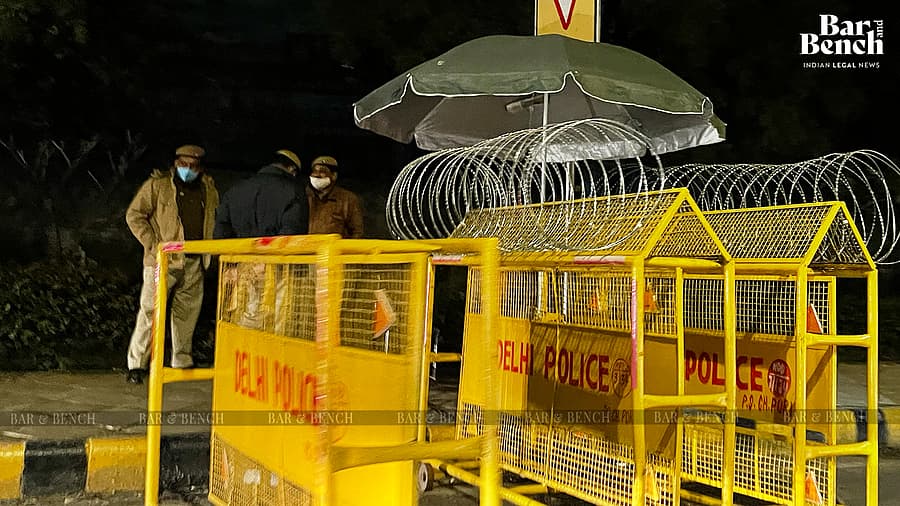
Supreme Court: Prima Facie Contempt Over Delhi Metro Protest Restrictions
Summary
- The Supreme Court has found a prima facie case of contempt of court regarding restrictions on Delhi Metro and railway services.
- This finding relates to alleged violations of the Court's October 9 directives during protests on October 10.
- Advocate Shailendra Mani Tripathi filed the contempt petition against Union Home Secretary Govind Mohan, Delhi Police Commissioner Anurag Kumar, and DMRC Chairperson D Thara.
- The alleged contemnors must file counter-affidavits and a compliance report by October 13.
- The petition claims authorities continued public transport restrictions despite prior Supreme Court orders against a complete prohibition during protests.
What Happened
This ruling by the Supreme Court sends a clear message regarding the imperative of strict adherence to judicial pronouncements, particularly for government agencies and public transport operators like the DMRC.
The Supreme Court of India has determined that a prima facie case of contempt of court has been established concerning alleged non-compliance with its directives issued on October 9. This finding specifically relates to restrictions imposed on Delhi Metro and railway services during protests that took place on October 10. The decision was formally recorded in a written order by a Bench comprising Justices Joymalya Bagchi and V Mohana, following a special Sunday hearing dedicated to the matter.
The contempt petition, which prompted this judicial review, was initiated by advocate Shailendra Mani Tripathi. It named several high-ranking officials as alleged contemnors: Union Home Secretary Govind Mohan, Delhi Police Commissioner Anurag Kumar, and Delhi Metro Rail Corporation (DMRC) Chairperson D Thara. The Court, after reviewing the submissions from all parties and the details within the contempt petition, concluded that the petitioners had indeed presented a sufficient initial case. Consequently, notices have been issued to the alleged contemnors.
As part of the ongoing proceedings, the individuals accused of contempt have been directed to submit counter-affidavits. Additionally, they are required to provide a comprehensive report detailing their compliance with the Supreme Court's original October 9 order. The deadline for these submissions is October 13. While these filings are mandated, the Court has, for the time being, waived the requirement for their personal appearance in court.
Legal Context
The core of the contempt allegation centers on the claim that authorities continued to enforce restrictions on public transport, specifically Delhi Metro and railway operations, despite previous explicit directions from the Supreme Court. These earlier directives had cautioned against a complete prohibition of such services during public demonstrations. The protests in question were organized to demand the resignation of Chief Election Commissioner (CEC) Gyanesh Kumar, occurring amidst increasing public scrutiny.
A "prima facie" finding by the Supreme Court signifies that, based on the initial evidence and arguments presented, there is enough merit to proceed with the case, suggesting a potential violation has occurred. This does not constitute a final judgment of guilt but rather an acknowledgment that the allegations warrant further investigation and response from the accused parties. The October 9 order, which forms the basis of this contempt petition, was intended to balance the right to protest with the need for public order, while ensuring essential services like public transport remained accessible.
Why It Matters
This ruling by the Supreme Court sends a clear message regarding the imperative of strict adherence to judicial pronouncements, particularly for government agencies and public transport operators like the DMRC. The establishment of a prima facie case of contempt underscores the judiciary's firm stance against any perceived disregard for its orders, especially when they pertain to fundamental aspects of public life, such as freedom of movement and the right to protest. This development highlights the significant legal exposure faced by officials who may be perceived as failing to implement court directives fully.
The decision serves as a critical reminder for entities managing public services in India, including those overseeing the Delhi Metro, that compliance with Supreme Court orders is not discretionary. The potential for contempt proceedings, as demonstrated by the Shailendra Mani Tripathi contempt petition, places a heightened responsibility on officials like Govind Mohan, Anurag Kumar, and D Thara to ensure that operational decisions, particularly during periods of public unrest and protest restrictions, are meticulously aligned with judicial mandates. This case reinforces the principle that the judiciary will actively intervene to ensure its orders are respected and implemented, thereby upholding the rule of law in the context of India Supreme Court public transport protests.
Practical Implications
Lawyers advising government agencies or public transport operators in India should note this ruling as it underscores the Supreme Court's strict stance on compliance with its orders regarding public movement during protests, indicating a heightened risk of contempt proceedings for non-adherence. Compliance officers must review protocols for implementing court directives during periods of public unrest to avoid similar legal challenges.
Source
How does this affect you?
Get an AI analysis of this article grounded in your jurisdictions, practice areas, and any policy documents you've uploaded to Wansom.
Finish Reading the Full Story and the Expert Analysis.
Get the latest legal & regulatory intelligence in India
Wansom is AI and can make mistakes.