
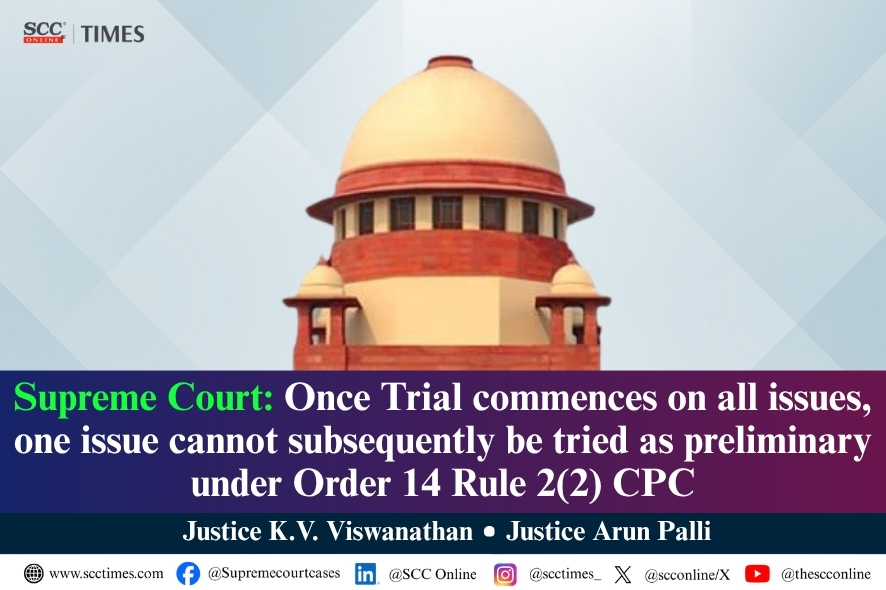
India Supreme Court: No Order 14 Rule 2(2) Preliminary Issue After Trial Begins
Summary
- The Supreme Court of India recently clarified the scope of Order 14 Rule 2(2) of the Civil Procedure Code.
- The Court held that once the general trial of all issues in a lawsuit has begun, no single issue can subsequently be tried as a preliminary matter.
- This ruling establishes a definitive procedural boundary, requiring preliminary issues to be raised before the comprehensive trial phase commences.
What Happened
The core of the Supreme Court's decision establishes a definitive procedural boundary.
The India Supreme Court has recently provided crucial clarity on the procedural framework governing preliminary issues under the Civil Procedure Code (CPC). This significant ruling addresses the timing for adjudicating specific points of law or jurisdiction that could potentially resolve a case without a full trial. The apex court's pronouncement specifically interprets the scope of Order 14 Rule 2(2) CPC, a provision central to the efficient management of civil litigation.
The core of the Supreme Court's decision establishes a definitive procedural boundary. It unequivocally states that once the general trial of all issues in a lawsuit has commenced, it is no longer permissible to isolate a single issue and seek to have it tried as a preliminary matter. This means the window for raising a Supreme Court Order 14 Rule 2(2) preliminary issue closes once the broader evidentiary and argumentative phase of the trial begins. The ruling underscores the importance of timely identification and application for preliminary issue determination.
Legal Context of Preliminary Issues
Order 14 Rule 2(2) of the Civil Procedure Code empowers courts to decide certain issues as preliminary issues, provided they relate to questions of law or jurisdiction, or if they concern a bar to the suit as created by any law. The fundamental objective behind this provision is to streamline judicial proceedings. By addressing such foundational legal or jurisdictional hurdles at an early stage, courts can potentially dispose of a case without the need for a lengthy and resource-intensive examination of all factual disputes. This mechanism is designed to prevent unnecessary trials on merits when a suit can be dismissed on a point of law or jurisdiction.
Historically, the application of this rule has aimed to promote judicial economy, allowing for an expedited resolution of disputes where a legal impediment or jurisdictional defect is apparent. The India Supreme Court CPC preliminary issues framework is intended to be a powerful tool for efficiency. However, its proper application requires careful consideration of when an issue truly qualifies as preliminary and, crucially, at what stage of the proceedings it can be legitimately raised. The Civil Procedure Code preliminary issues are distinct from issues of fact that require evidence and detailed examination.
The Court's Clarification and its Impact
The recent interpretation by the Supreme Court specifically targets the procedural timing for invoking Order XIV Rule 2(2) CPC interpretation. The Court clarified that the critical juncture is the "commencement of the trial of issues generally." This phrase signifies the point at which the court begins to examine all framed issues, typically involving the presentation of evidence and arguments on the merits of the entire case, rather than just preliminary legal points. Once this comprehensive trial phase is underway, the opportunity to carve out an issue for preliminary determination is forfeited.
This ruling has significant implications for trial commencement preliminary issue India. It compels litigants and their legal counsel to be proactive in identifying and moving for the determination of any potential preliminary issues *before* the general trial proceedings begin. The Court's stance effectively prevents parties from attempting to introduce a preliminary issue after trial begins, which could otherwise lead to delays and tactical maneuvering. The decision reinforces the principle that procedural rules are designed to ensure orderly and efficient justice, not to be exploited for dilatory tactics.
Practical Implications
This ruling clarifies the procedural window for raising preliminary issues under Order 14 Rule 2(2) CPC, compelling litigators to identify and argue such issues *before* the general trial commences to avoid forfeiture. Lawyers must now ensure comprehensive issue framing at the outset of trial.
Source
How does this affect you?
Get an AI analysis of this article grounded in your jurisdictions, practice areas, and any policy documents you've uploaded to Wansom.
Finish Reading the Full Story and the Expert Analysis.
Get the latest legal & regulatory intelligence in India
Wansom is AI and can make mistakes.